REVIEW · LISBON
Lisbon: Baixa Chiado Quarter Walking Tour
Book on Viator →Operated by Vox City International Ltd · Bookable on Viator
Downtown Lisbon gets a whole new meaning on foot. This Baixa-Chiado walking tour strings together the city’s headline sights and a few quieter corners, with guide-led stories about famous places like Bertrand Bookstore and the elevator connections between neighborhoods. You also get practical help with orientation, so your first day in Lisbon feels less like a blur.
What I like most is how you zoom in on the landmarks that matter: Praça do Comércio, Rossio, Santa Justa, Carmo Convent ruins, and the big theatres nearby. I also like that the tour mixes famous names with human details, like the poet-focused Camões Square and the steep, old-school funicular rides that make Lisbon what it is.
One thing to consider is pacing. The tour is about two hours, but it’s a walking route with multiple stops, and it may run long if the group moves slowly. If you’ve got tight plans afterward, keep a buffer and wear shoes built for hills.
In This Review
- Key highlights you’ll feel right away
- Getting Oriented in Baixa and Chiado in about Two Hours
- Price and Time: What $107 Really Buys (and what it doesn’t)
- Starting at R. dos Douradores 16: Where the Route Begins
- Augusta Street Arch and Praça do Comércio: Lisbon’s Grand Entry Symbol
- Lisbon City Hall and Bertrand Bookstore: Neoclassical Order Meets Literature
- Luís de Camões Square and the Camões Monument: Poetry in Stone
- Bica Elevator and Bairro Alto Streets: Steep Rides and Street-Level Life
- Carmo Convent Ruins: The 1755 Earthquake Still Shapes the View
- Queen Maria II National Theatre, Teatro Nacional, and Trinity Theatre Connections
- Rossio Square: Public Space, Power, and the Inquisition-Era Stage
- Santa Justa Elevator and Gloria/Bairro Alto Connections: Lisbon’s Vertical Shortcut
- Baixa Pombalina: The Rebuilt Shopping and Banking Spine
- Using Vox City After the Walk: Self-Guided Options on Your Schedule
- Who This Tour Fits Best (and how to get more from it)
- Should You Book the Lisbon Baixa-Chiado Walking Tour?
- FAQ
- How long is the Lisbon Baixa-Chiado walking tour?
- Where does the tour start?
- Does the tour end at the same place it starts?
- Is the Vox City app included in the price?
- What’s included in the tour?
- Are attraction entry fees included?
- Are public transportation tickets included?
- Can service animals join the tour?
Key highlights you’ll feel right away
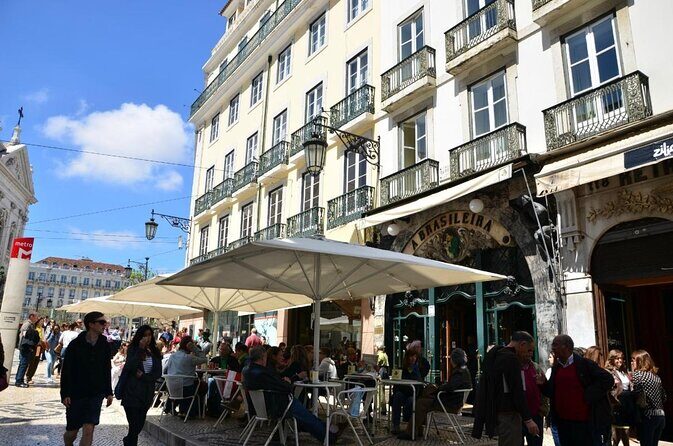
- Fast city orientation across Baixa and Chiado, centered on Praça do Comércio and Rossio
- Big Lisbon icons in one loop: Santa Justa Elevator, Bica elevator, and the famous 28 tram corridor
- Story stops that add context like Bertrand Bookstore and Carmo Convent’s earthquake scars
- Viewpoint time, including Sao Pedro Alcantara, so you’re not just walking in the flats
- Elevators as shortcuts, showing how Bairro Alto connects down to Downtown
Getting Oriented in Baixa and Chiado in about Two Hours
Baixa and Chiado can feel like two different worlds, even though they sit close together. Baixa is the grand, planned downtown—wide streets, stonework, and the shopping/banking spine rebuilt after the 1755 earthquake. Chiado is the cultural and literary side, with theatres, bookstores, and the streets that lead uphill toward Bairro Alto.
This tour’s value is that it teaches you how the neighborhoods link. You’ll move through the places that Lisbon uses as reference points—squares, major buildings, and the big vertical connections like elevators—so later, when you’re wandering on your own, you can actually place yourself.
The route is mostly a classic “downtown highlights” walk, but you should still expect climbs and steps. Lisbon isn’t flat, and Baixa’s grand boulevards don’t erase the hillside gravity once you start moving toward Carmo and the viewpoints.
If you care about seeing the right places without overplanning, this format works well. You get a guided framework plus the option to keep exploring on your own afterward.
You can also read our reviews of more walking tours in Lisbon



Price and Time: What $107 Really Buys (and what it doesn’t)
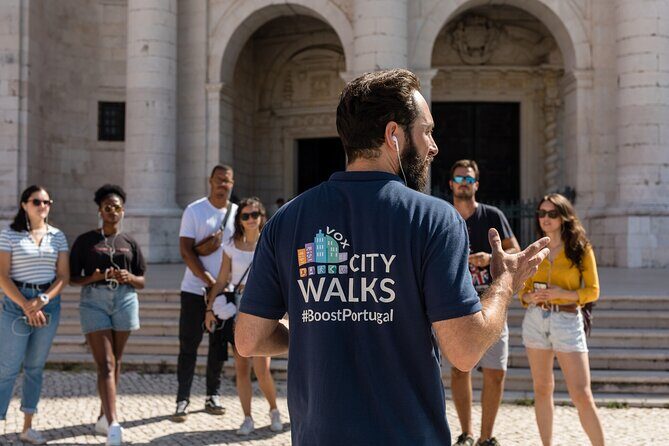
At $107, you’re paying for a guided two-hour walking route, a mobile ticket, and access to the included Vox City app. That app part matters more than it sounds, because it gives you multiple self-guided walking options for the same general area you’ll learn on the tour.
What’s not included: any attraction entry fees, food, and public transportation tickets. So if you want to go inside something major (or use extra transport), budget separately. The tour also doesn’t promise a long sit-down meal break—this is about moving and seeing.
For value, I’d frame it like this: you’re buying someone’s local stitching together of squares, elevators, theatres, and the earthquake story. If you’re the type who likes explanations while you walk, that’s a fair trade. If you prefer purely independent wandering, the Vox City app might cover enough on its own—though you’d miss the guide-led connections between stops.
Also, the tour caps at 25 travelers, which usually keeps the group from feeling too chaotic. Still, it’s a group walking tour, so you’ll match the pace of the day.
Starting at R. dos Douradores 16: Where the Route Begins

The tour starts at R. dos Douradores 16, 1100-161 Lisboa, and it ends back at the meeting point. That “back to start” design is handy if you’re continuing your day nearby. It also means you don’t have to reverse-commute across town just to get back to your hotel area.
The meeting point is near public transportation, which helps if you’re not staying in the Baixa/Chiado zone. In practice, that’s one of the hidden perks of this kind of itinerary: the places you’ll walk through are among Lisbon’s easiest to reach, and that reduces the “wasted time” factor.
Because the tour is a walking circuit, you’ll want shoes that handle uneven sidewalks and the small rises that pop up throughout downtown. Even if the big climbs come later, Lisbon’s surfaces are rarely perfectly smooth.
If you’re traveling with a service animal, the tour allows service animals.
Augusta Street Arch and Praça do Comércio: Lisbon’s Grand Entry Symbol
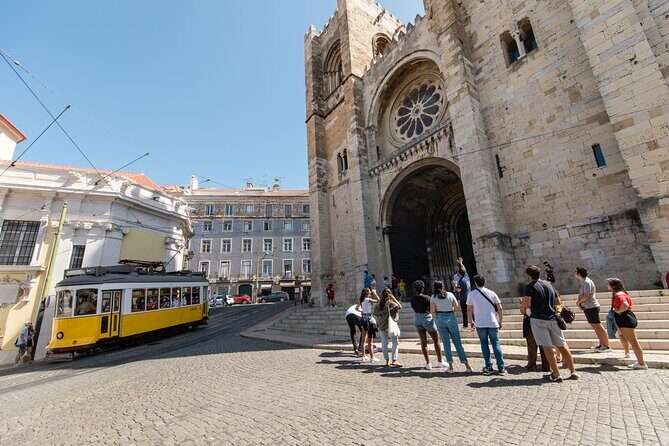
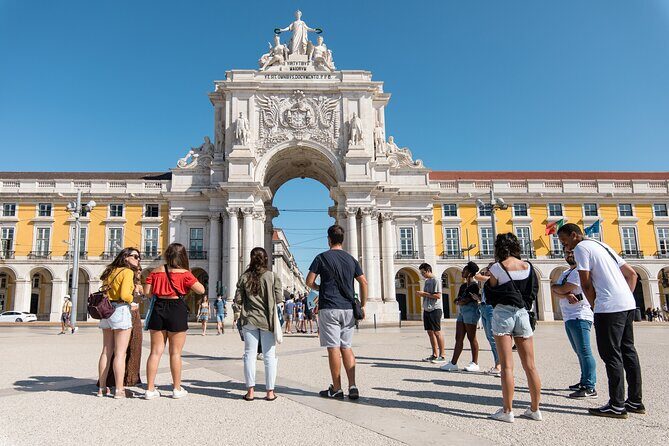
One of the tour’s early anchors is the Augusta Street Arch, placed in the wide open space of Praça do Comércio. This isn’t just a pretty structure. It’s Lisbon’s way of putting national identity and historical symbolism into a single visual statement, with references meant to honor Portugal’s layered past.
Standing here, you can see why Praça do Comércio is such a powerful downtown meeting point. It’s open, bright, and built for orientation. After you learn what the arch represents, it’s easier to connect the rest of the walk, because you’ll understand you’re not just moving randomly through streets—you’re circling around the city’s civic and cultural center.
Practical tip: give yourself a moment here even if the group is moving. You’ll be passing through this space again mentally later when you try to picture where everything fits.
Lisbon City Hall and Bertrand Bookstore: Neoclassical Order Meets Literature

Next comes Lisbon City Hall, a Neoclassical building completed in 1880. For architecture lovers, it’s a clear marker of Lisbon’s “after renewal” mindset—the city rebuilds, plans, and then displays confidence through formal design.
Then you hit the stop that most book people dream about: Bertrand Bookstore. It’s widely recognized as the oldest and longest operating bookstore in the world, founded in 1732 by Pierre Bertrand (a French entrepreneur). The point of this stop isn’t only the superlative. It’s what the bookstore represents in the neighborhood: continuity. Chiado isn’t just about pretty façades—it’s about institutions that have survived centuries.
If you like travel days with a few real anchors (not just photo stops), this is a great pair: one stop that shows civic structure, one that shows cultural permanence.




Luís de Camões Square and the Camões Monument: Poetry in Stone
Luís de Camões Square is one of those “small break” spaces that makes a walking tour feel human. It’s open, with trees and stone benches and traditional Portuguese paving patterns that you’ll notice more once you’ve been walking for a bit.
At the center is the Camões Monument, honoring the famed poet after whom the plaza is named. Even if you don’t know Portuguese literature, this stop gives you a feel for how Lisbon puts culture into the everyday map of the city. Squares here aren’t only intersections. They’re little stages for national identity.
This is also the kind of stop where you can reset your energy. Lisbon’s sidewalks are busy, and even on a downtown walk, you’ll be glad to pause somewhere that feels calmer than the major streets.
Bica Elevator and Bairro Alto Streets: Steep Rides and Street-Level Life
The tour includes a stop tied to the Bica elevator, which runs up along steep Lisbon ridges like an electrified funicular. Some slopes reach around a 12-degree inclination, which is your cue that Lisbon wasn’t built for flat-foot comfort.
Even if you’re not taking every elevator ride in the exact way the guide describes, you’ll walk away understanding the logic of Lisbon’s vertical neighborhoods. Bairro Alto sits above, and the city’s transport tricks help bridge that height difference.
Then the tour moves through Bairro Alto streets, where workshops and boutiques show up alongside street art and older architecture. This is also where the phrase tascas makes sense. At night, those family-owned taverns become a major part of the neighborhood’s atmosphere.
If you’re doing this earlier in the day, don’t expect the same nighttime energy. But you will still see how the streets are built for small social life, narrow lanes, and quick turns that feel more like old Europe than a modern grid.
Carmo Convent Ruins: The 1755 Earthquake Still Shapes the View
Carmo Convent is one of the most haunting stops on this route. The story is simple and heavy: it was devastated by the 1755 earthquake, and what you see now is the roofless remains—stone arches and walls that never fully returned to what they were.
What makes this stop valuable is the way it teaches you to read Lisbon’s cityscape. The earthquake isn’t just a date in a museum label. You see it in the forms that survived and the spaces left open.
This is also a great moment to slow down, because the ruins demand attention. A guided explanation helps, but you’ll also get something on your own just by looking—how the broken roofline frames the sky like an unexpected ceiling.
If you like photography, this is one of the places where you’ll want extra time, even if the tour’s schedule keeps you moving.
Queen Maria II National Theatre, Teatro Nacional, and Trinity Theatre Connections
The walk continues toward major performing-arts landmarks. The Queen Maria II National Theatre is one of Portugal’s prestigious historical venues, built in 1450. The key detail is that it wasn’t just a theatre from the start; it had other roles, including being tied to the Portuguese Inquisition and serving as lodging for foreign noblemen.
In the Chiado area, the tour also points out another older theatre still active today, built in the mid-19th century. These theatre stops give you a feel for Lisbon’s cultural gravity, especially in Chiado, where the city leans into arts and public life.
Even if you don’t plan to attend a show, these buildings help you map the neighborhood’s identity. You stop seeing Chiado as only “shops and cafés” and start understanding it as a place with institutions—places where Lisbon gathers.
Rossio Square: Public Space, Power, and the Inquisition-Era Stage
Rossio is one of Lisbon’s classic squares, and the tour ties it to what happened both before and after the earthquake. The area’s origins reach back to the 13th century, and it used to function as central ground accessible across social status.
But Rossio also served as a stage for major public events, including bullfights and public shows. During Inquisition-era periods, it also became a site for public executions. That’s the kind of detail that can change how you experience a square—suddenly you’re not just looking at a pretty landmark, you’re walking through a place that once hosted intense public power.
Practical note: Rossio is busy. Keep your phone handy, but also keep your attention on what the guide is pointing out, because the square contains a lot of activity and you’ll want the stories to anchor your memory.
Santa Justa Elevator and Gloria/Bairro Alto Connections: Lisbon’s Vertical Shortcut
Now for the signature vertical experience: the Santa Justa Elevator. It’s one of Lisbon’s most visited buildings, and the tour highlights the engineering inspiration—its design was inspired by the Eiffel Tower model in Paris. It also traces the elevator’s energy story, starting with a steam engine and later switching to an electrical motor.
You’ll also learn about the elevator logic connecting the downtown area with the hills. The tour mentions the Gloria Elevator as part of how Lisbon links Bairro Alto and the lower city.
Why this matters for you: if you’re walking all day, elevators aren’t only “attractions.” They’re a way to spend your energy smarter. If you’re heading from Baixa toward the Carmo hill area, using Santa Justa as a shortcut can keep you from turning your day into a painful stair marathon.
Even if you don’t ride, understanding the connections makes it easier to choose routes later.
Baixa Pombalina: The Rebuilt Shopping and Banking Spine
The tour also brings you through Baixa Pombalina, the reconstructed area shaped by the earthquake recovery after 1755 under Marquês de Pombal. This is Lisbon’s main shopping and banking district, running from the riverfront toward Avenida da Liberdade.
Here’s what you should notice: this is where the city’s plan shows. Straight lines, a clear sense of commercial purpose, and the kind of streets where you feel the city was designed for movement and trade.
If you like practical travel days, this is one of the best moments to mentally label where you are. After this stop, you’ll better understand which streets are for browsing, where major corridors lead, and where to position yourself if you want to head toward Avenida da Liberdade.
Using Vox City After the Walk: Self-Guided Options on Your Schedule
This tour includes the free Vox City sightseeing app, with a map of Lisbon and multiple self-guided walking tours. That means your guide-led orientation doesn’t end when the tour ends. You can keep exploring based on what you’re most interested in that day—views, neighborhoods, and additional walking routes.
This is a smart value add because Lisbon has a lot of repeatable sightseeing potential. You can spend the morning learning the core layout with a guide, then use the app to branch out with less guesswork.
The app also helps if you find yourself drifting a bit after a long walk. Having a map and built-in routes can keep you from wasting time asking random questions or second-guessing where you are.
Who This Tour Fits Best (and how to get more from it)
This tour is a good match if you want:
- A guided route that hits major downtown anchors without complicated planning
- Elevator and viewpoint education, so you understand how the hills connect
- A walk that mixes civic landmarks, culture, and earthquake context
It also works well for first-time Lisbon visitors who want the core mental map fast. The group size limit (up to 25) helps keep it manageable, and the duration is short enough that you’re not surrendering your whole day.
Two guide-related notes to keep you prepared: in some groups, guides have been praised for sharing information clearly and making the walk feel professional. Other feedback has pointed to tours that focused more on highlights than deep explanations. So if you crave extra context, bring your curiosity and ask simple questions as you go. You’ll get more out of the experience that way.
Should You Book the Lisbon Baixa-Chiado Walking Tour?
Book it if you want a guided route that helps you place Lisbon in your head: Praça do Comércio, Rossio, major theatres, Carmo Convent ruins, and the elevator connections that connect downtown to the hills. The included Vox City app is a real bonus for turning the walk into a longer day.
Skip it or adjust your expectations if you’re looking for an ultra-deep lecture or you have a rigid schedule. This is a walking tour with multiple stops, and it can feel slow if your group pacing runs behind.
If you’re traveling with family, looking for your first-day orientation, or you want the practical “how Lisbon fits together” lesson without spending hours mapping routes yourself, this is a solid choice.
FAQ
How long is the Lisbon Baixa-Chiado walking tour?
It runs for about 2 hours.
Where does the tour start?
The meeting point is R. dos Douradores 16, 1100-161 Lisboa, Portugal.
Does the tour end at the same place it starts?
Yes, the tour ends back at the meeting point.
Is the Vox City app included in the price?
Yes. The tour includes a free Vox City sightseeing app with a map of Lisbon and multiple self-guided walking tours.
What’s included in the tour?
The experience includes the Downtown, Baixa-Chiado walking tour and the free Vox City app. In high season, there’s also an evening walking tour included.
Are attraction entry fees included?
No. Entry to attractions is not included.
Are public transportation tickets included?
No. Public transportation tickets are not included.
Can service animals join the tour?
Yes. Service animals are allowed.