
REVIEW · LISBON
Lisbon City Center Tour – The Unmissable Lisbon
Book on Viator →Operated by Take Lisboa · Bookable on Viator
This is the fastest way to get bearings. This walking tour threads together Lisbon’s big squares and back-street shortcuts, so it feels less like a checklist and more like a local route. I especially like the pay-what-you-think setup, which makes the experience feel fair before you even start.
I also love the way the stops connect. You move through places like Igreja de São Domingos, Rossio Square, Chiado, and the climb-friendly views near Elevador de Santa Justa, with guides such as Miriam, Cecília, Claudia, and Hugo keeping the pace lively and the stories clear in English. The one possible drawback: it leans into history and facts, so if you want a lighter chat and fewer mini-lectures, you may find parts a bit heavy, especially on rainy days when photos are harder.
In This Review
- Key highlights that make this Lisbon walk worth your time
- Getting your bearings in central Lisbon on a 2.5-hour loop
- Price you control: why the pay-at-the-end model works here
- Praça dos Restauradores: the independence square that sets the tone
- São Domingos and the 1506 memorial: Lisbon’s religion and memory side
- Rossio Square, a landmark opened in 1846, and the imposing Estação do Rossio
- Chiado and Bairro Alto edges: how the tour maps Lisbon’s moods
- Elevador de Santa Justa and the “beautiful transport” angle
- Largo do Carmo and the Jesuit chapter at Igreja de São Roque
- A Brasileira and Teatro Nacional de São Carlos: coffee culture meets opera culture
- Rua Augusta and Praça do Comércio: the big Lisbon-book finale by the Tagus
- The practical stuff I think you’ll care about most
- Who should book this Lisbon City Center Tour
- Should you book it
- FAQ
- How long is the Lisbon City Center Tour – The Unmissable Lisbon?
- Where does the tour start and end?
- Is the tour offered in English?
- What does the tour cost?
- How big is the group?
- Do I need paid admission tickets for the stops?
- Is the tour weather-dependent?
- What is the cancellation policy?
- Is a mobile ticket used?
Key highlights that make this Lisbon walk worth your time
- Pay-what-you-think: the price starts low, and you control what you pay at the end
- Small group cap (max 25): easier questions and more real conversation
- Off-car streets: alleys and secret streets that you’d likely skip on your own
- A route across 3+ neighborhoods: from Restauradores through Baixa, Chiado, and Bairro Alto
- Practical takeaways: quick guidance you can use for the rest of your trip
- Classic Lisbon finale: Rua Augusta and Praça do Comércio framing the Tagus
Getting your bearings in central Lisbon on a 2.5-hour loop
This is a focused city-center orientation walk designed to make Lisbon feel navigable fast. In about 2 hours 30 minutes, you cover a stretch that links major landmarks and neighborhood “edges,” from the end of Avenida da Liberdade near Praça dos Restauradores down toward Praça do Comércio by the water.
The route is paced for a standard walking group. It’s not a sit-and-stare tour. You’ll be moving steadily, and you’ll cover uneven streets at street level. Most people can participate, but if your mobility is limited, plan for a lot of walking.
It also helps that the group size tops out at 25 people. That keeps the vibe from turning into a hurried parade. And since it’s English with a mobile ticket, you can show up, scan, and go without fuss.
You can also read our reviews of more city tours in Lisbon


Price you control: why the pay-at-the-end model works here
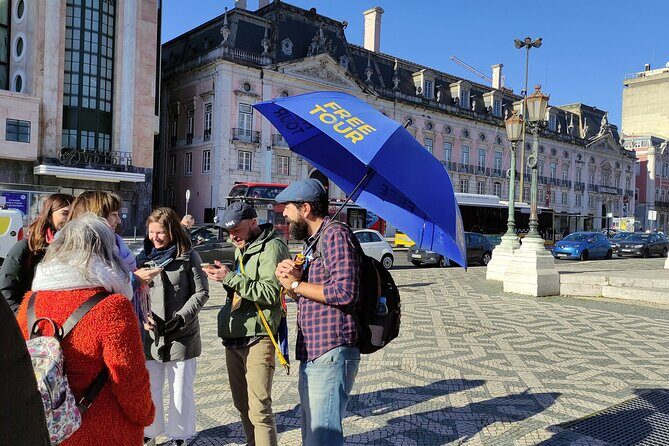
The listed price is $3.62 per person, but the main value is the approach: you choose the price and pay only what you think the experience is worth. That matters because this tour isn’t selling you tickets to expensive attractions. It’s selling time with a guide, a smart route, and context that makes the places click.
A fair warning, though: because you’re walking through churches, memorials, and theaters, this tour has a strong storytelling backbone. If you’re the type who wants scenery only, you may prefer a lighter food or viewpoint tour instead. If you’re the type who likes understanding what you’re looking at, this style tends to land really well.
Also, guides who keep it funny and personal can make the “history bits” feel like story, not homework. Names that come up in past groups include Miriam, Cecília, Claudia, Hugo, Sandra, and Ricardo, and that variety hints at different teaching styles while keeping the same core route.
Praça dos Restauradores: the independence square that sets the tone
The tour starts at Monumento dos Restauradores in Praça dos Restauradores (Avenida da Liberdade’s end). This is a good warm-up stop because it immediately gives you a sense of Lisbon’s layout. You’re standing in a main city square, then you’ll get pulled into quieter streets soon after.
Look around for how the square ties into Lisbon’s grand central axis. The guide’s job here is simple: help you understand what you’re seeing before you start weaving through side streets. You’re not just getting facts; you’re getting a mental map.
São Domingos and the 1506 memorial: Lisbon’s religion and memory side
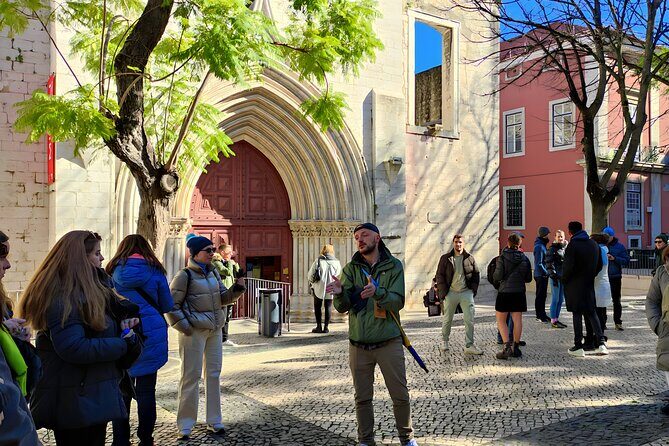
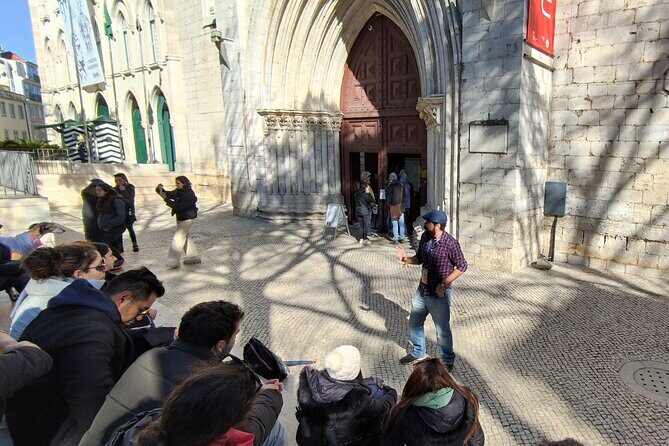
Next comes Igreja de São Domingos. The church is described as less decorated on the outside, yet rich in what it represents. The tour frames it as a tribute tied to peace, tolerance, and unity, so it’s not just architecture viewing. It’s a theme stop.
Then you move to a memorial to the victims of the Jewish massacre of 1506. This is one of those stops that changes how you walk through a city. Lisbon isn’t only sunny façades and tiled cafés. It has moments of intolerance recorded in stone, and the guide helps you place that weight in the city’s story.
If you’re traveling with kids, or you prefer lighter content, this section might feel more intense than the rest. But it’s also one of the clearest examples of why a guided walk is useful. Standing next to a memorial with no context can leave you staring at text. With context, it becomes understanding.
Rossio Square, a landmark opened in 1846, and the imposing Estação do Rossio
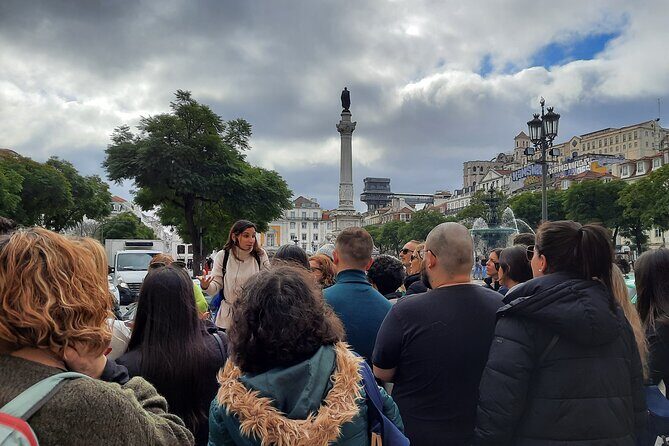
Then the route shifts to Praca Dom Pedro IV, better known as Rossio Square. It’s one of the oldest and most beautiful squares in Lisbon, and the tour connects it to the kind of public life that runs through a capital city: celebrations, political moments, and everyday bustle.
Right in this area, there’s also a pause at a landmark that opened in 1846, noted as overlooking some of Lisbon’s big historical events. Even without a long stop, this is a smart way to anchor the timeline: you’re seeing how old Lisbon structures still frame modern movement.
From there, you’ll reach Estação do Rossio. The station is described as imposing, and the construction date is meant to surprise you. Stations are great “insider” stops because they show how a city actually runs. They also give you a natural transition point before the walk starts feeling more neighborhood-specific.




Chiado and Bairro Alto edges: how the tour maps Lisbon’s moods
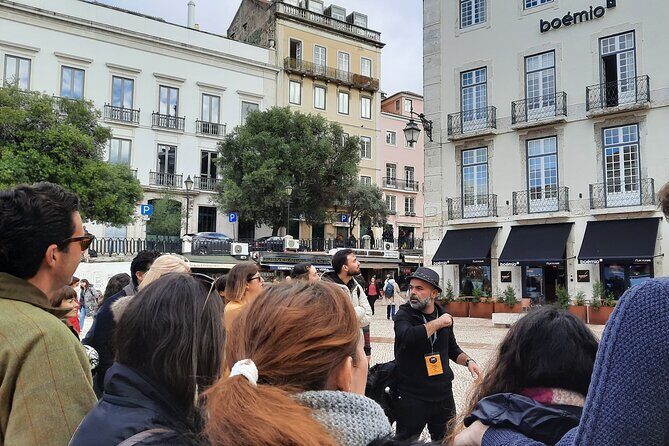
Chiado is next, and it’s framed as the entrance to Lisbon’s more cosmopolitan neighborhood. This stop is short on purpose. It’s not asking you to become a Chiado expert. It’s showing you the neighborhood boundary and giving you a reason to come back later—after you know where you are.
From Chiado, the route heads toward Bairro Alto, the nightlife district with over 500 years of history. The key here is balance: the tour doesn’t try to turn into a late-night plan. Instead, it explains why Bairro Alto feels like Lisbon’s creative, bohéme side. You learn what to look for when you wander later: street rhythm, hangout corners, and the way the neighborhood “lives” in layers.
You’ll also pass Largo do Chiado, described as the transition zone between Chiado and Bairro Alto. I like this kind of stop because it teaches you to notice movement. Neighborhoods don’t have walls. They have gradual shifts—and Lisbon’s hills make those shifts visible if you know where to stand.
Elevador de Santa Justa and the “beautiful transport” angle
At Elevador de Santa Justa, you get access to the free area of the elevator. This is a smart middle ground. You see the monument and the idea of the lift without turning the tour into a ticket chase.
Santa Justa is treated as one of Lisbon’s most beautiful public transports, and the guide’s perspective helps you see it differently than a tourist postcard. It’s not only a ride. It’s a piece of city engineering that solves a practical problem—steep terrain—and turns it into a visual landmark.
If it’s foggy or rainy, this stop can still be worthwhile, but your photo odds drop. Pack for weather and expect slower sightlines. This is one of those tours where a light rain jacket is not optional.
Largo do Carmo and the Jesuit chapter at Igreja de São Roque
Then you land at Largo do Carmo, described as a stage for passionate revolutions. This stop gives you a political mood shift. Lisbon isn’t only old churches and elegant squares; it’s also a city that reacts and changes.
After that comes Igreja de São Roque, built in the 16th century and identified as Portugal’s earliest Jesuit church. The tour explains that it served as the Jesuits’ home church in Portugal for over 200 years, before the Jesuits were expelled. That timeline matters because it explains why the building feels like more than one era.
Inside, you’ll hear about one of the world’s most valuable chapels. Even if you don’t linger long, this is a stop that changes how you read religious architecture. The guide helps you spot meaning in what you might otherwise treat as decoration.
A Brasileira and Teatro Nacional de São Carlos: coffee culture meets opera culture
One of the route’s most interesting pauses is A Brasileira, where coffee was launched and where Fernando Pessoa and other intellectuals created the modernist magazine Orpheu. That’s not random café lore. It ties Lisbon’s literary history to a physical location you can step into later.
If you like connecting art to streets, you’ll enjoy this segment. It gives you a reason to treat Lisbon as something more than museums. Lisbon’s ideas have addresses.
Then you reach Teatro Nacional de São Carlos, noted as the only Portuguese theatre focused on producing and presenting opera plus choral and symphonic music. This is a great stop for travelers who want to feel the city’s cultural texture without buying a ticket that night.
Rua Augusta and Praça do Comércio: the big Lisbon-book finale by the Tagus
The tour closes with Lisbon’s classic finale. You’ll pause at the triumphal arch on the Rua Augusta side, then walk Rua Augusta, described as the most agitated and charming street in downtown Lisbon.
Finally, you end at Praça do Comércio, one of the most beautiful squares in Europe, where the city seems to end and the Tagus begins. This endpoint is perfect because it’s visual closure. You go from tight lanes and steep neighborhood edges to an open waterfront space.
If you want to keep the day going, Praça do Comércio is also a natural springboard. You’ll have a clear sense of direction and can pick your next move with confidence.
The practical stuff I think you’ll care about most
This tour earns its reputation because it’s not just landmarks. It’s timing, sequencing, and a guide who helps you interpret the scene while you’re still close enough to ask questions.
Here’s what tends to matter on the ground:
- You’ll get a usable mental map across the central neighborhoods, not a single-site tour.
- The walking style helps you notice Lisbon’s street logic: squares as anchors, side streets as shortcuts.
- Weather matters because it’s a walking tour with a good-weather requirement. Rain doesn’t ruin Lisbon, but it does affect comfort and photos.
- You’ll leave with next-day focus: you’ll know which neighborhood to return to and what kind of sights to hunt for.
If you’re picky about pace, keep your expectations honest. It’s a steady walk with frequent stops, and the guide will connect details to bigger themes.
Who should book this Lisbon City Center Tour
Book it if:
- You’re arriving soon and want get-your-bearings-fast value.
- You like a guided mix of architecture, neighborhood edges, and story context.
- You want a route that’s designed for walking, including alleys and secret streets where cars don’t go.
Skip it or swap it if:
- You want long time inside a single attraction or only want views.
- You strongly dislike history-heavy explanations. Some people prefer shorter fact bursts.
- Your plans depend on perfect weather and you don’t like walking on uneven pavement.
This tour is especially well suited for first-time visitors, solo travelers, and anyone who wants to feel confident exploring afterward.
Should you book it
If you want a smart first-day walk that makes Lisbon feel legible, I’d book this. The value is strongest if you actually use the takeaways afterward. The pay-at-the-end price model also makes it easier to commit, since you’re not locking into a pricey attraction day.
Just go in with the right mindset: it’s a narrated walk. You’ll get the best result if you’re curious, ready for stories, and happy to keep moving across central Lisbon.
FAQ
How long is the Lisbon City Center Tour – The Unmissable Lisbon?
It lasts about 2 hours 30 minutes.
Where does the tour start and end?
It starts at Monumento dos Restauradores, Praça dos Restauradores, 1250-188 Lisboa and ends at Praça do Comércio MB, 1100-148 Lisboa, near the arch and the equestrian statue of D. José I.
Is the tour offered in English?
Yes. It is offered in English.
What does the tour cost?
The listed price is $3.62 per person, and the tour highlights a pay-at-the-end approach where you choose the price based on what you think it’s worth.
How big is the group?
The tour has a maximum of 25 travelers.
Do I need paid admission tickets for the stops?
The sights on the route are listed as admission ticket free.
Is the tour weather-dependent?
Yes. It requires good weather. If it’s canceled due to poor weather, you’ll be offered another date or a full refund.
What is the cancellation policy?
You can cancel for a full refund up to 24 hours before the start time. If you cancel less than 24 hours before, you won’t get a refund.
Is a mobile ticket used?
Yes, the tour includes a mobile ticket.