REVIEW · LISBON
Lisbon: Alfama, Chiado and Baixa Walking Tour with Tastings
Book on GetYourGuide →Operated by Bluedreamtours Portugal · Bookable on GetYourGuide
Lisbon feels like a puzzle with a great view. This 3.5-hour walking tour stitches together Alfama, Chiado, and Baixa in one clean route, with viewpoints like Miradouro de Santa Luzia and food stops that taste truly Portuguese. I especially love how it mixes famous sights (Rossio Square, Santa Justa) with quieter corners (fountain stops and tight alley facades) plus real local flavors. The one drawback to watch: some of the time is built around tastings, so if you want maximum walking time in Chiado and Baixa only, you may feel the balance is a bit food-heavy.
What makes this trip work is the flow. You start at Merendinha and move through Lisbon’s layers—Roman traces in the city center, Mouraria-era street patterns in Alfama, and the grand-plaza layout of Baixa—while you’re continually learning how the neighborhoods connect. Guides such as Ricardo, Eduardo, Matias, and João are repeatedly praised for keeping the story clear and the pace friendly, which matters when you’re doing hills on cobblestones.
In This Review
- Key things to know before you go
- Starting at Merendinha: how the tour gets you oriented
- Alfama’s winding streets and Miradouro de Santa Luzia views
- Baixa’s squares, Commerce Square, and Roman traces
- Chiado between art-culture streets and church stops
- Tastings that actually feel Portuguese (and how to time them)
- Santa Justa Lift and the final viewpoint sweep
- Price and logistics: is $63 worth it?
- Who should book this Lisbon walking tour
- Should you book this Lisbon walking tour?
- FAQ
- How long is the Lisbon Alfama, Chiado and Baixa walking tour?
- Where does the tour start?
- What tastings are included?
- Is the tour good for solo travelers?
- What languages are available for the guide?
- Is it wheelchair accessible?
Key things to know before you go
- Merendinha is the starting hub (R. Nova do Almada 45a), so you’ll want an easy meetup plan before you arrive.
- The route includes steep lanes and cobblestones, so comfortable shoes are non-negotiable.
- You’ll hit multiple miradouros (viewpoints), including Santa Luzia, Portas do Sol, and São Pedro de Alcântara.
- Included tastings cover classics like pastel de nata, ginjinha, coffee or juice, bifana, and a drink (beer or green wine).
- Entrance fees are not included, so don’t plan on paying zero for everything you see.
- Wheelchair access is not supported, so choose another option if mobility is a concern.
Starting at Merendinha: how the tour gets you oriented
The tour begins at Merendinha at R. Nova do Almada 45a. That’s a practical start point because it’s close to the action you’ll be walking through anyway, and it helps you get moving quickly instead of spending your morning hunting for a meeting place.
From there, you roll into the Pink Street area and then head toward Baixa de Lisboa and the city center core. The early part matters because Lisbon can look chaotic from the street—streets braid together, stairs appear where you didn’t expect them, and viewpoints are tucked around corners. A guided walk helps you get your bearings fast.
You also get languages covered: the guide can work in English, Spanish, Italian, German, or Portuguese. If you’re booking for a group, there’s even a private group option, which is handy when you want a less stop-and-go rhythm or a more tailored pace.
Practical stuff I’d plan around:
- Bring water. You’ll be out for about 3.5 hours, and Lisbon’s hills add up.
- Wear comfortable shoes. Cobblestones + slopes can be more tiring than you expect.
- Bring a camera, because you’ll be turning around for views more than once.
You can also read our reviews of more walking tours in Lisbon


Alfama’s winding streets and Miradouro de Santa Luzia views
Alfama is where Lisbon stops feeling modern and starts feeling old-world. This part of the walk is built around the neighborhoods’ signature: narrow lanes, steep grades, and azulejo-covered facades that turn simple street corners into photo stops.
You’ll get guided time through key Alfama areas and landmarks, including the Castle Quarter and stops around Lisbon Cathedral. Expect the walking to feel more like “stroll with effort,” not a casual flat-walk. That’s not a dealbreaker—just be honest with yourself about your energy. If you’re the type who rushes on flat sidewalks, you’ll be fine. If hills drain you early, plan for slower steps and frequent water sips.
One of the best moments is the viewpoint time at Miradouro de Santa Luzia. This is the kind of spot where the city suddenly makes sense: rooftops stack up, streets drop away, and you can see why people build homes on these slopes. The guide’s job here is to point out what you’re actually looking at, so it’s not just a pretty panorama—it’s a map you can carry in your head.
You also pass through spiritually important and historic sites such as:
- National Pantheon of Santa Engracia (guided)
- Monastery of São Vicente de Fora (guided)
- Miradouro das Portas do Sol (guided)
Even if you’re not a museum person, the combination of churches, viewpoints, and street patterns gives you an “understand Lisbon” payoff without needing to buy multiple tickets.
Baixa’s squares, Commerce Square, and Roman traces
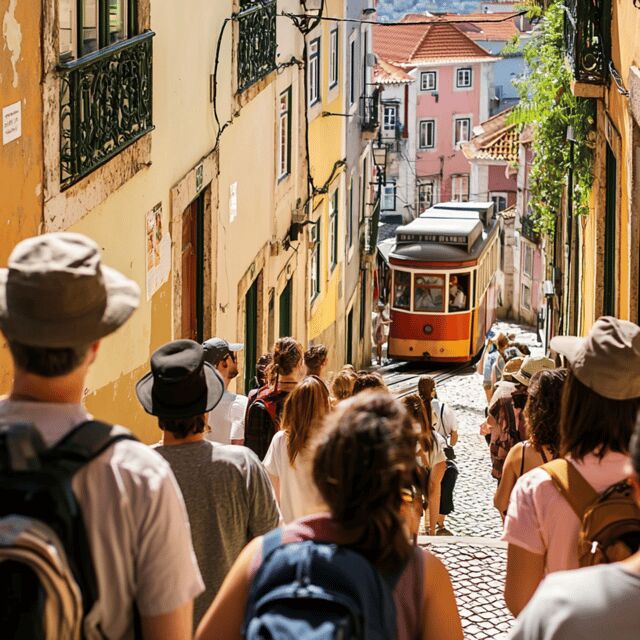
After Alfama’s maze-like streets, Baixa hits you with geometry: straighter corridors, larger spaces, and a sense of city planning. This is where Lisbon starts acting like the capital it wants to be.
You’ll get time around Commerce Square, including the area’s grand architecture and the open-sky feeling that contrasts with Alfama’s tight alleys. You’ll also visit the Museum of Lisbon – Roman Theater, which is one of those Lisbon reminders that the city didn’t start in the age of tiles and trams. The Roman layer helps you understand why Lisbon keeps reinventing itself on top of what was already here.
There’s also a fountain stop at Chafariz d’El-Rei. These small public landmarks are more useful than they sound: they’re meeting points in old neighborhoods, they show how water and streets shaped daily life, and they give you a breather without stopping the tour.
As you continue through Baixa’s flow, you reach the center around Rossio Square. This is the kind of place you can return to later on your own, but having it on a guided route means you’ll learn what to notice—street layout, major thoroughfares, and how the neighborhood transitions work.
One warning that’s less about the tour and more about Lisbon: central streets can feel busy at certain hours. Keep an eye on personal belongings and expect slower movement where people cluster.
Chiado between art-culture streets and church stops
Chiado is the smooth middle between the steep old quarters and the formal Baixa grid. It’s known for art and literature vibes, and on this walk you feel that through the streetscape and the types of places you pass.
You’ll be guided through Casa dos Bicos, which is one of those Lisbon sights that looks decorative from outside but tells a story once you’re pointed in the right direction. Then you move through more classic landmarks like:
- Igreja de São Roque (visit)
- Carmo Convent (guided)
- Casa do Alentejo (guided)
- Church of St. Dominic (visit)
This is also where the tour’s pacing matters. Chiado can be a place where you want to slow down and browse, and the guide does a good job of keeping the route moving without making it feel like a race. If you’re the kind of traveler who hates being “herded,” this part may still feel structured—but it’s structured in a way that helps you see more than you’d find alone.
And yes, you’ll have more photo moments. If Lisbon is a city that rewards curiosity, Chiado is where that curiosity turns into real street-level detail.
Tastings that actually feel Portuguese (and how to time them)
This is a food-forward walk, but not in a gimmicky way. The tastings are built around Lisbon’s classics and a couple of quick, high-impact stops.
Here’s what’s included:
- Portuguese custard tart (Pastel de Nata)
- Drink: coffee plus water or juice
- Ginjinha chocolate shot (local cherry licor)
- 1 beer or green wine
- 1 bifana (traditional Portuguese sandwich)
- Food tasting at Manteigaria – Pastéis de Nata Factory
If you’re wondering whether it’s enough or too much: it’s “enough” if you want to snack while you see sights. It’s “too much” only if you planned the day as a serious walkathon with zero interest in food stops. One traveler note called out that the Alfama tasting focus felt limited for the price, which is a useful reminder to check what matters most to you: the route and viewpoints, or the number of separate food moments.
A smart strategy: eat the tastings, but keep your appetite from turning into a dessert sprint. You’ve got hills and stairs later, and sugar + fatigue is not a fun combo.
Solo travelers get an extra perk. There’s an option where solo travelers pay for 2 and get extra food options on this product. If you’re traveling alone and you love sampling more than the standard set, that option can make the value feel even better.




Santa Justa Lift and the final viewpoint sweep

Near the end, the tour comes together into a classic Lisbon finish: center-city architecture, a major landmark, and one more set of panoramic views.
You’ll include Elevador de Santa Justa (guided). Even if you don’t ride it, the lift is one of those Lisbon icons you should recognize visually. It’s a reminder that Lisbon loves clever engineering as much as it loves tiles.
Then you move into viewpoint territory again with Miradouro de São Pedro de Alcântântara (guided). This is where the city’s shape becomes your last lesson. From a miradouro, you stop thinking of Lisbon as streets and start thinking of it as layers—hills, courtyards, and neighborhood edges.
You’ll end back at Merendinha, so the whole walk forms a loop that starts with orientation and ends with perspective.
Price and logistics: is $63 worth it?

At $63 per person for about 3.5 hours, the value comes from two things: what you get to see and what you get fed while seeing it.
On the included side, you’re not just paying for a guide. You’re getting:
- A local guide throughout the route
- Multiple tasting items (pastel de nata, bifana, ginjinha shot, coffee/juice, a beer or green wine)
- A structured walk across three major neighborhoods, including multiple viewpoint moments
Entrance fees are not included, so don’t assume that everything you stop at will be ticket-free. But you’ll still get a lot of Lisbon just from being there—especially at miradouros and outdoor landmarks.
Weather matters too. Lisbon can shift quickly, and you’ll be outside for the full half-day. If you’re planning around rain, bring a light layer and keep water handy.
Logistics that also affect comfort:
- Moderate walking with some steep streets
- Not suitable for wheelchairs or mobility impairments
- Keep belongings secure in busy areas
Who should book this Lisbon walking tour
This tour makes the most sense if:
- You want a first-timer route that connects Alfama, Chiado, and Baixa in one go
- You like learning how Lisbon works as a city of layers and street patterns
- You enjoy classic Portuguese foods and don’t want to hunt down tastings yourself
- You’re okay with hills and cobblestones as long as the pace stays friendly
It’s less suitable if:
- You need step-free access (it’s not built for wheelchairs)
- You hate food stops and prefer sights only
- You’re extremely time-sensitive and want zero sightseeing detours
Should you book this Lisbon walking tour?
If you want a practical way to understand Lisbon fast—street by street, viewpoint by viewpoint—and you’re happy to snack your way through the classics, I think this is a strong pick. The included tastings and the mix of Alfama viewpoint drama with Baixa’s central landmarks give you good variety for the time.
Book it if you like learning from guides who can turn architecture into explanations, and if you don’t mind walking uphill. Skip or choose another plan if mobility is an issue or if your priority is strictly maximum time in Chiado and Baixa without tastings.
FAQ
How long is the Lisbon Alfama, Chiado and Baixa walking tour?
The tour lasts about 3.5 hours.
Where does the tour start?
Meet your guide at Merendinha, R. Nova do Almada 45a.
What tastings are included?
Included tastings include Portuguese custard tart (pastel de nata), coffee plus water or juice, a ginjinha chocolate shot (cherry licor), a drink (beer or green wine), a bifana sandwich, and a food tasting at Manteigaria – Pastéis de Nata Factory.
Is the tour good for solo travelers?
Yes. There is an option for solo travelers where you pay for 2 and get extra food options on this product.
What languages are available for the guide?
The live guide is available in English, Spanish, Italian, German, and Portuguese.
Is it wheelchair accessible?
No. The tour is not suitable for people with mobility impairments or wheelchair users.