REVIEW · LISBON
Lisbon: Private Boat Trip, Guided Walking Tour, Bike & Tram
Book on GetYourGuide →Operated by World Experience · Bookable on GetYourGuide
Lisbon in five hours feels like a shortcut. You get a smart mix of walking, cycling, and time on the Tagus so you’re not just looking at postcards—you’re moving through the city’s layers, from old Alfama streets to Belém’s waterfront monuments.
Two things I really like: the private, story-led guiding that helps the sights click, and the practical transport mix that covers ground without exhausting you the whole day.
The biggest consideration is the one-two punch of walking plus bike time—plus the fact that the yellow tram portion is temporarily out of service, so you may not get that ride right now.
In This Review
- Key takeaways before you go
- Why this Lisbon mix of walk, bike, and boat actually makes sense
- From Praça Dom Pedro IV to Bairro Alto: a walk that sets your bearings fast
- Alfama’s streets: where the city’s past shows up in the cracks
- The yellow tram reality check (and how to enjoy the plan anyway)
- Bike along the Tagus to Belém: easy riding with real scenery rewards
- Belém’s monuments: Jerónimos, Discoveries, and Belém Tower in one flow
- Pastéis de Belém and the Tagus cruise: turning food and water into the finale
- Price and logistics for a 5-hour private guide (the value math)
- Who this Lisbon tour suits best (and who should rethink it)
- Should you book this Lisbon private boat trip, guided walking tour, bike & tram combo?
- FAQ
- Where is the meeting point?
- How long is the tour?
- What’s included in the price?
- Is the yellow tram ride available right now?
- Are hotel pickup and drop-off included?
- Is this tour suitable for kids?
Key takeaways before you go
- Private guide, small group (up to 8): easier pace, more questions, less waiting around.
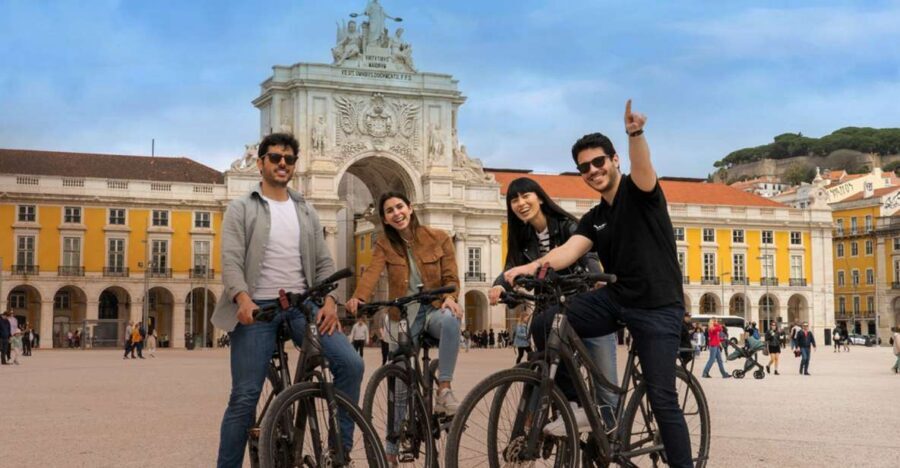
- Tri-mode sightseeing: foot + bike + boat is a fast way to connect Lisbon’s neighborhoods.
- Belém classics done in one run: Jerónimos Monastery, Padrão dos Descobrimentos, and Belém Tower.
- Pastéis de Belém stop: you’ll taste the original custard tart from the historic shop.
- Tagus views from two angles: riverfront biking and a cruise back toward Praça do Comércio.
Why this Lisbon mix of walk, bike, and boat actually makes sense

Lisbon is built for wandering, but it’s also full of hills, shortcuts, and “wait, how did I miss that?” moments. This tour’s strength is that it doesn’t ask you to choose only one style of sightseeing. You start on foot to learn the city’s story, then you switch gears to a bike ride where you can breathe and take in the river, and you end with a boat ride that turns the day’s miles into views.
I also like that the plan is structured around major areas instead of random stops. You’re guided through the Downtown Lisbon core, then you’re sent into Alfama, then you connect to Belém, where the monuments explain Portugal’s sea-driven history. By the time you’re cruising the Tagus, you understand why the waterfront matters so much.
That structure is exactly why this is good value. You’re paying for a guide who keeps you oriented and flowing, plus the added convenience of getting transport included: the bike segment, the boat cruise, and a tram ticket (even though the tram ride may not happen right now).
You can also read our reviews of more walking tours in Lisbon


From Praça Dom Pedro IV to Bairro Alto: a walk that sets your bearings fast
You meet at Praça Dom Pedro IV 81–83, right by McDonald’s. This matters because Rossio Square and the surrounding center are where Lisbon becomes easiest to navigate after the tour. You’re not starting in a far-flung neighborhood—you’re starting where most first-time visitors need help getting their bearings.
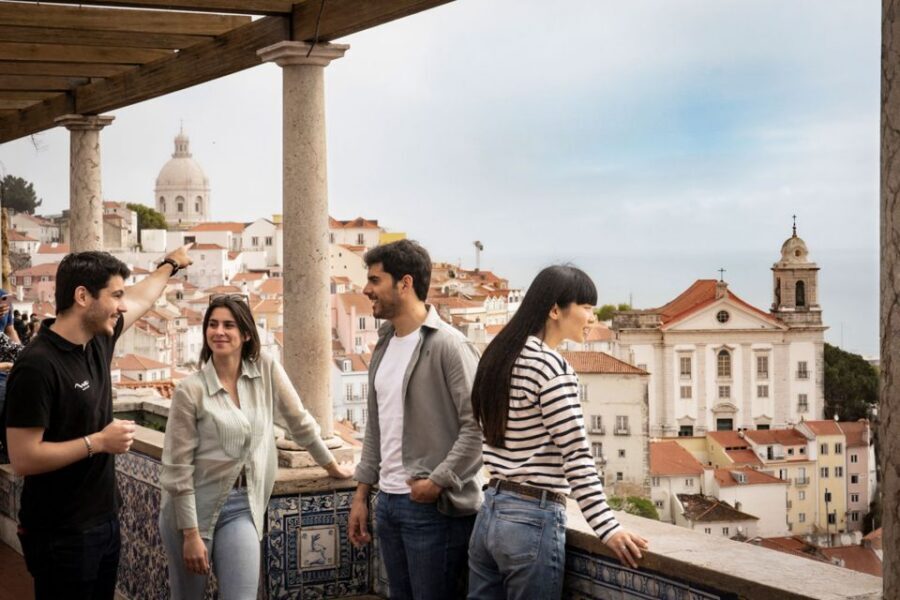
The walking portion takes you into the historic center and toward key viewpoint moments. You’ll pass through the area near Restauradores Square, then you head toward one of Lisbon’s iconic yellow rides (listed as a tram segment) that helps get you up to Bairro Alto and the viewpoint at São Pedro de Alcântara. Even if you’ve never climbed a hill in Lisbon before, this part helps you feel the city’s vertical rhythm without turning the whole day into a leg workout.
Along the way, your guide points out buildings and street patterns, then ties them to Lisbon’s major turning points. Two of the strongest stops in this phase are:
- Igreja de São Roque (St. Roque): the oldest Jesuit church in the city. It’s the kind of place where details make sense once someone explains the why behind the architecture.
- Carmo Convent ruins: destroyed in the 1755 earthquake, these remains are a hard-hitting reminder that Lisbon’s beauty sits alongside real history.
One practical drawback here: you’ll want comfortable shoes and the patience to walk on uneven ground. This isn’t a museum tour where you sit and look; you’re on Lisbon streets, which means steps, cobbles, and quick transitions.
Alfama’s streets: where the city’s past shows up in the cracks

From the center, the route moves into Alfama—the neighborhood where Lisbon still feels like it runs on old routes and old textures. You’ll get guided time to explore the area, including stops tied to the Cathedral of Lisbon. This is a good place for your guide to explain what you’re seeing, because Alfama’s appeal is partly how things layer over each other.
You’ll notice the difference between “pretty scenery” and lived-in older streets. In Alfama, the architecture and narrow lanes aren’t just visual—they shape how people move, how views open up, and where you can pause for a better look. With a guide, you don’t just walk through it; you learn how to read it.
If you’re the type who likes to ask questions—about Portugal’s history, Lisbon’s development, or even why neighborhoods look the way they do—this portion is where that pays off. The tour’s pace is designed so you can still think while you move.
The yellow tram reality check (and how to enjoy the plan anyway)

The highlights list includes riding Lisbon’s famous yellow tram. Here’s the honest part: the tram service is temporarily out of operation, so this part of the experience may not be available right now even though a tram ticket is included.
How do you handle that? Mentally treat the tram as a bonus, not the backbone. The walking and bike segments still do the heavy lifting for your day:
- You’ll reach the Bairro Alto viewpoint via the route that includes an iconic yellow ride segment.
- You’ll spend plenty of time in the center and then connect to the river and Belém.
So if the tram doesn’t run, you’re not losing the “whole tour,” but you may feel slightly less of that classic Lisbon tram moment. If that’s the one photo you really care about, you should still plan to take lots of viewpoint pictures from São Pedro de Alcântara and the riverfront—because those are built into the experience regardless.
Bike along the Tagus to Belém: easy riding with real scenery rewards
After the walking phase, you switch to a bike ride along the Tagus River. The good news: you’ll be on flat paths for much of the route, and you’re riding in a way that’s meant to be scenic, not sporty.
The bike segment is where the day changes tone. Instead of turning corners on foot, you glide along the riverfront and watch Lisbon unfold in long lines. You’ll see the April 25th Bridge and pass by modern architecture, including the MAAT Museum area. That mix is useful: it shows how Lisbon doesn’t only protect the past—it builds next to it.
A couple practical notes you should take seriously:
- You must be able to ride on unpaved or uneven terrain.
- The bike portion has a weight limit: 110 kg / 242.5 lb.
- You should be comfortable riding with the heat and sun. One guide-friendly review note flagged that biking in summer can feel tough. So bring water and plan for sun if you’re going in peak months.
The ride is also a great spot to slow down mentally. If your feet already feel busy from walking, this is your reset: the scenery comes to you, and you can take in the river without constantly calculating steps.
You can also read our reviews of more boat tours in Lisbon





Belém’s monuments: Jerónimos, Discoveries, and Belém Tower in one flow

Once you arrive in Belém, you shift into a guided walk through the area’s big-ticket sights—especially the Manueline-style and UNESCO-listed heritage that explains why Portugal was such a sea power.
Here are the highlights that matter most for your time:
- Jerónimos Monastery: you’ll see the famed 16th-century Manueline artwork up close. This is one of those places where details are easier to appreciate once someone frames what you’re looking at.
- Padrão dos Descobrimentos: a monument tied to the important Portuguese navigators. If you’re not familiar with the country’s maritime story, the guide’s context here helps the monument stop being just a structure and start being a lesson.
- Belém Tower: this fortified landmark defended the city from maritime attacks in the 16th century, and it gives you a strong sense of how the waterfront used to work.
This section is the reason the tour feels efficient. You’re not bouncing between separate bookings or spending your day in transit. You’re working through a tight sequence of sites that connect thematically—monastery to navigators to defense—so the history keeps flowing.
One minor caution: you’ll still be walking at this point. It’s not a full-on hike, but you’ll appreciate a steady pace and breaks when your guide offers them.
Pastéis de Belém and the Tagus cruise: turning food and water into the finale
This is the moment that most people remember most clearly. You’ll stop for a traditional Pastel de Belém (pastel de nata) at the historic shop Pastéis de Belém, founded in 1837. The tour includes the custard tart, and the whole point is that you get the iconic taste from the original place.
What makes this better with a guide? Timing and ease. You’re guided to the pastry moment as part of the route, not as an afterthought. That means you can focus on the flavor instead of just scanning for where to go next.
Then you move into the finale: a Tagus River boat cruise. This cruise runs from Belém back toward Lisbon, with the viewpoint payoff coming in stages. From the water, the city’s geometry changes. You see the shoreline, the bridges, and the skyline as a connected system—something you simply can’t grasp from streets alone.
The boat segment also helps you transition from “tour energy” into “memory mode.” After walking and biking, you can sit back and let the river do the talking. The cruise ends near the central area (your tour finishes around Largo de São Julião, and the tour’s route wraps back toward the Praça do Comércio area).
Price and logistics for a 5-hour private guide (the value math)

At $206 per person for about 5 hours, this isn’t a cheap sightseeing deal—but it is built like one. You’re not paying only for information. You’re paying for organization plus multiple included activities:
- private guide for the full flow
- guided walking in the city center and Belém
- bike ride from Lisbon to Belém
- pastel de nata included
- boat trip on the Tagus River
- tram ticket included, though the tram ride may be paused right now
For comparison, if you booked walking tours, bike rentals, and a river cruise separately, you’d likely spend more (and you’d spend more time coordinating). Here, the value is in the reduced friction and the guided route that keeps you from wasting energy on “where do we go next?”
Logistics-wise:
- Meeting point: Praça Dom Pedro IV 81–83, in front of McDonald’s
- No hotel pickup or drop-off
- Small group: up to 8 participants
- Languages: Portuguese, Spanish, English
- You should bring: comfortable shoes and clothes, plus a face mask or protective covering
Who this Lisbon tour suits best (and who should rethink it)

This experience is ideal if you want a single, high-impact day that connects Lisbon’s core sights to Belém’s monuments—without turning the trip into a checklist of separate tickets.
You’ll be happiest with this tour if you:
- like active sightseeing (walking plus a real bike ride)
- enjoy learning through conversation and guided interpretation
- want both landmark sites and panoramic views
You should reconsider if you:
- can’t bike comfortably on uneven terrain
- are over 110 kg / 242.5 lb
- need wheelchair access (it’s not listed as suitable)
- are dealing with pregnancy or want a low-impact day (not suitable)
- are traveling with children under 10, or if a child doesn’t meet the height requirement (10 years old or at least 1.50 meters)
Should you book this Lisbon private boat trip, guided walking tour, bike & tram combo?
I’d book it if your goal is to see the big essentials of Lisbon and Belém in one smooth run, and you’re okay with a day that mixes walking and cycling. The Tagus River pieces—bike and boat—are the strongest payoff, and the Pastéis de Belém stop gives you a clear, delicious anchor point.
I’d hesitate only if a yellow tram ride is the one detail you’re counting on most, because the tram service is temporarily out of operation. If you can adapt to that, the rest of the tour still does what it’s designed to do: connect districts, explain the landmarks, and get you back on the water with a calmer, more scenic finale.
FAQ
Where is the meeting point?
You meet at Praça Dom Pedro IV 81–83 (in front of McDonald’s) in Lisbon.
How long is the tour?
The tour lasts 5 hours.
What’s included in the price?
It includes a private guide, city-center and Belém guided walking tours, a yellow tram ticket (though the tram ride may not be operating), a bike ride from Lisbon to Belém, Pastel de Nata, and a Tagus River boat trip from Belém to Lisbon.
Is the yellow tram ride available right now?
The tram service is temporarily out of operation, so the tram portion may not be available at the moment.
Are hotel pickup and drop-off included?
No. Hotel pickup and drop-off are not included.
Is this tour suitable for kids?
It’s not suitable for children under 10 years old, and children must be at least 1.50 meters tall. Child seats are available for children under 20 kilograms.