REVIEW · LISBON
Lisbon Complete Tour! Eco TukTuk Private Guided
Book on Viator →Operated by Tuks da Paty · Bookable on Viator
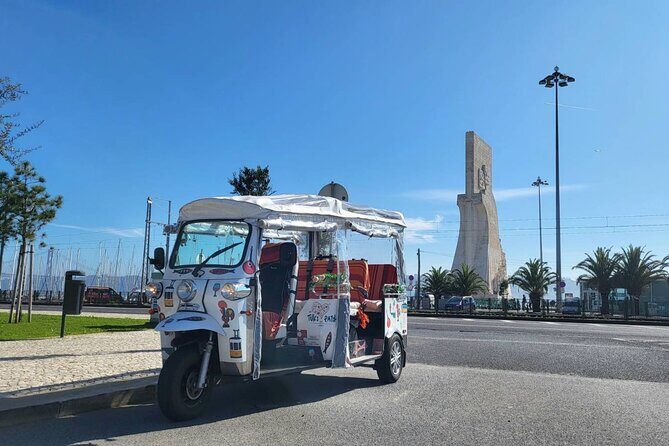
Lisbon clicks into place fast. This private eco tuk-tuk tour strings together major Lisbon stops in about 4 hours, with an efficient route that helps you get oriented fast. I love the pickup flexibility (you can hop on in a convenient spot around the city) and the personalized feel of having just your group. The one thing to keep in mind: it’s a lot of ground to cover, so each stop is short.
This is the kind of tour that works especially well on day one, when everything feels new and you don’t want to waste energy walking between hills without a plan. Guides like Mariana are known for high energy and strong local knowledge, while Marco is singled out for a smooth arrival-day overview that keeps the day from feeling like a slow blur.
You’ll get plenty of viewpoints and photo angles built into the schedule, not just monuments. Just note that with viewpoints and historic lanes, you’ll want to be ready to stand, look, and move on without lingering too long at any one place.
In This Review
- Key highlights to know before you go
- Eco tuk-tuk logistics: why this style works in Lisbon
- From Lisbon Cathedral to Roman traces: the quick-start history stop
- Miradouros that build your Lisbon “mental map”
- São Vicente de Fora: baroque tiles and a pantheon-like stop
- Alfama and the surrounding streets: slow feeling, fast access
- São Pedro de Alcântara and the Santa Justa connection
- The Pink Street moment and when to treat food as a stop, not a mission
- Belém power run: Jerónimos, Tower, Discoveries, and MAAT
- Time in the real world: what 4 hours feels like
- Price and value: is $182.99 per person fair for what you get?
- Should you book this Lisbon Complete Tour! Eco TukTuk Private Guided?
- FAQ
- How long is the Lisbon Complete Tour with eco tuk-tuk?
- Is pickup included?
- Is the tour private?
- What language is the tour offered in?
- Are tickets required for the stops?
- Do I get a mobile ticket?
- Can I cancel for a full refund?
Key highlights to know before you go

- Eco-friendly tuk-tuk transport makes the steep parts of Lisbon feel manageable in a single afternoon.
- Private, group-only format means you can ask questions and adjust pacing without a crowd.
- Four miradouros (viewpoints) give you a fast map of Lisbon’s geography and neighborhoods.
- Belém and Discoveries power in one run: Pastéis de Belém, Jerónimos, Tower, and more.
- Free-entry stops across the route for the listed sights, so your time goes to seeing, not paying.
Eco tuk-tuk logistics: why this style works in Lisbon
Lisbon is a city where distance feels longer than it looks on a map. Hills, winding streets, and sudden viewpoints can turn an “easy stroll” into a whole workout. A tuk-tuk route makes sense here because it keeps your energy for looking, photographing, and learning.
The private part matters, too. When you’re not sharing with strangers, you can move at a human pace. You also get a guide who can steer you through the right order for first-time orientation—starting with older Lisbon, then shifting east toward Belém.
One more practical win: pickup is flexible. You can hop on your tuk-tuk in a location that works for you within the city. That’s helpful when you’re staying somewhere off the main tourist traffic and you don’t want to force yourself to reach a fixed meeting point.
You can also read our reviews of more guided tours in Lisbon



From Lisbon Cathedral to Roman traces: the quick-start history stop

The tour begins at Lisbon Cathedral (Sé), a 12th-century landmark that’s easy to spot and hard to forget. This is where you get a sense of how Lisbon has been shaped by centuries of change and resilience. Even if you’re not an architecture specialist, the key idea lands fast: this is old Lisbon at its core.
Right after that, you move to Museu de Lisboa – Teatro Romano, where you’ll see remnants of a Roman theater dating to the 1st century BC. It’s a short stop, but it’s a valuable one because it adds depth to the city’s story. Lisbon isn’t just “medieval streets and tiles.” It also has Roman roots that still show up if you know where to look.
Both of these are listed as free admission for your visit, so you’re not spending your limited time on paperwork or ticket lines. The real benefit is that early history gives you context for everything you’ll see later.
Miradouros that build your Lisbon “mental map”

If you only do Lisbon’s viewpoints, you’d still feel like you did the right thing. Here, you get multiple miradouros in sequence, which makes the city geography finally click.
At Miradouro de Santa Luzia, you’ll look out over the Alfama terracotta rooftops, with the Tagus River and historic monuments stretching beyond. This spot also features azulejos—the traditional Portuguese tiles—with scenes that connect Lisbon’s art style to its past. The result is more than a pretty photo. You’re learning how Lisbon tells stories visually.
Next is Miradouro da Senhora do Monte, described as Lisbon’s highest central viewpoint. The schedule gives you an expansive 180-degree view, with big-name sights visible in one sweep: São Jorge Castle, Chiado, the 25th of April Bridge, the Christ the King statue, and the downtown area. In practical terms, this is the stop that helps you stop guessing where things are.
You also end up back with another classic viewpoint at Miradouro de São Pedro de Alcântara, famous for the view of the historic center and São Jorge Castle. A bonus is the connection to the city through the Gloria Funicular, which adds a fun transport-story element to your sightseeing.
If you’re the kind of traveler who likes structure—see this, then understand how it links—this viewpoint lineup is built to help.
São Vicente de Fora: baroque tiles and a pantheon-like stop

A strong mid-tour transition comes at Mosteiro de São Vicente de Fora. The monastery is described as a monumental 17th-century Mannerist building with austere, sober forms—so even the exterior reads as “serious architecture,” not just scenery.
What makes this stop especially useful is that it’s tied to something very Lisbon: tiles. The monastery is home to the largest collection of baroque tiles, which is the kind of detail you can’t really replicate on your own without knowing where to go. You get a quick hit of Portuguese visual culture in one place.
The tour also notes that this site is connected to a later use as a pantheon, housing tombs of notable people such as historic leaders, writers, and public figures. So you’re not only seeing a monument; you’re seeing how Lisbon honors its most important names.
It’s listed as a short stop, but that works here. It’s a “highlight density” type of stop.
Alfama and the surrounding streets: slow feeling, fast access

Alfama is the oldest district of Lisbon, and the tour’s description captures the texture you’d want: narrow lanes, colorful houses, and the sense of a neighborhood where music belongs in the air. Fado is part of that identity, and the schedule gives you a slice of it through the district’s atmosphere rather than trying to turn it into a full performance night.
After Alfama, you’ll visit a former royal palace site that now features arcaded buildings and a central statue of King José I. Even if you don’t know the story beforehand, the visual cue—arcades plus royal statue—signals that this is a place that once mattered politically and still matters as a symbol.
Then there’s another district stop described as a mix of tiled facades, narrow winding streets, and an easy daytime-to-night shift: cafes and boutiques by day, bars and Fado houses by night. The practical takeaway: Lisbon neighborhoods don’t stay the same from morning to evening. This tour gives you a “taste of that shift” by moving through the city with a plan.
The short durations may feel limiting if you love to linger. But if your goal is orientation and variety in one session, it’s an efficient hit.
You can also read our reviews of more private tours in Lisbon




São Pedro de Alcântara and the Santa Justa connection

Another viewpoint stop brings you to Miradouro São Pedro de Alcântara, and it’s one of those locations that feels classic the moment you arrive. The listed view includes São Jorge Castle, plus sweeping shots of Lisbon’s historic center.
What I like about this stop in the tour context is that it’s paired with an actual local transport story: the viewpoint ties into the city via the historic Gloria Funicular. Even when you don’t plan to ride every transit line, learning how people climb and connect areas helps you navigate later.
Then you move to Convento do Carmo, a Gothic monument with a “ruined but preserved” feel. It’s specifically linked to the 1755 earthquake, so it’s not just an old church. It’s a physical reminder of how Lisbon survived disaster and rebuilt its identity.
And for a different kind of structure, there’s Elevador de Santa Justa (also called the Carmo Lift). This is a wrought-iron elevator with neo-Gothic details, designed by Raoul Mesnier du Ponsard, a disciple of Gustave Eiffel. The tour notes you can enjoy the viewpoint without the typically long waiting lines, which is a big deal when your time is limited.
The Pink Street moment and when to treat food as a stop, not a mission
Between monuments and miradouros, the route includes a quick pause for Lisbon’s Pink Street—the iconic street with pink pavement and hanging umbrellas. It’s a small moment, but it’s exactly the kind of visual landmark that helps you remember the route later. It also breaks up the more serious sightseeing with something playful.
Then comes one of the easiest “why this tour is worth it” stops: Pastéis de Belém. You’ll learn about the famous custard tart and watch the traditional preparation process. The secret recipe is described as closely guarded since the factory’s founding in 1837.
The best practical part: you get a freshly made take-away at the end. That’s smart in a tour like this because you’re not hunting down food after you’ve already walked and climbed. You’re also not forced into a full sit-down meal when you still want to see monuments.
If you care about food culture, this is one of the tastiest ways to end a sightseeing arc before you hit the big Belém sights.
Belém power run: Jerónimos, Tower, Discoveries, and MAAT

Belém is where Lisbon shifts from “old city layers” to “Age of Discoveries” scale. This tour gives you that transition in a tight sequence.
First up is Mosteiro dos Jerónimos, a major monument combining Gothic and Renaissance styles, built in the 16th century during the Age of Discoveries. It’s noted that you can explore the monastery’s church for free, which is a strong value point when you’re paying for a short, action-packed day.
Next is Torre de Belém, the 16th-century tower that served as a ceremonial stage for departure and arrival of Portuguese explorers. It’s one of those places that feels “made for photos,” but the real payoff is how the monument ties back to the idea of exploration, travel, and Portugal’s maritime era.
Then you visit Padrão dos Descobrimentos, the commemorative monument with a world-map design on the ground showing dates when Portuguese explorers reached important locations. Even if you only read part of it, you’ll feel the scale of the era quickly.
To finish, you get the contemporary counterpoint: MAAT (Museu de Arte, Arquitetura e Tecnologia). The tour notes the striking modern architecture invites you to stroll on top of the building, and it’s located along the Tagus River. It’s a short stop, but it’s a nice reminder that Lisbon isn’t stuck in postcard history—it keeps reinventing itself.
Time in the real world: what 4 hours feels like
This is a 4-hour tour, and it’s structured around fast entrances, short viewpoints, and quick monument reads. Each listed stop is timed in the itinerary, with many marked as about 5 to 20 minutes.
So the best way to think about it is: you’re buying an overview and a set of anchors, not a deep, slow museum day. I like it for that exact reason. After the tour, you can return to the one or two places that grabbed you—Alfama at night, a closer look at tiles, a longer church visit, or a full Belém exploration on a separate day.
Comfort-wise, the tuk-tuk ride helps you spend less time in transit. But your legs still do their part at viewpoints and stops. Wear shoes you trust for uneven stone and keep a calm pace.
Price and value: is $182.99 per person fair for what you get?
At $182.99 per person for about 4 hours in a private format, the price can feel high at first glance. But compare what’s included in the way the tour is designed: transport by eco tuk-tuk, guide interpretation in English, a tight route through major districts, and multiple free-entry stops listed along the way.
In practice, value is strongest if:
- you’re arriving with limited time and want an overview that keeps you awake and oriented (the Marco-style arrival-day logic),
- you want someone to connect sights into a single story (instead of bouncing between locations alone),
- you care about viewpoint sequencing, not just “stop at a landmark and move on.”
If you’re traveling solo, this cost can be more noticeable. If you’re traveling as a small group, it often starts to feel more reasonable because you’re paying for privacy and a guided “route solution,” not just sightseeing time.
Should you book this Lisbon Complete Tour! Eco TukTuk Private Guided?
Book it if you want an efficient first-day plan, love viewpoints, and prefer a guide to do the work of connecting Lisbon’s layers—Roman traces to tiled monasteries, then the Belém era and its monuments. It’s also a good choice if you hate wasting time trying to “figure it out” in a steep city.
I’d hesitate if you’re the type who needs long museum hours, hates short stops, or plans to linger at every viewpoint. This tour moves. It gives you the highlights fast, not a slow, soak-everything day.
One smart strategy: treat it like a map with photos. When you see what clicks—Alfama lanes, the tile collection, Belém’s maritime story—make a short list for your next day and build your own return route from there.
FAQ
How long is the Lisbon Complete Tour with eco tuk-tuk?
The tour is listed as about 4 hours.
Is pickup included?
Pickup is offered. You can hop on the tuktuk in any convenient place within the city for you and your group.
Is the tour private?
Yes. It’s a private tour/activity, so only your group participates.
What language is the tour offered in?
The tour is offered in English.
Are tickets required for the stops?
The itinerary lists admission ticket free for the included stops.
Do I get a mobile ticket?
Yes, it includes a mobile ticket.
Can I cancel for a full refund?
Yes. You can cancel up to 24 hours in advance for a full refund. Changes within 24 hours of the start time aren’t accepted, and the amount paid is not refunded.