REVIEW · LISBON
Half Day Private Tuk Tuk Tour in Lisbon and Belém
Book on Viator →Operated by enRoute Lisboa · Bookable on Viator
A great city day can fit in 4 hours. This private tuk tuk tour strings together Lisbon’s most photogenic viewpoints, big landmarks, and classic neighborhoods, then carries you across the river to Belém for the iconic sites. You also get a guide who helps you connect the dots between old streets, royal power, and the Tagus skyline.
Two things I really like: the guides (Carlos Ventura and João come up in local experience) bring facts with a friendly, human style, and the route is packed with miradouros so you’re always getting that “oh right, Lisbon is built for views” feeling. One consideration: the pace is tight—some major stops are short, and a few attractions have entry not included (so you’ll need to plan for that).
In This Review
- Key things to know before you ride
- A private tuk tuk route that makes Lisbon feel readable
- Price and value for a 6-person private group
- Pickup and the reality of a 4-hour pace
- Lisbon start: St. Anthony and the Cathedral’s cloister vibe
- Miradouros as the main event: Portas do Sol to Senhora do Monte
- Mouraria and Rossio: fado roots and classic square life
- Chiado, Bairro Alto, and São Roque: walking Lisbon’s mood
- Lisbon’s iconic central squares, plus the Santa Justa lift option
- The market stop: Feira da Ladra, if your day lines up
- Belém Palace pass-by and the river-to-land shift
- Pastéis de Belém: the snack stop you’ll remember
- Jerónimos Monastery and Belém Tower: Portugal’s iconic monuments
- Monument to the Discoveries: short stop, strong symbolism
- Tickets and admissions: what’s free vs not included
- Who this half-day private tour fits best
- Should you book this tour?
- FAQ
- How long is the tour?
- How much does the Half Day Private Tuk Tuk Tour cost?
- Is pickup available?
- Do I get a mobile ticket?
- Is the tour private?
- Are entrance tickets included for all stops?
- Will the Feira da Ladra market be happening during the stop?
- How many people can be in the group?
- What’s the cancellation policy?
Key things to know before you ride
- Private tuk tuk for up to 6: small-group feel, more control over pacing.
- A viewpoint-heavy route: Portas do Sol, Senhora do Monte, São Pedro de Alcântara, plus more.
- Belém in half a day: Pastéis de Belém, Jerónimos, Tower, and the Monument to the Discoveries.
- Most entries are free: several churches and squares are walk-in, with a few paid add-ons.
- Feira da Ladra timing matters: it runs Tuesday and Saturday.
- Pickup is offered: helps you start without wasting time.
A private tuk tuk route that makes Lisbon feel readable
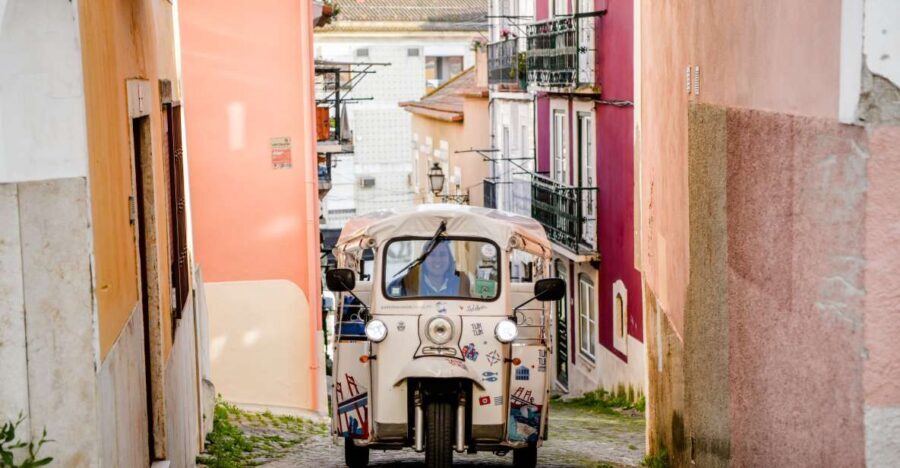
Lisbon can be a lot on foot. Hills, switchbacks, and sudden stairs can turn a sightseeing plan into a stamina test. This tour’s answer is simple: you ride in a traditional tuk tuk, hit key sights in an efficient order, and then use the stops to orient yourself so the city starts making sense.
What makes it especially practical is that you’re not just collecting famous names. You’re moving between places that show Lisbon’s different layers. You begin near saints and cathedrals, then you work your way through neighborhoods where the city’s identity changes block by block. Later you head to Belém, where Portugal’s Age of Discoveries gets a very physical presence around the river.
You can also read our reviews of more private tours in Lisbon



Price and value for a 6-person private group

The price is $370.43 per group, up to 6 people, for about 4 hours. On paper, that sounds steep if you’re traveling solo. But here’s the value angle: you’re paying for convenience, direct routing, and a guide who can shape the day to your group.
For a small group, it often pencils out better than you might expect, because you’re spreading the cost across people while still getting private attention. Also, much of what you see is free to enter (churches, viewpoints, squares), which reduces the “surprise costs” feeling that can pop up on a half-day plan.
If you’re a couple or a family of four to six, this is a strong way to save time and avoid the constant decision-making of which hill to climb next.
Pickup and the reality of a 4-hour pace
Pickup is offered, and you’ll get a mobile ticket. That matters because the first 30–60 minutes of a half-day can vanish quickly if you have to locate the start point and coordinate transport.
The pace is designed for movement. Many stops are short—think 5 to 15 minutes—so you should expect photo moments, quick interior highlights (when available), and “look-and-learn” context from your guide rather than slow museum time.
This is ideal if:
- You want a concentrated highlights circuit without committing to a full day.
- You’re dealing with limited mobility or just want your legs to rest.
- You’d rather spend your energy tasting the city (and maybe shopping) than climbing between viewpoints.
Lisbon start: St. Anthony and the Cathedral’s cloister vibe
The tour begins near the Church of St. Anthony, which is symbolically important because it stands by the house where St. Anthony was born. It’s a quick stop, but it sets the tone: Lisbon isn’t only about ocean views and tiles. It’s also deeply tied to Catholic devotion and local identity.
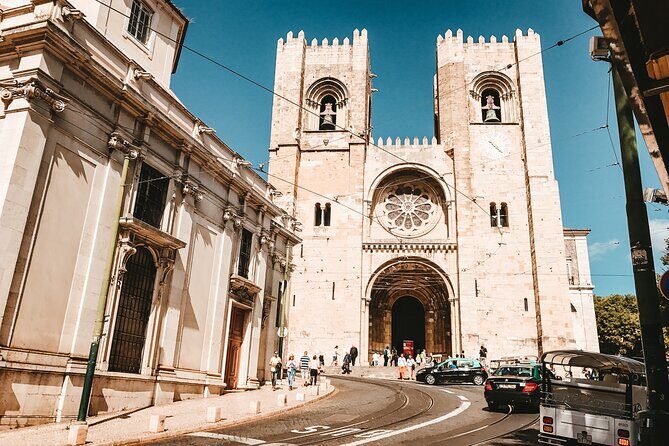
Next comes Lisbon Cathedral, one of the city’s signature buildings and its most important church. Here you get a chance to understand layers of time through the chapels and cloister, and how different eras and styles shaped what you see today. It’s also a good “orientation” stop—once you understand the cathedral area, the surrounding old-city streets become less confusing.
Right after, you’ll make time for the Lisbon Museum – Roman Theater, connected to the ancient city of Felicitas Iulia Olisipo. Even if the stop is brief, it’s a smart reminder that Lisbon’s story goes way beyond the modern postcard version.
Miradouros as the main event: Portas do Sol to Senhora do Monte
Lisbon’s viewpoints are not filler here. They are the rhythm of the day. After the cathedral zone, you head to Miradouro das Portas do Sol, famous for views and for its decorative azulejo tiles. It’s one of those places where you get the scenery and the visual character at the same time.
Then you later reach Miradouro da Senhora do Monte, another major viewpoint stop that’s specifically recommended as a top choice for seeing the city. If you’re the type who loves sweeping panoramas, this is one you’ll want to linger at—15 minutes goes fast, so move quickly to the best angles.
The route also includes Miradouro São Pedro de Alcântara, a very popular terraced lookout with gardens, statues, and a fountain. From here you can look out toward São Jorge Castle and the Tagus River, with views down into central Lisbon. If you like places with a bit of atmosphere (not only views), this one is extra appealing.




Mouraria and Rossio: fado roots and classic square life
After the viewpoint sequence, you slide into neighborhoods where Lisbon’s cultural heartbeat gets louder.
In the Moorish Quarter (Mouraria), you’re in one of Lisbon’s most traditional areas and closely linked to fado—including the mention of Severa, the first known fado singer, who lived and performed here. Even if you don’t catch music on the day of your visit, the context helps you understand why these streets feel like more than a tourist backdrop.
You also stop near Praca Martim Moniz, which honors the nobleman connected to the 1147 conquest of the castle. And there’s time in Praca da Figueira in the Baixa area, plus Rossio Square (Praça de D. Pedro IV). Rossio is lively, old, and beautiful, and it works well as a “breathing space” between hills and interiors.
Chiado, Bairro Alto, and São Roque: walking Lisbon’s mood
As you move into Chiado and Bairro Alto, you get a different Lisbon feel—less cathedral-stone and more street-level energy. Chiado sits on a hill, which is why its streets have that up-and-down rhythm. Bairro Alto is known for nightlife, but the key point for a day tour is that it still contains interesting corners and stops even before the evening crowd arrives.
You also visit Igreja de São Roque, noted as an early Jesuit church in the Portuguese world and part of a long story connected to the Society’s presence in Portugal, the 1755 earthquake context, and later the church’s connection to the Lisbon Holy House of Mercy. You don’t need to be a religious-history nerd to appreciate it; the payoff is seeing how buildings change roles over time and still remain prominent in the city’s fabric.
Near these areas, the tour also includes Príncipe Real Garden (Praca do Principe Real), where there’s a weekly organic market on Saturdays. Even if it’s not Saturday, it helps you understand why locals like to gather there—this is a garden stop with social life.
Lisbon’s iconic central squares, plus the Santa Justa lift option
One of the best parts of Lisbon sightseeing is that the city keeps opening to you at the right moment. The tour’s time at Praça do Comércio (Terreiro do Paço) is one of those moments. It’s described as the most famous square in the country, built to welcome visitors with grand setting, and known to locals as Terreiro do Paço because it was the Paço da Ribeira area until the 1755 earthquake. In other words: it’s not just a pretty postcard. It’s a place shaped by catastrophe and rebuilding.
You also have a stop at Elevador de Santa Justa—a famous lift with a unique structure and a view from the top. The key detail: entry is not included, so if your group wants the ride, you’ll need to pay separately. Even without riding, the lift is a strong visual landmark.
The market stop: Feira da Ladra, if your day lines up

There’s also a stop at Feira da Ladra, which is Lisbon’s best-known market. It’s a place for original, kitsch, vintage, and collectible finds—utilities, clothes, books, antiques, and more. The important practical detail is timing: this market takes place Tuesday and Saturday.
So here’s the smart way to treat this stop: if your tour day matches, treat it as a bonus chance to browse local textures and pick up small souvenirs. If it doesn’t match, you’ll still pass through an area linked to that market vibe, but don’t expect the same browsing experience.
Belém Palace pass-by and the river-to-land shift
When you head to Belém, the atmosphere changes. You’re moving from the hills and old central streets into a riverside zone tied to Portuguese exploration and state power.
The tour includes a stop at Belém Palace, described as the current official residence of the president of the Portuguese Republic. In practice, this is more of a context stop than a deep interior visit in a short half-day plan, but it helps connect the royal/exploration era you see next with the modern face of Portugal’s leadership.
Pastéis de Belém: the snack stop you’ll remember
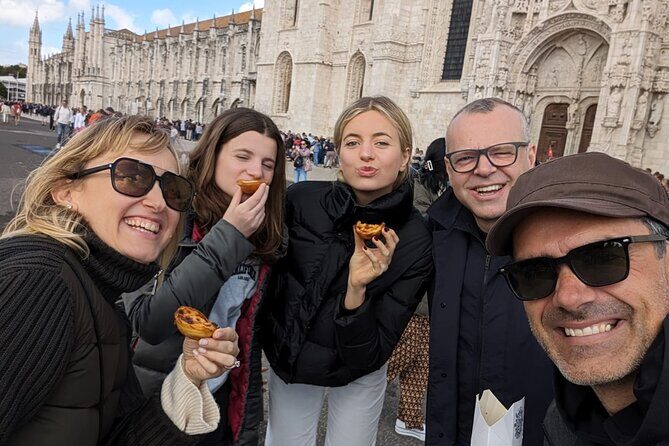
Every Lisbon-to-Belém day gets judged by one thing: the pastry. This tour gives you time at Pastéis de Belém, where pastel de nata (Pastéis de Belém) is one of Portugal’s most famous calling cards.
The tour allots about 15 minutes, which is short enough that you should go in with a plan:
- If you want to savor, grab and step into a rhythm that doesn’t slow the group.
- If you want photos, prioritize your moment before the line makes things tight.
Even if you already know you want pastel, I like that this tour doesn’t treat it like an afterthought. It places it right after the shift to Belém, so it feels like part of the journey.
Jerónimos Monastery and Belém Tower: Portugal’s iconic monuments
The centerpiece of the Belém portion is Mosteiro dos Jerónimos. This monastery was founded on a site outside Lisbon on the banks of the Tagus, tied to Manuel I and devotion connected to Our Lady and St. Jerome, and it received the Order of St. Jerome—hence the name Jerónimos. It’s also described as a cultural reference point across five centuries, and it became a burial place for kings and later poets.
In a half-day, you won’t get every detail, but you’ll get enough to feel why it’s a defining Portuguese identity landmark. The architecture alone does the work.
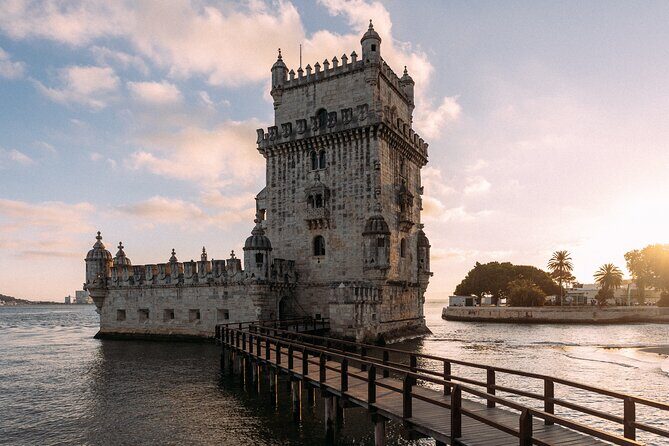
Next you reach Belém Tower, a defensive structure built between 1514 and 1520 as part of the Tagus estuary defense system. The tower’s description makes its purpose clear: it had two distinct volumes and artillery levels allowing long-distance cannon firing and ricochet shots over the water. That’s a big part of the appeal—this isn’t just decoration; it’s military architecture tied to a world-changing era.
Important: Belém Tower entry is not included, so if you want to go in, plan for an extra payment.
Monument to the Discoveries: short stop, strong symbolism
The last Belém stop on this tour is the Monument to the Discoveries, located in the Praça do Império area. The monument was reconstructed in reinforced concrete clad in Rosal limestone, inaugurated in 1960, and later underwent renovation work to allow public access to a viewing balcony, auditorium, and exhibition rooms.
That information is more useful than it sounds. It tells you the monument isn’t only about a photo from the outside. If your group has interest, this can be one of those “quick visit now, remember it later” stops—but note it’s marked as not included for admission.
Tickets and admissions: what’s free vs not included
A big reason this tour feels manageable is that many stops list admission ticket free. Churches like St. Anthony, Lisbon Cathedral, São Vicente de Fora, São Roque, and others are generally positioned as quick visits without ticket stress. Several viewpoints and squares are naturally free, too.
Where you should expect potential extra costs:
- Panteão Nacional has admission not included.
- Elevador de Santa Justa entry/ride is not included.
- Belém Tower admission is not included.
- Monument to the Discoveries admission is not included.
My practical advice: decide in advance what you care about most. If you’re into interiors and paid access, budget extra. If you’re happy with exterior views and quick stops, you’ll likely feel the tour’s pricing is more straightforward.
Who this half-day private tour fits best
This works best for you if you want:
- A high-efficiency highlights route without constant navigation.
- Private attention and a flexible small group (up to 6).
- Lots of Lisbon viewpoints and classic squares, plus a real Belém hit list.
It’s less ideal if you want a slow, deep museum day. This is short stop sightseeing. It’s designed to get you oriented and excited, not to replace a full, day-long museum plan.
Should you book this tour?
If your priority is seeing Lisbon and Belém without losing hours to transportation and hill logistics, I’d book this. The private tuk tuk format plus a guide like Carlos Ventura or João-style energy makes the day feel fun and structured at the same time. And because many stops are free, you’re not fighting your budget at every turn.
I’d hesitate only if you know you want long, ticket-based time inside the paid attractions (Pantheon, Santa Justa, Belém Tower, Discoveries monument). With a half-day, you may need to choose what to prioritize and accept that some places are more “taste” than “full visit.”
In short: book it for smart highlights, great views, and a Belém taste that actually lands.
FAQ
How long is the tour?
The tour runs for about 4 hours.
How much does the Half Day Private Tuk Tuk Tour cost?
It costs $370.43 per group, up to 6 people.
Is pickup available?
Yes, pickup is offered.
Do I get a mobile ticket?
Yes, a mobile ticket is included.
Is the tour private?
Yes. It’s private, and only your group participates.
Are entrance tickets included for all stops?
Many stops are listed as admission ticket free, but some are marked as not included, including Panteão Nacional, Elevador de Santa Justa, Belém Tower, and the Monument to the Discoveries.
Will the Feira da Ladra market be happening during the stop?
Feira da Ladra takes place on Tuesday and Saturday. If your tour day matches, you’ll have that market stop.
How many people can be in the group?
The tour is for up to 6 people per group.
What’s the cancellation policy?
You can cancel for free up to 24 hours in advance for a full refund. If you cancel less than 24 hours before, you won’t get your money back.