REVIEW · LISBON
Lisbon Small Group Tour
Book on Viator →Operated by RecordTours · Bookable on Viator
Lisbon moves fast, but this tour keeps you oriented. You get driven through the old neighborhoods and up to multiple miradouros so you see how the city stacks on its seven hills, from Baixa to Alfama to Belém. Then the route swings into the Age of Discoveries mood with river views, major monuments, and the classic Pastéis de Belém.
I particularly like two things: the small group size (up to 8), which makes it easier to hear your guide and ask quick questions, and the mix of viewpoints plus meaningful stops rather than just photo pull-offs. A guide named Joan is specifically praised for explaining Lisbon with passion and smart choices about what matters most.
One drawback to plan for: it’s a 5-hour route with lots of “look, walk a bit, move on” stops, so if you’re sensitive to steep streets or you hate standing at viewpoints, you’ll need to manage your pace.
In This Review
- Key highlights you’ll actually feel
- A small group tour that really helps you understand Lisbon’s layout
- The 5-hour rhythm: hills, historic districts, and a Belém day-dream
- Miradouro Da Senhora Do Monte: the quick geography lesson from São Vicente (Graça)
- Igreja de São Vicente de Fora: a church stop that gives you a sense of Lisbon’s layers
- Miradouro das Portas do Sol: Alfama from the right angle
- Lisbon Cathedral (Sé): where styles mix after the city retook its ground
- Igreja de Santo António: the St. Anthony tradition you can spot on site
- Parque Eduardo VII and the Águas Livres Aqueduct: Lisbon’s power to plan ahead
- Jerónimos and Torre de Belém: the Age of Discoveries section of Lisbon
- The Pastéis de Belém moment: cream pastry, old bakery vibes
- Padrao to the city core: Restauradores, Rossio, and Avenida da Liberdade
- Included perks and what they mean for your comfort
- Price and value: is $115.19 a fair deal?
- Who should book this Lisbon tour
- Should you book this Lisbon small group tour?
- FAQ
- How long is the Lisbon Small Group Tour?
- How many people are in the group?
- Where is the meeting point?
- What time does the tour start?
- What’s included in the price?
- Are breakfast or meals included?
- Can I cancel for a full refund?
- What if weather is poor on the day?
Key highlights you’ll actually feel
- Up to 8 people: quieter, easier questions, and less waiting around.
- Hilltop miradouros on purpose: you’ll learn Lisbon’s layout fast.
- Belém’s Portuguese navigators theme: Jerónimos, Tower of Belém, and the Discoveries area in one run.
- 25 de Abril Bridge viewpoints: that Golden Gate Bridge nickname makes sense once you see it.
- Pastéis de Belém time: you’ll get the iconic cream pastry moment in Bethlehem.
- Free-listed admission stops: the itinerary shows free entry for the scheduled stops.
A small group tour that really helps you understand Lisbon’s layout
This is the kind of Lisbon introduction that saves you hours of guesswork. Lisbon is all angles and slopes, so the biggest win is not just what you see, but how quickly you learn where everything sits. With a maximum of 8 people, you’re less likely to get shuffled around in a big crowd, especially at viewpoints where space is tight.
You’ll be based in a comfortable air-conditioned vehicle with WiFi on board and bottled water. That matters because Lisbon’s best viewpoints are spread out, and your energy is better spent on looking (and listening) than on transfers.
You can also read our reviews of more tours and experiences in Lisbon.



The 5-hour rhythm: hills, historic districts, and a Belém day-dream
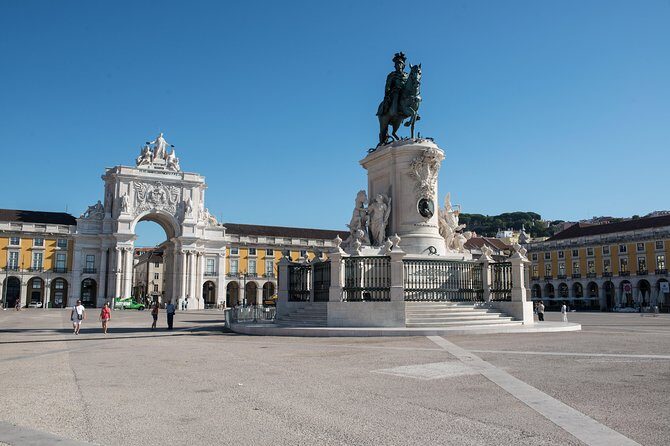
This tour is built like a guided “Lisbon greatest hits” loop, but it’s not just a list of landmarks. The driving route takes you through narrow historic streets and key areas like Baixa, Bairro Alto, and Alfama, then pushes out toward Belém for the big monuments near the Tagus.
In between, you’ll cross the 25 de Abril Bridge, commonly nicknamed the Portuguese Golden Gate Bridge. That bridge crossing is more than a fun photo moment—it gives you a sense of scale and river geography that you simply don’t get from postcards.
You’ll also reach the Statue of Christ King, described as a replica of Christ the Redeemer in Rio. Even though it’s not the original, the viewpoint idea is the same: a quick dose of sweeping city-and-water perspective before you move on.
Miradouro Da Senhora Do Monte: the quick geography lesson from São Vicente (Graça)
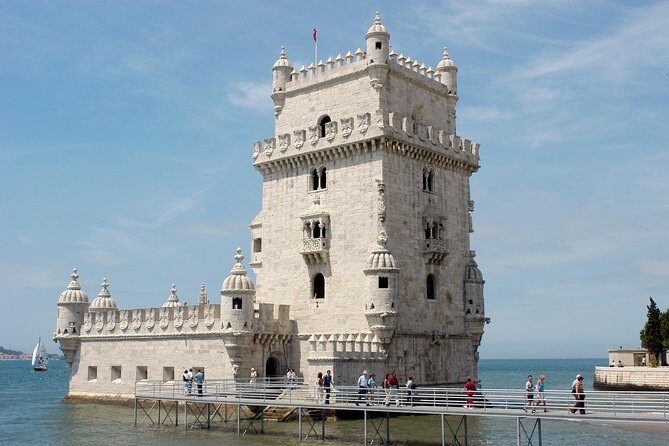
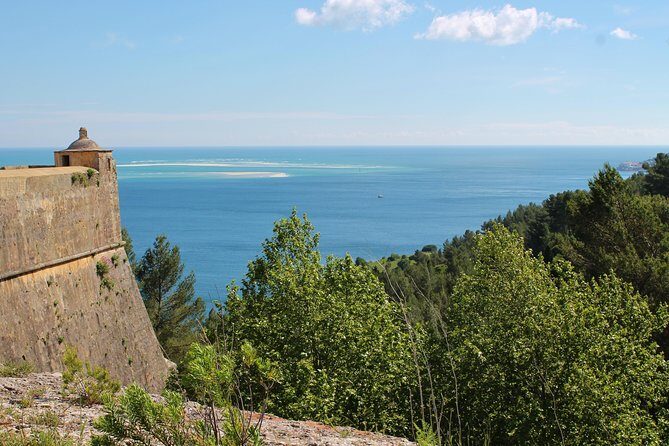
Your first major viewpoint is Miradouro da Senhora do Monte (near the Chapel of Our Lady of the Mount). This belvedere is famous for broad sightlines, including views to the south toward the sea of the Straw, the Castle of São Jorge, and part of Baixa, plus the Tagus estuary. Looking from up here, Lisbon stops feeling like a confusing maze and starts looking like a stacked set of neighborhoods.
The tour schedules about 20 minutes here, which is enough time to take in the angles and then spot what you’ll recognize later. If you’re the type who wants to understand before you photograph, this is a strong start.
Practical tip: plan for wind and sun. Viewpoints can feel cooler or harsher than the streets below, and you’ll be standing at an altitude even if the time on your feet is short.
Igreja de São Vicente de Fora: a church stop that gives you a sense of Lisbon’s layers
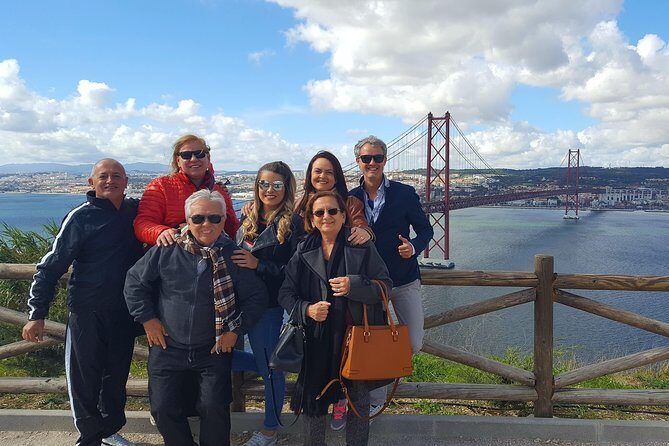
Next up is Igreja de São Vicente de Fora, which traces back to an older temple idea on the spot of where D. Afonso Henriques built a primitive temple. The church’s story connects to St. Vincent, who became the patron of Lisbon in 1173 when his relics were transferred from the Algarve to a church outside the city walls.
What I like about stopping here during a “first day” tour is that it shows you Lisbon’s ability to keep adding layers instead of starting from scratch. Construction began later, with work associated to architect Filippo Terzi and based on a drawing by Spanish architect Juan de Herrera, with Baltasar Álvares also highlighted in the building history.
You get about 20 minutes at this stop, so treat it as a focused introduction: look at the setting and let your guide frame why it’s important, rather than trying to read every detail yourself.
Miradouro das Portas do Sol: Alfama from the right angle
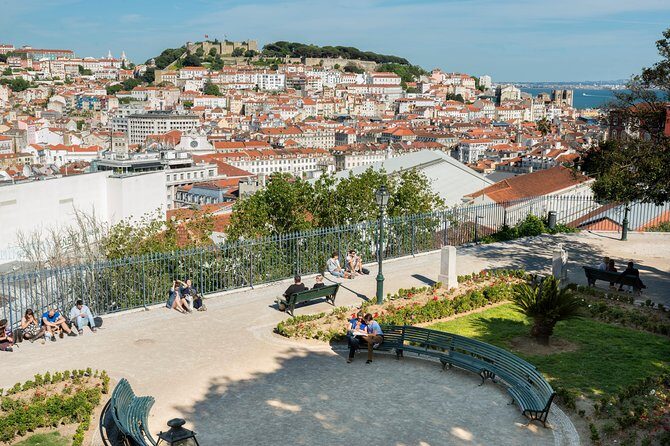
The tour then moves to Miradouro das Portas do Sol in Alfama (about 20 minutes). This viewpoint is named for the old Porta do Sol, once integrated into a Moorish fence of Lisbon—then damaged in the 1755 earthquake. From here you’ll see the city’s eastern zone, plus the Tagus River, and you can line up what you later want to explore on foot in Alfama.
This is also one of those stops where the “why” matters. Alfama is famous for its maze of narrow streets, but from Portas do Sol you can understand how the neighborhood visually feeds toward the river.
Watch your footing. Viewpoint edges and steps can be uneven. If you’re carrying camera gear, keep one hand free.

Lisbon Cathedral (Sé): where styles mix after the city retook its ground
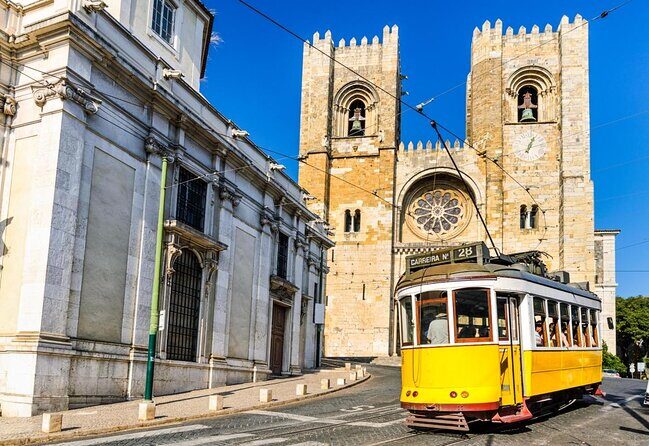
You’ll step into Lisbon Cathedral (Santa Maria Maior), linked with the Patriarchate of Lisbon and the Parish of Sé. Construction began in the second half of the 12th century after D. Afonso Henriques resumed the city from the Moors. Today, it’s described as a mixture of architectural styles and is listed as a National Monument from 1910.
I like cathedral stops on short tours because they act like anchors. When you’re seeing multiple neighborhoods in a day, a major religious landmark helps you remember the timeline.
The schedule gives you about 20 minutes, so the best approach is simple: focus on the exterior presence and ask your guide to point out the style shifts that make the building feel like an ongoing project rather than a single moment in time.
Igreja de Santo António: the St. Anthony tradition you can spot on site
Another historic church stop is Church of St. Anthony (Santo António), located in the Santa Maria Maior (Sé) area. It’s associated with the tradition that this is where St. Anthony was born, next to the old Port of the Sea within medieval Lisbon’s access wall. Beside it is a small museum dedicated to him.
What makes this stop memorable is the tradition angle. The tour information highlights the idea that young men who plan to marry visit the church, pray, and leave flowers for Saint Anthony as intercessor for newlyweds. You can also find a panel of modern tiles in the descent to the crypt celebrating Pope John Paul II’s visit in 1982.
This is a 20-minute stop, so you won’t get lost in museum hours. Instead, you’ll get a church setting that connects religion, local customs, and modern moments in one compact visit.
Parque Eduardo VII and the Águas Livres Aqueduct: Lisbon’s power to plan ahead
After the cathedral and church stops, the tour shifts from religious Lisbon to civic Lisbon.
At Parque Eduardo VII, you’ll see the largest central park in Lisbon, commonly known as Edward VII Park. It was baptized in 1903 in honor of Eduardo VII of the UK, after his visit the previous year to reaffirm the alliance between the two countries. Before that, it had been called Freedom Park.
Then comes Aqueduto das Aguas Livres, the famous water system and its grand stone arcaria across the Alcântara valley. Built in the 18th century under King João V, it’s tied to water sources in the Belas area near Sintra, with reinforcements and expansions through the 19th century. A key detail here is that it reportedly resisted the earthquake of 1755 without major damage.
I love when a tour includes infrastructure like this, because it shows a side of Lisbon that isn’t only about monuments. It’s about engineering choices that shaped daily life.
Expect about 20 minutes for each of these stops.
Jerónimos and Torre de Belém: the Age of Discoveries section of Lisbon
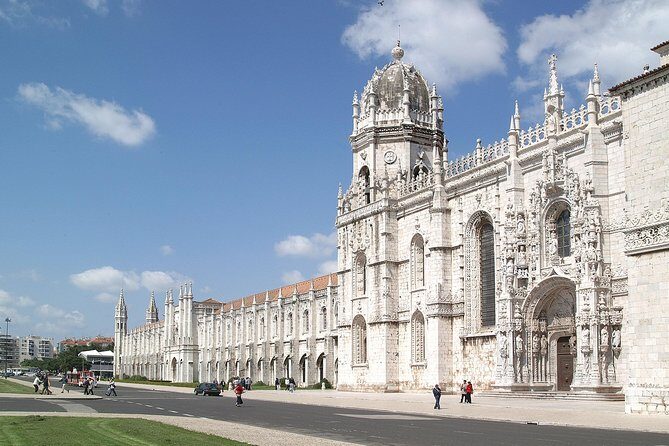
Belém is where Lisbon leans into its global past, and this itinerary builds that story in a clean sequence. You’ll visit Mosteiro dos Jeronimos (Jerónimos Monastery), a 16th-century monastery linked with the Order of St. Jerome. It’s described as a high point of Manueline architecture and is noted as Portugal’s National Pantheon status since 2016.
This stop is scheduled for 30 minutes, which is good because Jerónimos can feel like a “stand here and stare” place. Even without trying to memorize every sculptural detail, your guide can help you read what the architecture is signaling.
From there, it’s to Torre de Belém (Tower of Belém), described as originally surrounded by water around its perimeter. It’s framed as an icon of D. Manuel I’s reign, blending medieval tower tradition with a more modern bulwark for artillery defense. You’ll also get about 30 minutes here.
Then the tour adds the Padrao dos Descobrimentos (Monument to the Discoveries). It was inaugurated in 1960 and features architectural design by Cottinelli Telmo with sculptures by Leopoldo de Almeida. This is a more interpretive stop: it helps you connect what you’re seeing at the monastery and tower to the larger “discoveries” theme.
The Pastéis de Belém moment: cream pastry, old bakery vibes
The overview of this tour sets up an intentional food break in Belém: Pastéis de Belém, described as using the original cream pastry recipe that only a small number of people know, in an old bakery from 1837. Even if you don’t care about recipe lore, this is one of those Lisbon experiences that’s worth doing at least once because it’s tied to place and tradition.
Just keep expectations practical. The tour lists breakfast, lunch, and dinner as not included, so plan to pay for pastries as a personal add-on if the pricing isn’t clearly covered for you at booking.
I find this kind of stop works best when you treat it as part of the rhythm. You’re seeing monuments for hours, and then you get one local bite that makes the day feel real.
Padrao to the city core: Restauradores, Rossio, and Avenida da Liberdade
Once you leave the Belém concentration, the tour brings you back toward central Lisbon with classic Baixa and major boulevard stops.
Praça dos Restauradores is next, known for the Monument to the Restorers—a 30-meter obelisk inaugurated on April 28, 1886. This monument commemorates Portugal’s liberation from Spanish rule in December 1640. It’s a good pause point because it marks where you stop feeling like you’re in a museum zone and start feeling like you’re back in everyday Lisbon.
Then you’ll reach Praça Dom Pedro IV (the Rossio area). This square connects with the city’s older market-and-fair life, and it’s described as having been an important open space for gatherings. The tour gives you about 15 minutes, enough for orientation and a quick walk through the energy of central Lisbon.
Finally, there’s Avenida da Liberdade, one of Lisbon’s main avenues. It runs between Praça dos Restauradores and Marquês de Pombal Square, with wide walks and gardens, plus Portuguese sidewalk details. The tour keeps it around 15 minutes, which is ideal because this is more of a “see it, absorb it, remember it” boulevard stop.
Included perks and what they mean for your comfort
This tour isn’t just about sites. The included transportation details can make or break a day like this.
You’re getting private transportation (so it’s not mixed with strangers), air-conditioned vehicle, WiFi on board, and bottled water. For a 5-hour schedule that includes multiple viewpoints, water and comfort add up. WiFi is a small perk, but it helps if you’re mapping neighborhoods for later.
Also, the tour uses a mobile ticket and is described as near public transportation. That’s helpful if you want to link it with your own independent exploration afterward.
Price and value: is $115.19 a fair deal?
At $115.19 per person for about 5 hours, the value depends on what you want from Lisbon on day one.
If your priority is efficient orientation—views, historic stops, and Belém monuments without the stress of planning the route—this price can feel fair, especially with a small group of up to 8 and private vehicle support. You’re paying for time saved and for a guide who can explain what you’re seeing and why those places matter.
If you already know Lisbon well and mainly want to wander at your own pace, you might feel the structure is limiting. But for most first-timers, this kind of guided route is one of the fastest ways to build confidence and pick what you’ll return to later.
Who should book this Lisbon tour
This tour fits best if:
- you want a guided intro without a huge crowd,
- you like viewpoints and want help understanding the city’s shape,
- you want Belém highlights in one go, including the Pastéis de Belém stop,
- you value a guide’s explanations and well-paced stops.
It’s less ideal if you have limited mobility and find stairs or standing for viewpoints difficult. It’s also not the best match if you hate guided time limits and prefer to linger on your own.
Should you book this Lisbon small group tour?
I’d book it if you’re arriving in Lisbon and want the city to click quickly. The combination of miradouros, major historic buildings, and Belém monuments gives you a strong first-day foundation, and the small group size makes the experience feel personal without becoming slow.
If you’re budgeting time for later self-guided walks, this is a smart start. You’ll see enough to know where you want to return—especially around Alfama and Belém—while you let the driving and route logic do the heavy lifting for you.
FAQ
How long is the Lisbon Small Group Tour?
It runs for about 5 hours.
How many people are in the group?
The tour is limited to a maximum of 8 people.
Where is the meeting point?
The meeting point is Pç do Marquês de Pombal 8, 1250-160 Lisboa, Portugal.
What time does the tour start?
The start time is 9:30 am.
What’s included in the price?
Included items are an air-conditioned vehicle, private transportation, WiFi on board, and bottled water.
Are breakfast or meals included?
No. Breakfast, lunch, and dinner are listed as not included.
Can I cancel for a full refund?
Yes, free cancellation is available. You can cancel up to 24 hours in advance for a full refund.
What if weather is poor on the day?
The tour requires good weather. If it’s canceled due to poor weather, you’ll be offered a different date or a full refund.