REVIEW · LISBON
Lisbon River Boat Sightseeing Tour with a Drink
Book on Viator →Operated by Blue Cruises · Bookable on Viator
Lisbon changes fast when you watch it from the water. This Tagus River cruise gives you a smooth, photo-friendly way to clock major waterfront landmarks, while the English audio helps you connect the buildings to Portugal’s bigger story. You’ll sail for about 1 hour 40 minutes, and you can pick from multiple departure times to match your day.
What I like most is the way this cruise helps you get your bearings quickly, especially if you plan to explore neighborhoods on foot afterward. I also like the self-guided setup: you’re not stuck listening to one pace for the whole trip, and the audio can fit how you’re looking out the windows. One real drawback to plan around: on busier days, the upper deck can get hot and crowded, and ventilation can be limited if windows stay shut or partially open.
In This Review
- Quick Take Before You Go
- Why This Lisbon Tagus Cruise Works for First-Timers
- Getting Onboard: Seats, Timing, and the Drink You’ll Actually Get
- The Blue Cruises App and Audio Commentary Reality Check
- Following the Route: What Each Landmark Is and How to See It Best
- Praça do Comércio (Terreiro do Paço): Lisbon’s Rebuilt Front Door
- 25 de Abril Bridge: Golden Gate Color, Bay Bridge Shape
- MAAT and Tejo Power Station: Art, Architecture, and Old Industry
- Monument to the Discoveries (World Exhibition Origins): A Beacon That Became Permanent
- The Late Gothic Manueline Monastery: Lisbon’s UNESCO-Level Craft
- Belém Tower: A Ceremonial Gateway Built for Sailors
- Bugio Lighthouse: The Estuary Marker
- Christ the King (Almada): Lisbon’s Giant Embrace
- São Jorge Castle and the Alfama Slope: Medieval Power Meets Surviving Streets
- Comfort and Heat: How to Avoid the Worst-Day Experience
- Is It Worth $22.83? Value vs. What You Must Manage
- Should You Book This Lisbon River Boat Tour?
- FAQ
- How long is the Lisbon river boat sightseeing tour with a drink?
- Where does the tour start and end?
- What languages is the tour offered in?
- How do I listen to the commentary during the cruise?
- Is there Wi‑Fi on the boat for the audio?
- Is food or drink allowed on the boat?
- What drink is included with my ticket?
- How many people are on the tour?
- Are service animals allowed?
Quick Take Before You Go
- A fast orientation tool: you’ll spot landmarks that later make sense when you walk Lisbon’s streets
- English audio via the Blue Cruises app: listen through your phone, not by onboard announcements
- Best views come from choosing your spot early: shade is limited, especially on the top deck
- Included drink, but details vary: some sailings feel like wine and sweet drinks, others lean toward orange juice or water
- This is a sightseeing cruise, not a step-off tour: you mainly watch from the boat, so good weather matters
Why This Lisbon Tagus Cruise Works for First-Timers
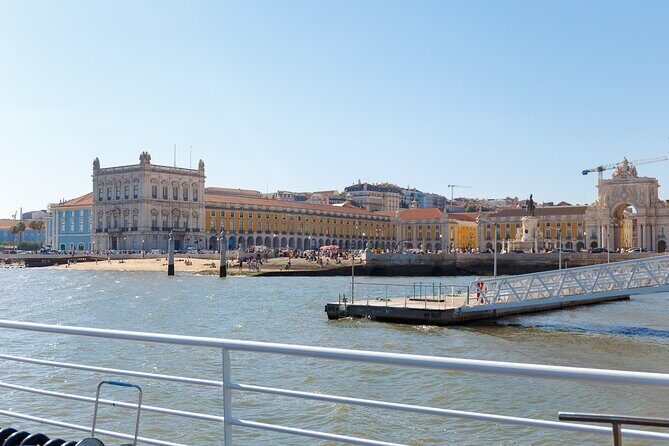
If you’re trying to do Lisbon without turning the trip into a sprint, this type of river cruise is a smart move. In under two hours, you’re moving along the Tagus and picking up a “map in your head” for later. Praça do Comércio, the 25 de Abril Bridge, and the Belém waterfront all line up in a way that’s hard to recreate from street level.
The price is also easier to justify when you think about what you’re buying. At about $22.83 per person, you’re paying for time on the water, big sightline views, and an audio guide experience that runs at your pace. It’s not a private tour and it’s not meant to replace walking tours. It’s meant to get you oriented and relaxed, then send you back ready to explore.
The ship runs with a maximum of 150 travelers, which is large enough for smooth scheduling but small enough that you can usually find a decent viewpoint if you get on early. This is also one of those activities that works well even if you’re not super into museums. The “museum” here is the city itself from the waterline.
You can also read our reviews of more boat tours in Lisbon
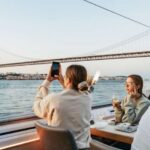
Getting Onboard: Seats, Timing, and the Drink You’ll Actually Get
The tour meets at Estação Fluvial Sul e Sueste, on Av. Infante Dom Henrique 1B (1100-016 Lisboa). After the cruise, it ends back at the same spot, so you’re not stuck figuring out transport afterward.
You’ll have three departure times during the day, so you can match your sail with your energy level. If you’re heat-sensitive, you’ll want to think carefully about when you go. Some experiences described an uncomfortably hot interior with limited fresh air and windows that don’t open much. The upside is that there’s outdoor seating too, but the top deck can fill fast.
Here’s the practical move I’d make: arrive early enough to grab the best position you can. Reviews and responses strongly suggest that the best outdoor areas are first-come, first-served, and that access to the top outside deck can be restricted by maritime rules. If you want shade, aim for it early, because once the boat is full, options shrink.
About the included drink: the ticket includes a drink during the cruise, and you may find it offered as something like sweet wine or orange juice depending on your sailing. Other accounts describe the included option as orange juice or water, and mention that the drink isn’t always truly a choice. So treat the drink as an included bonus, not a guaranteed bar order.
Also note a key onboard rule: it’s not possible to bring food or drinks onto the ship. If you’re used to packing snacks for long days, plan your food before you board.
The Blue Cruises App and Audio Commentary Reality Check
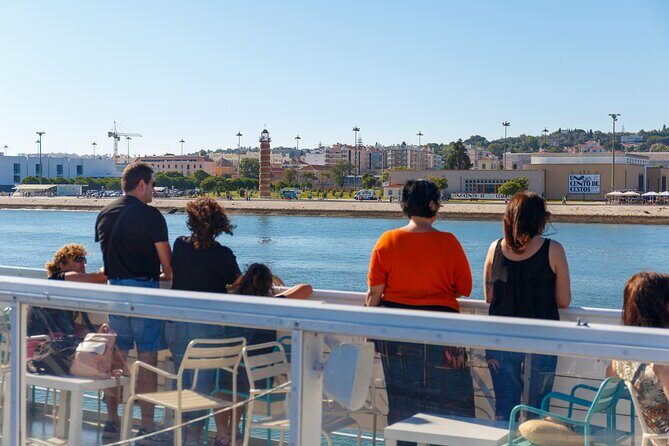
This is an audio-driven experience. Instead of a live guide narrating from the deck, you get audio commentary through the Blue Cruises app, typically accessed by scanning a code during the trip. Reviews also highlight the importance of having the audio work on your phone and pairing it with headphones.
A few practical points to make the audio work well:
- Download or get ready to access the app before you step onboard. Some reports mention no Wi‑Fi on the boat, so you shouldn’t count on streaming.
- Bring headphones if you want the commentary to be clear, not drowned out by boat noise.
- Expect that the experience may be more “self-directed” than “announced.” Some people noted there were no onboard announcements, so your phone becomes the guide.
There are also occasional mismatches reported between audio and what you see outside, especially when conditions aren’t perfect. Bad weather can reduce visibility, and audio timing can feel off. That’s not a deal-breaker if you’re mainly using the cruise as a visual tour. But if you want tight narration synced to every landmark, you’ll feel more confident when the weather is clear.
Following the Route: What Each Landmark Is and How to See It Best
This cruise loops through some of Lisbon’s most iconic waterside sights, with stops you recognize later when you walk. You won’t get out of the boat at each point, so the trick is learning what you’re looking for.
Praça do Comércio (Terreiro do Paço): Lisbon’s Rebuilt Front Door
You’ll start with Praça do Comércio, a large harbor-facing plaza facing the Tagus to the south. The square is often called Terreiro do Paço in Portuguese.
What makes it worth paying attention to from the water is the rebuilding story. After the 1755 earthquake, the plaza was remodeled as part of the Pombaline downtown restoration. From the river, you get a clear sense of why this area became a seat for important Portuguese state departments in later centuries.
How to use it: treat it as your “anchoring landmark.” When you later enter Alfama or head toward Baixa, knowing where this waterfront hub sits helps everything feel less confusing.



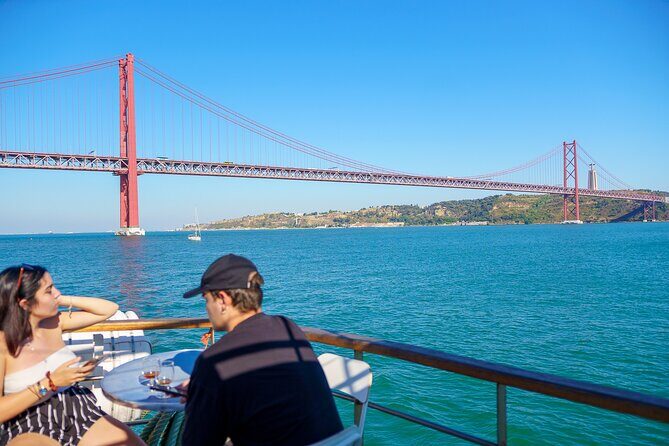
25 de Abril Bridge: Golden Gate Color, Bay Bridge Shape
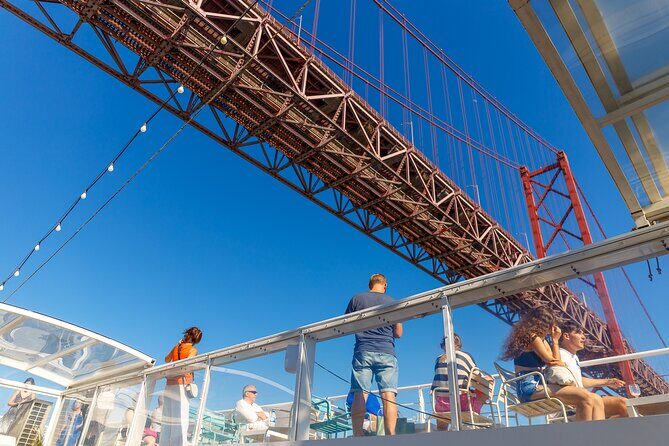
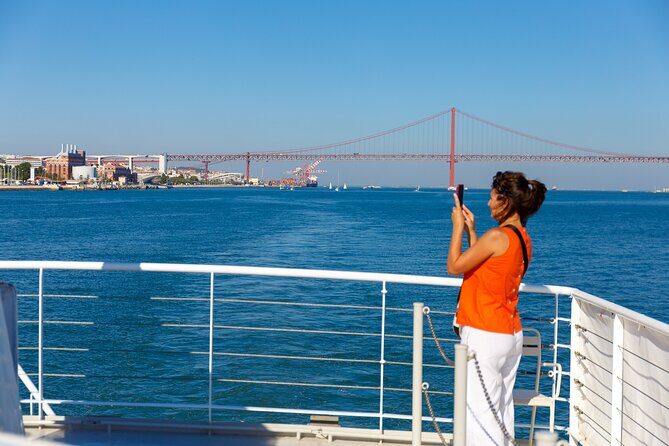
Next comes the 25 de Abril Bridge, the bridge originally named Salazar Bridge (from 1966 to 1974). After the Carnation Revolution, it was renamed for April 25, the date of that uprising, and it’s also commonly called the Tagus River Bridge.
What makes this bridge interesting is its design lineage. It’s based partly on two bridges from the San Francisco Bay Area, and its International Orange paint is the same color family as the Golden Gate Bridge. The connection to the same builder company is also a nice detail to listen for in the audio.
Photo tip: when you see the bridge from the river, you understand the scale fast. It’s one of the best “Lisbon is modern too” moments on the water.
MAAT and Tejo Power Station: Art, Architecture, and Old Industry
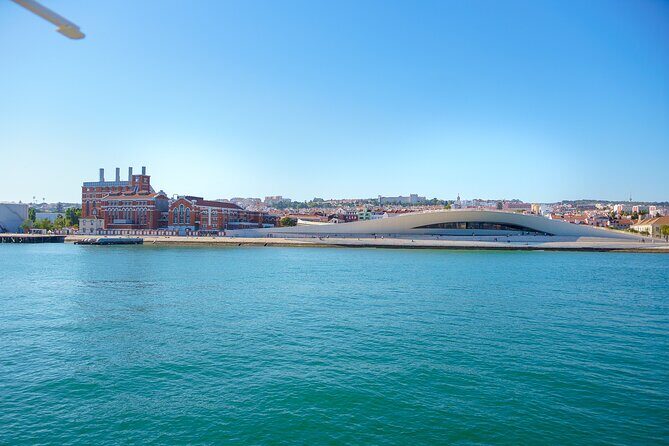
Around the riverside area west of the city center, you’ll pass MAAT. MAAT is focused on Art, Architecture, and Technology, and the museum building sits along the Tagus. The structure is designed by Amanda Levete Architects, and it’s described as creating a lyrical connection between the modern building and the nearby Tejo Power Station.
The Tejo Power Station is one of Portugal’s most prominent examples of early 20th-century industrial architecture and is among the most visited museums in the country. From the cruise, you get a rare sense of how Lisbon repurposes heavy industry into cultural space.
How to see it best: watch for how the buildings relate to the river edge. From a street viewpoint, that connection can feel hidden. From the water, it’s more obvious why this area became a cultural destination.
Monument to the Discoveries (World Exhibition Origins): A Beacon That Became Permanent
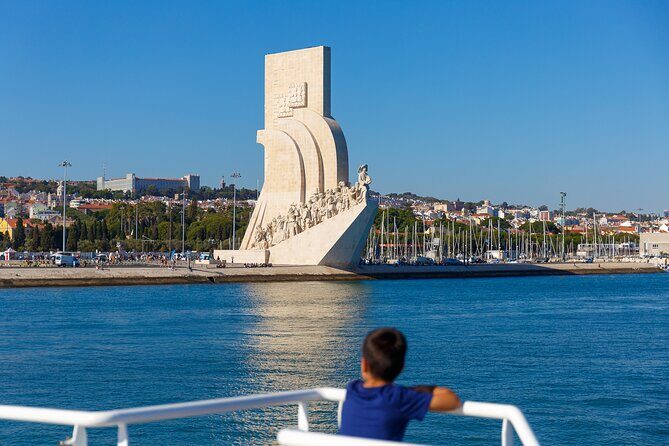
The route also includes the Monument conceived in 1939 by architect José Ângelo Cottinelli Telmo and sculptor Leopoldo de Almeida. It started as a temporary beacon for Portugal’s World Exhibition opening in June 1940. Later, the permanent version was built in 1960 to celebrate the fifth centennial of the death of Infante Henry the Navigator.
If your interest in Portugal is more than just beaches, pay attention here. This is where you visually connect Lisbon to the age of exploration. From the water, the scale hits different, and you’ll likely recognize it later if you visit Belém’s historic zone.
The Late Gothic Manueline Monastery: Lisbon’s UNESCO-Level Craft
The cruise also covers the nearby monastery, a major example of Portuguese Late Gothic Manueline architecture. It was classified as a UNESCO World Heritage site, along with the nearby Tower of Belém, in 1983.
The practical way to appreciate Manueline details from a boat is to focus on silhouette and craftsmanship lines: the shape, stonework rhythm, and how the complex sits against the waterfront.
Drawback to note: if the weather gets hazy or the light isn’t great, you’ll feel more “context” than “detail.” Still, the overall form is worth tracking.
Belém Tower: A Ceremonial Gateway Built for Sailors
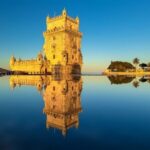
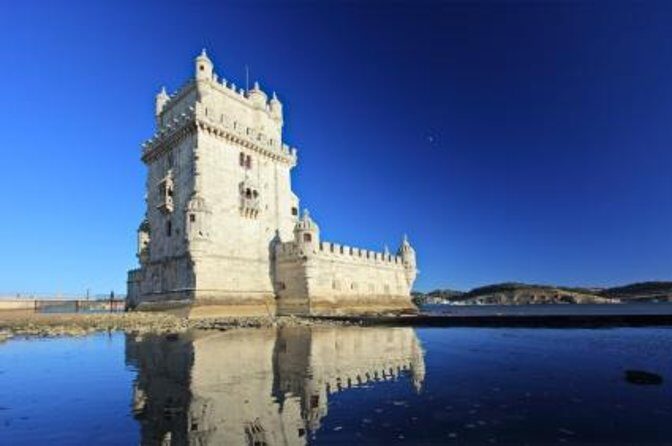
You’ll also see the Belém Tower (officially the Tower of Saint Vincent). This 16th-century fortification functioned as a point of embarkation and disembarkation for Portuguese explorers, and it served as a ceremonial gateway to Lisbon.
It’s UNESCO-listed since 1983, and from the river it works like a visual bookmark: you can spot it, then immediately understand why Belém became so closely linked to exploration.
Photo tip: Belém Tower looks best when you give it a clean river background. If you’re on the crowded top deck, try to angle yourself so the tower isn’t framed through dirty glass or smudged windows.
Bugio Lighthouse: The Estuary Marker
The Bugio Lighthouse sits on an island in the Tagus estuary, on the Fort of São Lourenço do Bugio. It’s not always the “wow” landmark people plan around, but it’s a great reminder that this river cruise isn’t just about old monuments. It’s about Lisbon’s geography and how ships once navigated this approach.
If you want something slightly different from the typical postcard scene, this is the stop that does it.
Christ the King (Almada): Lisbon’s Giant Embrace
In the Almada area, you’ll get views of the Sanctuary of Christ the King, a Catholic monument dedicated to the Sacred Heart of Jesus Christ. The figure forms a cross with arms extended toward Lisbon, like it’s embracing the city.
Comparisons have been made to Rio’s Christ the Redeemer in the way it faces a city below. From a distance, it can read more symbol than subject. Still, it’s a strong “Lisbon from above/beyond” moment that adds variety to the cruise.
São Jorge Castle and the Alfama Slope: Medieval Power Meets Surviving Streets
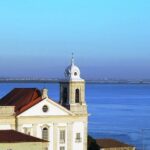
Finally, you’ll circle back toward São Jorge Castle, set on a hill and central to Lisbon’s long history. Since the 12th century, it has served multiple roles: royal palace, military barracks, home of the Torre do Tombo National Archive, and now a national monument and museum.
Below it is Alfama, the city’s oldest district, stretching from the castle down toward the Tagus. The name comes from Arabic Al-hamma, meaning fountains or baths. And here’s a helpful historical detail: the 1755 Lisbon earthquake caused considerable damage across the capital, but Alfama survived with relatively little damage.
You’ll also pass over the idea of Mouraria, a more traditional neighborhood that takes its name from Muslims who remained after the reconquest, and were confined to that part of the city.
How to use this part of the cruise: treat it as your “walking route preheat.” If you plan to explore Alfama afterward, you’ll know where to aim.
Comfort and Heat: How to Avoid the Worst-Day Experience
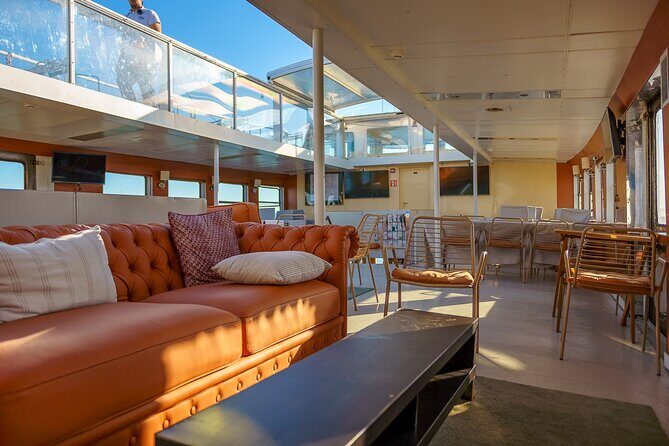
This tour can be brilliant on a clear day. It can also be hard when the boat is full and the sun is relentless. Some accounts describe the upper deck getting crowded quickly, with people limited to areas exposed to sun and with limited shade. Others describe warm interior conditions, with windows that don’t open much and limited fresh air.
So I’d plan like this:
- Choose an earlier departure time if you can, especially in summer heat.
- Get on early to improve your odds for shade and better airflow.
- Bring a hat and light layer. Reviews specifically recommend a hat and jacket for sun and wind.
- Make sure your phone battery is topped up before you board since you may not have reliable Wi‑Fi.
If you’re traveling with kids or anyone who gets heat easily, I’d treat deck comfort as the main factor, not the audio. This isn’t a climate-controlled experience.
Also, keep your expectations grounded about onboard service. Some experiences mention friendly staff and others mention more limited interaction. In most cases, the staff works within safety and maritime constraints, especially around deck access and window ventilation.
Is It Worth $22.83? Value vs. What You Must Manage
At around $22.83 per person for roughly 1 hour 40 minutes, this cruise can be good value if you want sightseeing with minimal hassle. You get:
- Major waterfront landmarks
- English audio guidance through your phone
- A drink included with the ticket (though the exact drink may vary)
- A relaxed pace that fits into a packed schedule
Where it can feel like less value is when you expect a fully narrated, step-by-step guided tour. On this format, you’re doing more of the listening yourself through the app. When audio doesn’t work well, or doesn’t match what you see, the experience can drop from “guided” to “just looking out a window.”
Another value question is comfort. If you’re paying for comfort but the top deck is crowded and the inside stays hot, you’ll notice it fast. In that case, it might be worth spending a bit more on a different style of boat tour with better ventilation or fewer people—something hinted at in alternative suggestions people made.
My “value test” for you is simple: if you’re the type who enjoys spotting landmarks, taking photos, and listening at your own pace, you’ll probably feel satisfied. If you want live guide narration and a lot of onboard comfort, you’ll want to weigh that carefully.
Should You Book This Lisbon River Boat Tour?
Book it if you want an easy way to connect Lisbon’s waterfront landmarks into one visual storyline. This works especially well as a first-day or mid-trip reset when you’re trying to get your bearings. The included audio is handy when it’s working, and the cruise format is a nice break from hills and walking.
Skip it or choose another style if:
- Heat and crowded spaces are a concern for your group
- You strongly prefer live commentary over app-based audio
- You’d feel frustrated by limited ventilation or the chance you may not get the best deck position without arriving early
If the forecast looks good and you plan to grab a comfortable spot right away, this cruise can be a calm, cost-effective way to see a lot of Lisbon without draining your feet.
FAQ
How long is the Lisbon river boat sightseeing tour with a drink?
It lasts about 1 hour 40 minutes.
Where does the tour start and end?
It starts at Estação Fluvial Sul e Sueste and ends back at the same meeting point.
What languages is the tour offered in?
The tour is offered in English.
How do I listen to the commentary during the cruise?
You access the audio using the Blue Cruises app, typically after scanning a code. Many people recommend using headphones.
Is there Wi‑Fi on the boat for the audio?
No Wi‑Fi is mentioned in some reports, so it’s smart to be ready before boarding.
Is food or drink allowed on the boat?
You can’t enter the ship with food or drinks.
What drink is included with my ticket?
Your ticket includes a drink, but some experiences mention it may be orange juice or water, while others describe options like sweet wine. If you care about a specific drink, plan to ask onboard.
How many people are on the tour?
There is a maximum of 150 travelers.
Are service animals allowed?
Yes, service animals are allowed.