REVIEW · LISBON
Tuk Tuk Lisbon: Exploring Urban Art
Book on Viator →Operated by TukGuide Portugal · Bookable on Viator
Street art in Lisbon feels personal. This tuk tuk tour strings together some of the city’s most famous urban works, then adds guiding that helps you read what you’re seeing. I like the mix of big outdoor murals and specific artist context, so the art doesn’t blur into one colorful wall. I also like that the experience is built around short, efficient stops in a tight 2–3 hour window. One drawback to plan for: it’s not recommended for pregnant travelers or people with reduced mobility, so you’ll want to think about comfort and getting on/off the tuk tuk.
The route leans toward the parts of Lisbon where street art has become part of the neighborhood identity. You’ll start near Santa Apolónia, work through murals tied to Graça and other key streets, and finish back where you started. If you want a fast way to understand Lisbon’s urban art scene without spending half a day chasing coordinates, this is a smart choice.
In This Review
- Key things you’ll notice on this tour
- Lisbon Street Art, Served in a Tuk Tuk Ride
- What You Pay for: $93.73 for 2–3 Hours of Urban Art
- Pickup That Fits Real Life: Hotels, Airbnb, and Cruise Terminals
- How Photo Stops Work (and Why Traffic Matters)
- Stop-by-Stop Murals: Santa Apolónia and Santa Clara Field
- Vhils in Travessa das Merceeiras: When Street Art Looks Like Carving
- Graça’s Literary Faces: Sophia de Mello, Natália Correia, Florbela Espanca
- Avenida Fontes Pereira de Melo: Big Names on Busy Streets
- Lx Factory Wrap-Up: Bordalo II and the Creative Factory Feeling
- Should You Book Tuk Tuk Lisbon Exploring Urban Art?
- FAQ
- How long is the Tuk Tuk Lisbon Exploring Urban Art tour?
- What does the tour cost?
- Is pickup available, and where do they pick up?
- Where is the meeting point, and do you return to it?
- Is the tour private?
- What language is the tour guided in?
- What’s included, and what’s not included?
- Is there a mobile ticket?
- Is it suitable for children?
- What’s the cancellation policy?
Key things you’ll notice on this tour
- Private guide + private tuk tuk: Your group controls the pace, not the crowd.
- Artist names with real meaning: You get who made it and why the style matters.
- Huge-scale works: Expect walls that are hard to picture until you see them in place.
- Photo-friendly stops: Some guides allow flexible stopping for photos when traffic allows.
- A finish at Lx Factory: You end in a creative hub with well-known street-art work.
- Built for short time windows: It’s designed to pack a lot into 2–3 hours.
Lisbon Street Art, Served in a Tuk Tuk Ride
Lisbon has a street-art personality that changes street to street. One moment you’re looking at a mural that feels like sculpture; the next you’re staring at a tile wall so large it looks like it was built for a whole movie set. This tour helps you connect those dots fast, because it’s not just sightseeing—it’s a guided walk-through of visual ideas.
The tuk tuk format matters. It keeps you from burning your day on transit while still getting you close to the art. You’re also less dependent on lining up buses or walking longer stretches than you planned.
And the guiding is the difference between pretty walls and understanding the message. When the guide gives names, context, and style notes—like why certain artists use coarse brushstrokes or why a tile mural becomes a wall-wide statement—you’ll leave with a mental map that actually makes the city easier to explore later on your own.
You can also read our reviews of more tours and experiences in Lisbon.



What You Pay for: $93.73 for 2–3 Hours of Urban Art
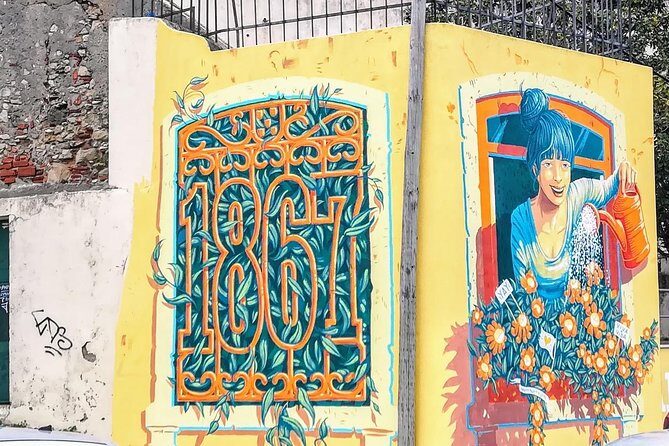
The price is listed at $93.73 per person for about 2 to 3 hours. That can sound like a lot if you compare it to a basic walking tour, but here you’re paying for private transportation plus a private guide. If you’re traveling as a small group, it also lines up well with the idea of paying once for an experience that saves time and coordination.
You also get a mobile ticket, plus the tour runs in English. There are group discounts, which is helpful if you have friends or family joining in. And since food and drink aren’t included, you keep the day flexible—grab a pastry or coffee before or after, rather than feeling pushed into a specific meal.
The main value question is simple: do you want art context without doing the research? If yes, this format usually feels worth it.
Pickup That Fits Real Life: Hotels, Airbnb, and Cruise Terminals
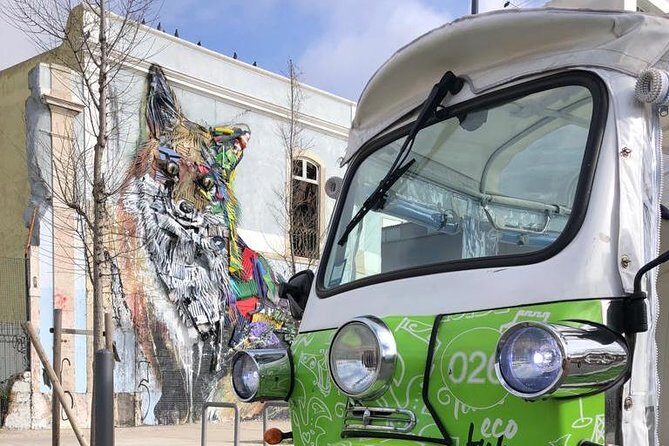
Pickup is offered at many convenient spots. You can be collected from Lisbon hotels and Airbnbs near the historic center, from the three cruise terminals, and from restaurants or other places close to the historic center that serve guests. The company even notes a couple of practical meeting ideas like Time Out Market and Alto do Parque Eduardo VII—places that are easy to find and work well if your hotel is tucked away.
This is one of those details that can save your vacation. In Lisbon, some streets are tight and parking can be tricky, so having pickup close to the neighborhood you’re staying in reduces the friction.
The tour ends back at the meeting point. That means you can plan your next step without guessing where you’ll be dropped off—nice when you’re coordinating dinner plans or another activity.
How Photo Stops Work (and Why Traffic Matters)
Street art photography is where tours either help or get in the way. Here, the structure is designed for seeing art clearly up close, not just riding past. The tour includes multiple mural areas, which means you’ll likely have moments to stand, look, and take pictures without feeling like you’re sprinting.
One tip from real tour experiences: guides may allow flexible stopping for photos if traffic lets them. That can be a big deal when you’re trying to get the whole piece in frame, not just a corner.
Plan to do this with a little patience. Lisbon traffic isn’t a myth, and even the best route may require small adjustments. In exchange, you get to focus on art instead of constantly checking directions on your phone.
Stop-by-Stop Murals: Santa Apolónia and Santa Clara Field
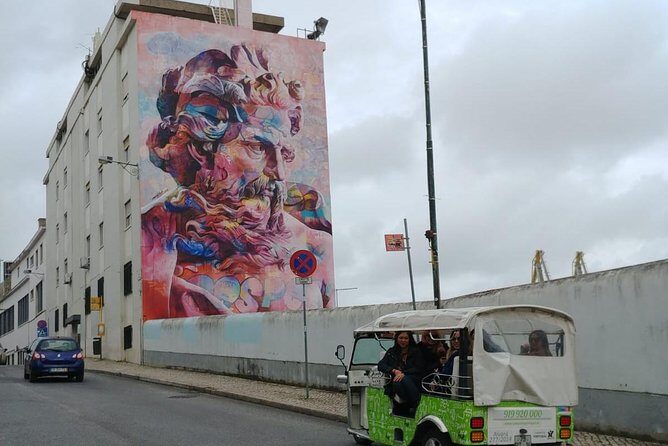
This route starts with a big statement piece near the Sidewalk of Santa Apolónia. You’ll see the Pichi&Avo statue on Calçada de Santa Apolónia—a sculptural figure layered over what’s described as infinite tags on the building side. Pichi&Avo are known for pairing classic art-like structure with graffiti rebellion. The artwork includes a contrast you’ll notice in person: coarse brushstroke energy met with more careful drawing.
Why this stop works: it teaches you how Lisbon street art often mixes styles on purpose. It’s not just color for decoration—it’s a deliberate blend of respect for art traditions and refusal to behave like a museum piece.
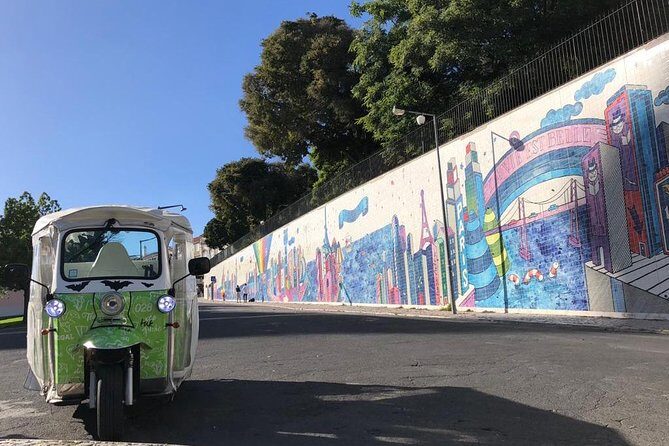
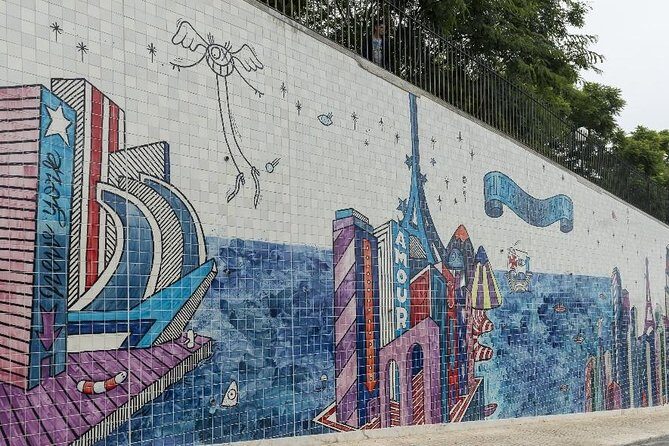
From there, the tour heads to the Santa Clara Field area, tied to the old wall of Jardim Botto Machado at Campo de Santa Clara / Feira da Ladra. Here you’ll find an André Saraiva tile mural that covers 170 meters of wall with about 53,000 tiles across roughly 1000 m². That scale is the whole point. From a distance it can look like a graphic scene; up close, tile-by-tile detail becomes part of the story.
What you should expect: a mural that feels engineered rather than painted. It’s also the kind of work that changes depending on where you stand—so don’t rush your photos. Even a few extra seconds can turn a flat picture into something that feels alive.
Potential drawback for this part of the route: with so many photo angles, you might feel tempted to linger longer than the tight schedule allows. The tour is designed to keep momentum, but you can still take breaks if you’re strategic with your shot list.




Vhils in Travessa das Merceeiras: When Street Art Looks Like Carving
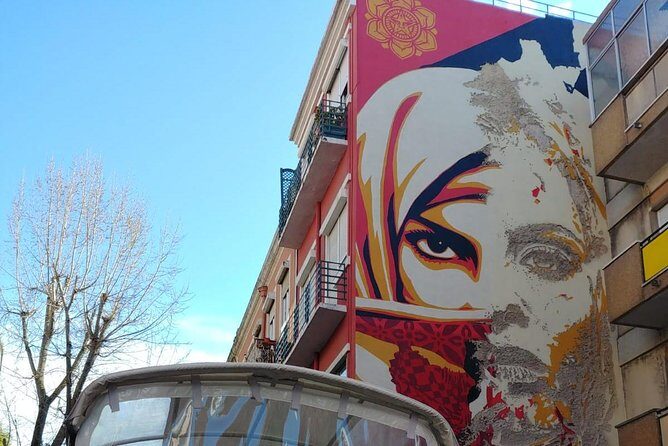
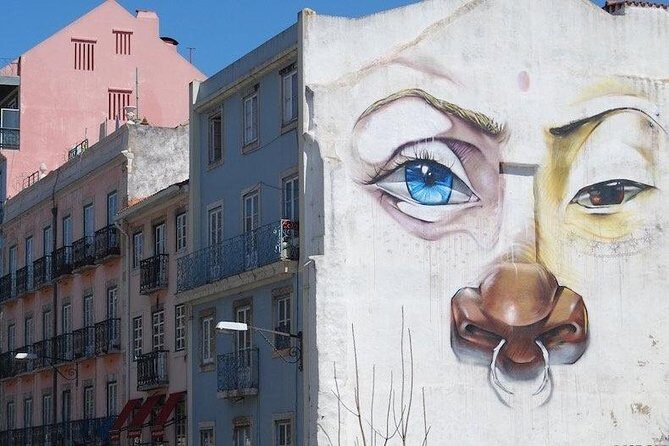
Next up is Vhils, the urban art name of Alexandre Farto. This one is described as a face hidden in Travessa das Merceeiras—one of those works you’d miss if you didn’t have a route and a guide.
Vhils is a name you’ll want to remember because his style is so distinct. The idea here is that his work can feel carved out, like the wall has been sculpted from within. That’s why the viewing angle matters; depending on where you stand, the image can look more like relief sculpture or more like street mural.
Why I think this stop is valuable: it turns your street-art eyes on. After seeing a tile wall and a layered tag-and-statue piece, you’re ready for a work that reads differently. This is also where you start seeing why urban art in Lisbon isn’t just about surface. It’s about texture, technique, and finding meaning in placement.
Graça’s Literary Faces: Sophia de Mello, Natália Correia, Florbela Espanca
One of the tour’s smarter moves is that it doesn’t keep everything limited to anonymous street art vibes. You’ll see artists honoring figures in Portuguese literature tied to the Graça district. The route includes artworks and then points you toward nearby viewpoints.
You’ll find the face of Sophia de Mello Breyner made by Eime on Rua Josefa de Óbidos. Then there’s Natália Correia and Florbela Espanca portrayed in Travessa do Monte in a work by Mariana Dias Coutinho. Near these areas, the tour also connects you with the viewpoints of Graça and Senhora do Monte.
What makes this part work for you: it links art to identity and place. If you’ve ever felt like Lisbon street art was just a cool backdrop, this section gives it a stronger narrative. You’re not only looking at style; you’re reading how artists choose cultural references that locals care about.
If you like city views, this is also the moment to slow down. Viewpoints can be quick stops or the best part of a tour, depending on timing and your interest. Since the tour includes those viewpoints by design, you’re not stuck wondering where to go next.
Avenida Fontes Pereira de Melo: Big Names on Busy Streets
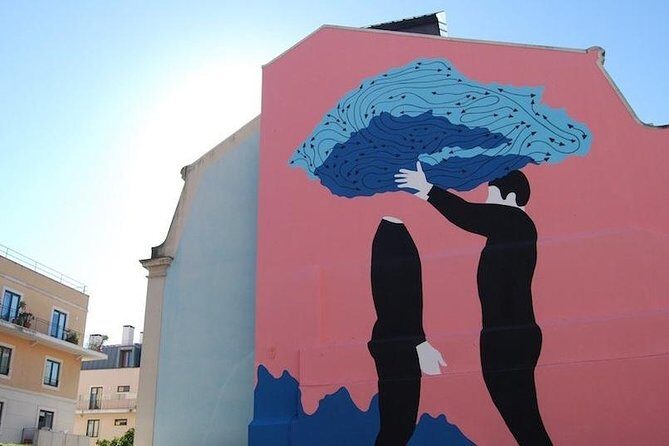
As you move to Avenida Fontes Pereira de Melo, the tour shifts from local-literature themes to international street art. This section focuses on works in three vacant buildings on one of Lisbon’s busiest avenues.
Here you’ll see contributions from several international artists, including the Brazilians Os Gémeos, the Italians Blu and Eric Il Cane, and the Spanish artist Sam3. One detail worth noting: the work is described as being considered one of the 10 best in the world by the British newspaper The Guardian.
Why it matters: even if you don’t know these artists, this stop shows you how street art can become globally recognized. It’s not only a local phenomenon; it can land on major media radars and still remain firmly tied to a specific street.
Practical note: busiest avenues can limit how long you can linger. So think of this as a stop for seeing well, not just taking an endless number of photos.
Lx Factory Wrap-Up: Bordalo II and the Creative Factory Feeling
The tour finishes at Lx Factory, Lisbon’s well-known creative hub. The description highlights that there are always more than a dozen works there, featuring renowned names.
One standout mentioned is Bordalo II with a huge bee made of garbage. Even if you’ve seen similar ideas in other cities, Lisbon’s version tends to feel grounded in the city’s street-art humor and critique.
This ending location is more than a victory lap. It gives you a smooth transition after outdoor murals. Instead of only moving between walls, you land somewhere designed for browsing and lingering, which is great if you want extra photos or want to compare different styles in one area.
It also helps you keep your day flexible. Since food and drinks aren’t included, you can decide at Lx Factory whether you want a quick snack, a coffee, or nothing at all and just enjoy the art on your own terms.
Should You Book Tuk Tuk Lisbon Exploring Urban Art?
Book this tour if you want:
- A fast, structured way to see multiple major street-art works in a short window
- Artist context that turns walls into stories
- A private guide and a more relaxed ride compared to doing everything on foot
Skip it (or be cautious) if:
- You need a tour that’s explicitly suitable for reduced mobility or pregnancy-related comfort, since this isn’t recommended for those cases
- You plan to bring very young kids, because children under 7 aren’t allowed
- You’d rather wander without structure. This tour is efficient, so it may feel a bit scheduled if you like long free-form exploration
If your goal is to understand Lisbon’s urban art scene quickly—and then use that understanding to spot more on your own later—this is a strong bet. The route covers a range of styles (tile mural scale, carved-face imagery, tagged street surfaces, and international artists) so you come away with street-art eyes that work.
FAQ
How long is the Tuk Tuk Lisbon Exploring Urban Art tour?
It runs about 2 to 3 hours.
What does the tour cost?
The listed price is $93.73 per person.
Is pickup available, and where do they pick up?
Pickup is available from Lisbon hotels and Airbnbs near the historic centre, from the three cruise terminals, and from restaurants or other nearby places that serve guests.
Where is the meeting point, and do you return to it?
The tour ends back at the meeting point. The company suggests Time Out Market and Alto do Parque Eduardo VII as meeting points because they’re usually functional.
Is the tour private?
Yes. It’s a private tour/activity, so only your group participates.
What language is the tour guided in?
The tour is offered in English.
What’s included, and what’s not included?
Included: guided tour, private guide, and private transportation. Not included: food and drinks and monuments tickets.
Is there a mobile ticket?
Yes, the tour includes a mobile ticket.
Is it suitable for children?
Children under 7 are not allowed.
What’s the cancellation policy?
You can cancel for free up to 24 hours in advance for a full refund. If you cancel less than 24 hours before the experience starts, the amount paid is not refunded.