REVIEW · LISBON
Lisbon Street Art – Private Guided Tour in a Electric Tuk Tuk
Book on Viator →Operated by The Portuguese Buddy - Tuk Tuk & Van Tours Lisbon · Bookable on Viator
Street art in Lisbon can feel like a scavenger hunt. This private electric tuk-tuk tour turns it into a smooth, story-filled ride through Graça and São Vicente, with stops that line up with big murals and key viewpoints.
I especially like two things: the on-the-ground commentary that explains what you’re seeing on the walls, and the way the route is built so you’re not spending the whole 2 hours fighting Lisbon hills and cobblestones. A fair heads-up: the tour is short, so you’ll enjoy multiple murals instead of lingering for long at any one spot.
You’ll start in Chiado (pickup is possible from your hotel) and end back there. The experience runs daily from 9:30 AM to 7:00 PM during the listed season, and it’s in English with a mobile ticket.
In This Review
- Key highlights worth planning for
- Electric tuk-tuk is the right tool for Lisbon’s graffiti routes
- Getting started in Chiado: pickup, timing, and what you actually get
- Stop 1: Miradouro da Graça and Daniel Eime’s Sophia mural
- Stop 2: Shepard Fairey x Vhils, Peace Guard, and the “turn-around” photo moment
- Stop 3: Graça & São Vicente murals, from Oze Arv to Andre Saraiva azulejo
- Stop 4: R. São Tomé 76—Bordalo II’s panda and Vhils’s Amália tribute
- Stop 5: Miradouro das Portas do Sol and the painted archway history
- What the guide adds: history, politics, and smart pacing
- Price and value for a private 2-hour mural circuit
- Who this tour fits best (and who might want a different plan)
- Should you book this Lisbon street art tuk-tuk tour?
- FAQ
- What’s the duration of the Lisbon street art private tour?
- How much does the tour cost?
- Is hotel pickup available?
- Is the tour private?
- What language is the tour offered in?
- Where do we meet, and where does it end?
- Are children allowed?
- When is the tour operating?
Key highlights worth planning for
- Electric tuk-tuk saves your legs on Lisbon’s narrow, hilly streets and uneven pavement
- Major street-art names on the route, including Vhils, Bordalo II, and Shepard Fairey (Obey Giant)
- A true landmark mural moment at Peace Guard, where positioning matters for photos
- Viewpoints are part of the art, with Miradouro da Graça and Miradouro das Portas do Sol built in
- Private means your pace, and you can steer the emphasis toward what interests you most
- Hotel pickup + free entry stops, so you spend less time figuring out logistics and more time looking closely
Electric tuk-tuk is the right tool for Lisbon’s graffiti routes
Lisbon is a city of steep streets, tight corners, and cobblestones that can wear you down fast. A ride in an electric tuk-tuk is a smart way to cover more wall space without arriving tired or sweaty, which is when you actually start noticing the details in the artwork.
The other win is flow. Instead of hopping between far-flung neighborhoods on your own, this route strings together murals and viewpoints in a way that keeps your attention on what matters: the art, the neighborhood context, and the angles for photos.
And yes, rain happens. Even if the weather turns, the tuk-tuk keeps you moving, and you still get outdoor stops where the guide helps you make the most of the moment.
You can also read our reviews of more guided tours in Lisbon



Getting started in Chiado: pickup, timing, and what you actually get
Your tour begins at Chiado (meeting point: 1200-445 Lisboa) and returns there. If you want to reduce walking right at the start, hotel pickup is available, which is a big deal in Lisbon’s “stairs to the museum” reality.
The total time is about 2 hours, so you’re looking at a tight, focused circuit. That’s great if you want breadth—seeing lots of murals and viewpoints without turning the day into a hike—but it does mean you won’t have long, slow hours to sit and read every plaque.
This is a private tour, so only your group rides. You’ll likely appreciate that if you’re traveling as a couple, small family, or a small group of friends who don’t want to compete for the best side of a mural.
Language is English, and you’ll use a mobile ticket. The operator also offers group discounts, which can help if you’re traveling with more than one family unit or a few friends.
Stop 1: Miradouro da Graça and Daniel Eime’s Sophia mural
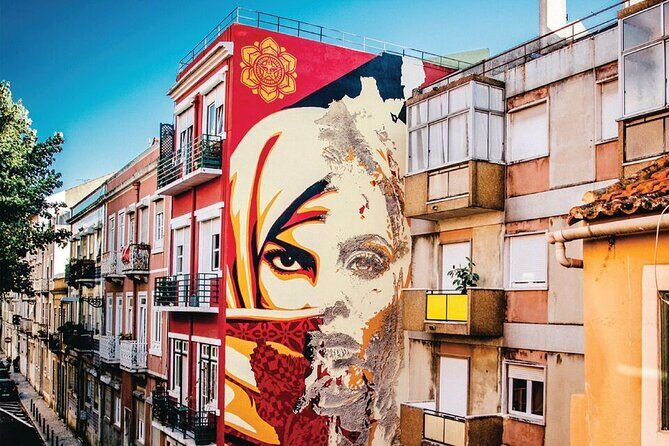
The tour starts at Miradouro da Graça, at a mural tied to the poet Sophia de Mello Breyner Andresen. This portrait mural was made by Portuguese street artist Daniel Eime, and it’s set in the Graça area—somewhere Sophia is closely associated with. The viewpoint itself is also named after her, so you’re not just looking at art; you’re stepping into a living reference.
What makes this first stop work is the mood. You get a quick visual hook, plus an anchor for the rest of the tour. If you’re new to Lisbon street art, this kind of starting point helps you understand how murals here can connect to identity, place, and memory.
Timing is short—about 10 minutes—so I’d treat this as a “look, then look again” stop. Snap a couple photos, then shift your position to see how the mural sits in the surrounding street texture.
Practical note: you’re at a miradouro, which means you’ll be outside near viewpoints. Wear shoes that work on uneven surfaces, especially if the weather is damp.
Stop 2: Shepard Fairey x Vhils, Peace Guard, and the “turn-around” photo moment
This is where the tour hits something close to an icon. Stop two focuses on a collaboration between Shepard Fairey and Vhils, with visible elements including Carnation Revolution, Fuel – adapt, and Universal personhood.
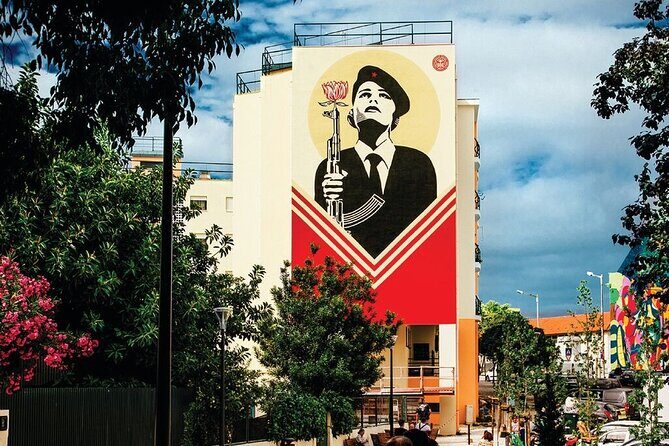
Then comes the must-do move: take a moment and turn around to view Peace Guard. The wording matters here because the angle is part of the experience. Ask your guide where the best viewpoint is from, and don’t rush past it while you’re still searching for your footing.
Peace Guard is described as the mural you can’t miss—set up in front of the most attention-grabbing kind of street art, the kind that works like a landmark. If you’ve seen Shepard Fairey’s work elsewhere, you’ll recognize his style language, but Lisbon’s version lands differently because it’s threaded through Portuguese street-art culture.
This stop runs about 30 minutes, which is plenty of time to notice the layering and step back and reassess. It’s also long enough for your guide to connect the dots between the U.S. artist’s visual vocabulary and what Vhils brings to the wall.
The best approach: let your guide talk first, then do a second pass with your camera.
Stop 3: Graça & São Vicente murals, from Oze Arv to Andre Saraiva azulejo
Stop three is a quick hop through Graça and São Vicente, where street art and neighborhood texture overlap. You’ll see works including Oze Arv and a mural by Andre Saraiva with an azulejo theme—Portuguese tile style translated into street-art scale.
This is a good moment to slow down mentally, even if you’re not slowing down physically. Azulejo traditions are part of Portugal’s visual identity, so seeing that language used in a street mural helps you understand street art here isn’t just shock value. It’s also craft, symbolism, and local references.
Time on this stop is about 10 minutes, so it’s more of a “spot it and learn the meaning” stop than a long sit-and-stare. If you care about art history, ask your guide what to look for in the tile-like design so you can catch the details fast.
If you’re more into photos, focus on texture and edges. Tile-style murals often reward close viewing, especially when you’re standing at street level.
You can also read our reviews of more private tours in Lisbon





Stop 4: R. São Tomé 76—Bordalo II’s panda and Vhils’s Amália tribute
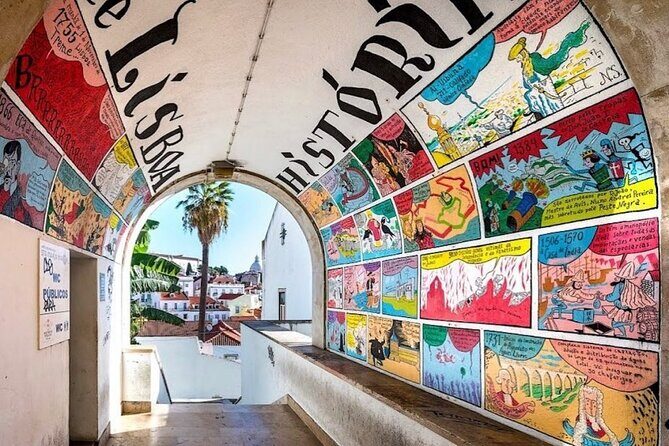
R. São Tomé 76 brings two standout pieces with very different vibes.
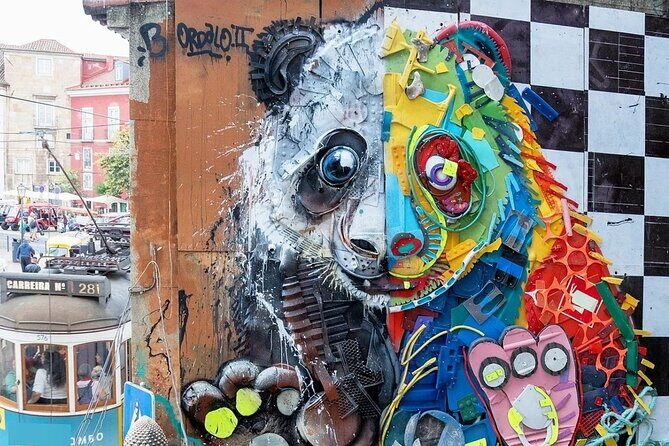
First, there’s the panda by Bordalo II. The panda was created in the context of an exhibition called Evilution, described as a neologism tied to environmental commitment and sustainability. Bordalo II is known for using nature imagery in a way that feels humorous but points at real issues, and this panda is exactly that kind of message-carrying street art.
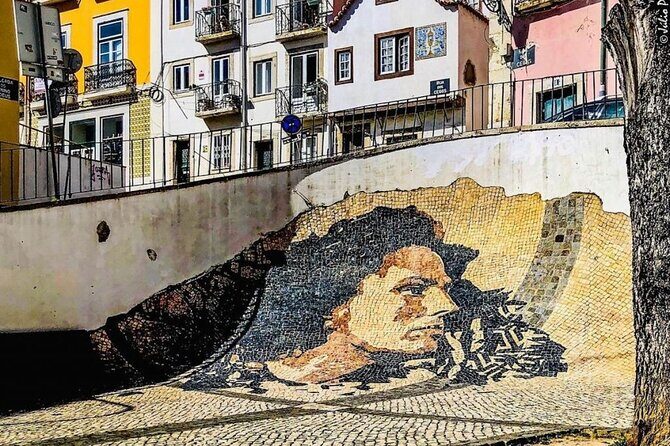
Next, you’ll see Vhils – Amalia, created on Portuguese traditional-style pavement. It’s a tribute to Amália Rodrigues, the late fado diva (1920–1999). That matters: it’s not just a portrait, it’s a cultural handshake between street art and a core musical identity of Portugal.
This stop takes about 15 minutes. That’s just enough time to register both pieces and understand the contrast—environmental commentary next to cultural homage—without rushing so hard you miss the materials and surface choices.
If you’re photographing, bring your phone close for texture shots. Works on pavement or tile-style surfaces can look bland from far away, but they sharpen when you get near and angle the light.
Stop 5: Miradouro das Portas do Sol and the painted archway history
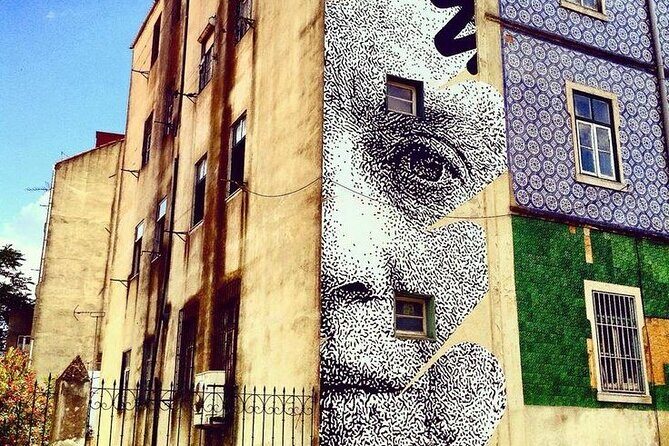
The final stop goes to Miradouro das Portas do Sol, one of those Lisbon viewpoints where the city seems to spill down toward you. Above is the viewpoint, and beneath it is a small archway with the history of Lisboa painted on.
This stop works for two reasons. First, it gives your eyes a break from the wall-level intensity of murals. Second, it connects the street-art visit to the broader story of the city—history not as a museum lecture, but as painted signage right in the walking path.
Time here is about 10 minutes. You’ll want to decide quickly: do you want the wide city view, or do you want the close-up of the archway artwork? Your guide can help you pick based on what you care about most.
For best results, give yourself a second look even if the first view feels “wow.” Lisbon viewpoints reward patience for small changes in perspective.
What the guide adds: history, politics, and smart pacing
The biggest difference between a street-art walk you plan yourself and this tour is the guide’s ability to connect art choices to Lisbon’s real context. The commentary is tied to specific pieces and artists—so you don’t just spot names, you learn why those names show up in these neighborhoods.
Across different days, guides like David, Andre, Susana, and Tiago come through with a consistent focus: history alongside art. One guide is noted for accommodating guests even on holidays, another for tailoring the tour to interests, and another for packing in more mural stops than you’d manage on foot.
You’ll also hear guides bring in cultural and even political influences, which helps explain why street art here often feels like public conversation instead of private decoration. And if you end up with a guide who’s himself an artist (there’s mention of Rumi Miguel as an artist), you may get extra clarity about technique and creative intent.
The other thing I appreciate is pacing. Multiple stops keep the tour moving, but the schedule isn’t just “drive-by photos.” You get real time windows at key pieces, like the longer Peace Guard moment, and short “scan and absorb” blocks at others.
Price and value for a private 2-hour mural circuit
At $101.97 per person for roughly 2 hours, this isn’t the cheapest way to see Lisbon. But it’s also not trying to be.
You’re paying for a few value pieces at once:
- Private guide time (so you can ask questions and adjust emphasis)
- Electric tuk-tuk transportation, which matters in Lisbon’s steep, uneven streets
- Hotel pickup availability, which reduces the friction of starting in Chiado
- A route that packs multiple mural stops plus viewpoints in one shot
- Free-entry mural viewing stops, so your money goes to experience time rather than ticket lines
If you were to do this alone, you’d spend time figuring out where to go, navigating hills, and losing time to transportation. Here, the route logic saves energy, and the commentary helps you actually understand what you’re seeing.
If you’re traveling with someone you’d otherwise book a private guide with, the cost can start to make more sense. And the operator mentions group discounts, which can help if you’re in a small crew.
Who this tour fits best (and who might want a different plan)
This tour is ideal if you:
- Love street art but don’t want to spend hours researching artists, locations, and context
- Want photos without a full-day walking grind
- Are visiting Lisbon for the first time or only have a short window for neighborhood exploring
- Care about both the art and the place, including viewpoints and local references
It may be less ideal if you:
- Want a slow, museum-style experience where you linger at one location for a long time
- Prefer purely independent exploring with no guide narrative
- Need extended time for accessibility accommodations beyond short outdoor stops (you can still do it, but the tour is designed as a compact circuit)
The good news: because it’s private, your guide can often work with your pace as you go.
Should you book this Lisbon street art tuk-tuk tour?
Book it if you want the smartest use of time for Lisbon street art. The electric tuk-tuk handles the city’s physical difficulty, and the guide’s piece-by-piece explanations help you see more than just cool images.
Skip it if you already know exactly where every mural is and you want to spend hours at a single favorite wall. In that case, self-guided exploring can be fun—but you’ll miss the “what am I looking at and why is it here” context that makes these murals click.
If you’re on the fence, I’d treat this as a great orientation tour. Even if you return later on your own, you’ll know which artists and neighborhoods deserve your next detour.
FAQ
What’s the duration of the Lisbon street art private tour?
The tour runs for about 2 hours.
How much does the tour cost?
The price is $101.97 per person.
Is hotel pickup available?
Yes, pickup from your hotel is offered.
Is the tour private?
Yes. It’s a private tour/activity, so only your group participates.
What language is the tour offered in?
The tour is offered in English.
Where do we meet, and where does it end?
You start in Chiado, 1200-445 Lisboa and the experience ends back at the same meeting point.
Are children allowed?
Yes, children must be accompanied by an adult.
When is the tour operating?
The listed hours are Monday to Sunday, 9:30 AM to 7:00 PM during 06/02/2025 to 06/01/2026.