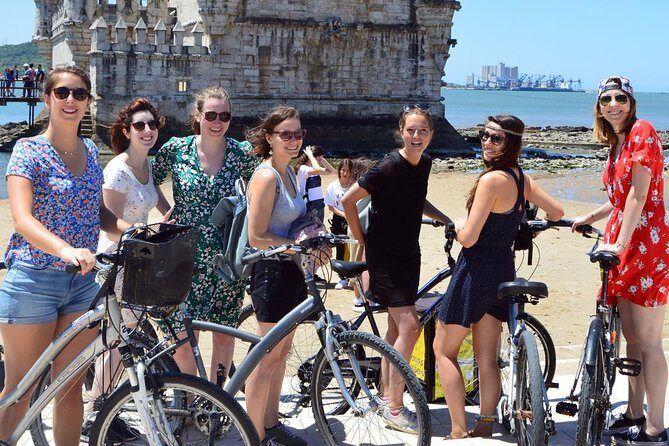
Lisbon by e-bike feels like cheating. In just about 3 hours, you roll through classic squares and viewpoints—with an e-bike and helmet—while a guide explains what you’re seeing.
I particularly like two things: you get the story behind major landmarks (tsunami, Roman Lisbon, independence), and the ride stays approachable because you’re not doing this on foot all day. The only real drawback is simple: the tour assumes you can drive a bicycle, and it’s geared to moderate physical fitness, not total beginners.
You’ll leave with a strong sense of how the city grew—from the old, winding Alfama streets to the big downtown squares—and you’ll also get food ideas for your next stop, especially around Time Out Market and Praça dos Restauradores.
In This Review
- Key highlights you’ll feel immediately
- Why this Lisbon e-bike tour makes sense in a short window
- Getting started near Rua dos Caminhos de Ferro (and what the 3 hours feel like)
- Alfama at the start: where Lisbon’s story begins
- Campo das Cebolas: the Roman port ruins you can see up close
- Praça do Comércio and the Tagus gateway (plus the tsunami story)
- Praca Dom Pedro IV, Rossio, and the Lisbon “downtown spine”
- Praça dos Restauradores: independence, theaters, and Avenida da Liberdade
- Santa Justa Elevator: a symbol, explained simply
- Miradouro da Senhora do Monte: big view, high effort made manageable
- Miradouro da Graça (Sophia de Mello Breyner Andresen): castle views and a church option
- Feira da Ladra area: market energy and iconic landmarks from above
- How the tour helps you plan meals afterward
- Who should book this, and who should skip it
- Value and pricing: what $28.83 buys you in real terms
- The practical bottom line
- Should you book The Heart of Lisbon by Electric Bike?
- FAQ
- How long is the Heart of Lisbon by Electric Bike?
- Is an electric bike and helmet included?
- Do I need to know how to ride a bicycle?
- Where does the tour start and end?
- What time does it start?
- Is it suitable for children?
- What if the weather is bad or I need to cancel?
Key highlights you’ll feel immediately
- Alfama first, not last: a quick but meaningful intro to Lisbon’s oldest, most traditional neighborhood
- Roman port ruins at Campo das Cebolas: ancient history you can actually see
- The 1755 tsunami explained at Praça do Comércio: a landmark stop with real-world context
- Multiple viewpoints (Senhora do Monte and Graça): big views without the full-day scramble
- Feira da Ladra area timing: this is where Lisbon’s street market happens on Tuesdays and Saturdays
- Small group size (max 12): easier pacing and more room for questions
Why this Lisbon e-bike tour makes sense in a short window
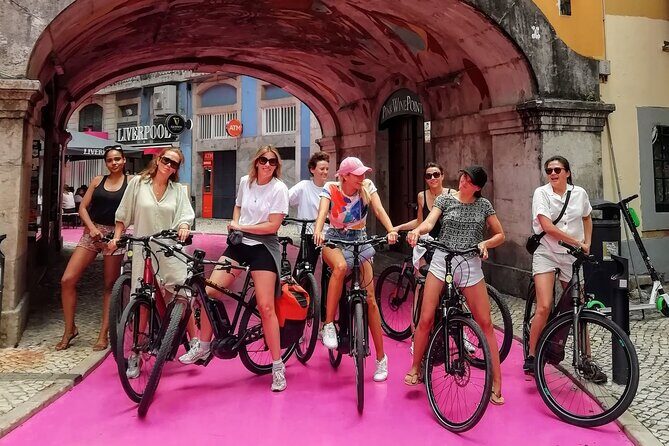
If you only have a couple days in Lisbon, you usually face the same problem: the best sights are spread out, and the streets can be tiring. This e-bike tour solves that by giving you a structured route that hits major squares and viewpoints in a tight time window.
It’s not just about motion, either. The stops are chosen so you understand why each place matters. You’ll talk about the city’s Roman layers, the consequences of the 1755 tsunami, and the story of Portuguese independence—so you’re not just collecting photos. And because you’re moving on a bike, you can cover ground without feeling like you’re constantly hauling yourself uphill.
The payoff is practical. By the end, you’ll know where you are in Lisbon—what connects the neighborhoods, which squares are the city’s anchors, and where to aim next for dinner and wandering.
You can also read our reviews of more cycling tours in Lisbon


Getting started near Rua dos Caminhos de Ferro (and what the 3 hours feel like)
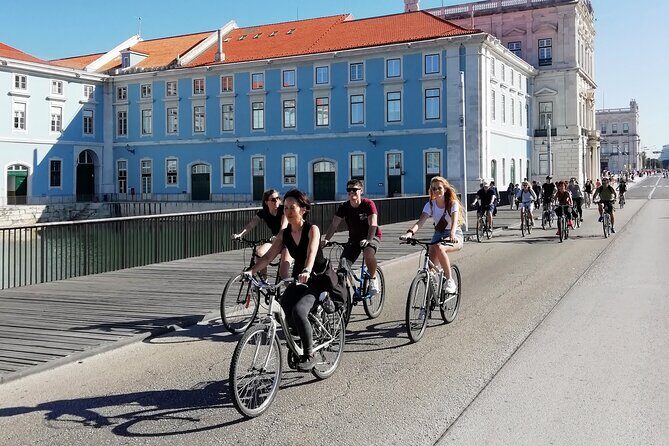
The tour starts at Rua dos Caminhos de Ferro 62, 1100-108 Lisboa, Portugal, and it returns you back to the same meeting point. The start time is 10:00 am, and the tour runs about 3 hours.
You’ll want to show up ready to ride. All participants must know how to drive a bicycle, and the guidance is for people with moderate physical fitness. The good news is that the experience is paced with frequent stops—so even if you’re not training for a cycling race, you’re not locked into long, hard stretches.
Also note what’s not included: bottled water and snacks aren’t part of the package. Bring your own if you’re the type who likes to snack in transit. The route includes breaks, but it’s still smarter to have a little cushion.
Alfama at the start: where Lisbon’s story begins
You’ll start in Alfama, Lisbon’s oldest and most traditional neighborhood. Starting here matters. Alfama isn’t just a pretty part of town—it’s a living introduction to the way Lisbon grew, with a character that’s very different from the downtown squares you’ll see later.
In plain terms: this first stop helps your brain “map” Lisbon. Once you’ve seen Alfama set the tone, the rest of the route feels connected, not random. You’re going from the city’s older, more distinctive fabric toward the grand downtown spaces that came later.
One practical benefit: getting Alfama out of the way early usually feels easier than doing it late in the day when you’re already tired. Even with the e-bike, your energy matters for enjoying the details.
Campo das Cebolas: the Roman port ruins you can see up close
At the end of Alfama, you’ll reach Campo das Cebolas, a high-value historical area tied to Lisbon’s Roman past. Here, you get to see part of the ruins of an ancient Roman port—one of those moments that turns Lisbon from a “picturesque city” into a layered one.
This stop is short, but it’s focused. You learn about Roman influence and how important the port was for Lisbon and Portugal centuries ago. For me, that’s the kind of history that actually sticks, because you’re looking at physical remains, not just hearing a timeline.
If you like architecture and old-city archaeology, this is a real standout in a compact ride.
Praça do Comércio and the Tagus gateway (plus the tsunami story)
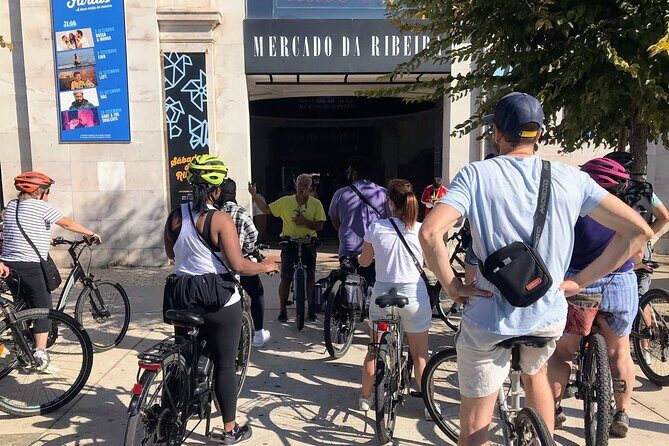
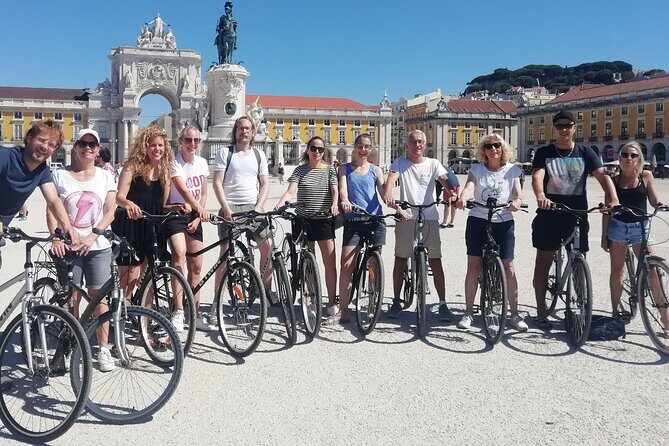
Next comes Praca do Comercio, the big monumental square facing the Tagus River. It’s described as the ancient gateway to Lisbon and remains one of the city’s most important squares today.
This stop isn’t only about standing in front of a famous scene. The guide explains why the square is so important and also covers the devastating 1755 tsunami—including social and architectural consequences. That’s a lot of weight for one square, and it changes how you read what you see around you.
Praca do Comercio is also a helpful orientation point. Once you’ve connected it to the Tagus, Lisbon starts to make more sense spatially. You begin to understand where the city opens up and where it turns inward toward older neighborhoods.
You can also read our reviews of more tours and experiences in Lisbon




Praca Dom Pedro IV, Rossio, and the Lisbon “downtown spine”
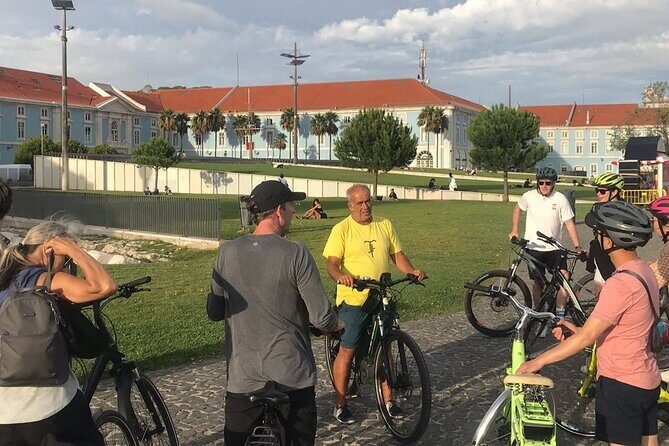
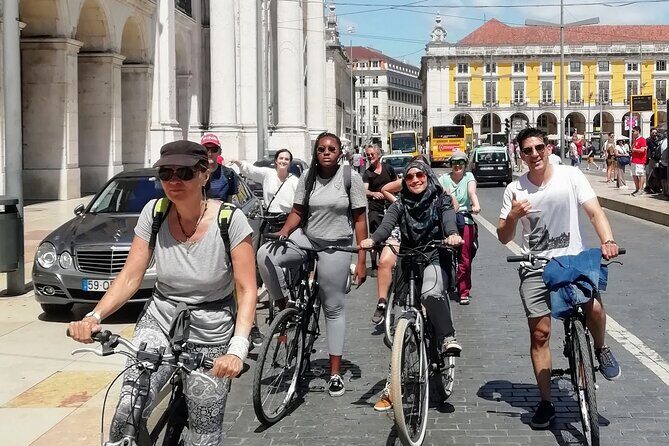
From Comércio, you’ll cycle through downtown for around 10 minutes until you reach Praca Dom Pedro IV. This is another key square, linked with Rossio and centered around major city landmarks.
One of the interesting things here is the mix: you’re near the National Theater, Lisbon’s first major train station, and the São Domingos Church. You can also discover some of the oldest and most legendary stores in the area.
This part of the route is great if you like a city that still functions. It’s not a museum lane; it’s everyday Lisbon, just in a more historic setting.
And because the tour moves between squares efficiently, you get a “center city” feel without spending your whole morning stuck in one neighborhood.
Praça dos Restauradores: independence, theaters, and Avenida da Liberdade
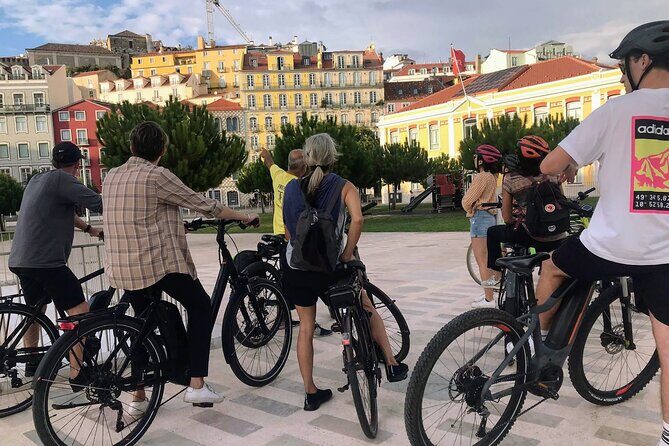
A short distance later you reach Praça dos Restauradores with the monument in the middle that marks Portugal’s restoration of independence in 1640. The guide explains why Portugal lost its independence for 60 years, giving the monument a clear story.
This square also acts like a beginning point for Avenida da Liberdade, Lisbon’s most important avenue. You’re not just seeing a landmark; you’re learning what it signals—where the city’s direction changes and where a bigger “modern Lisbon” begins to dominate.
The edges of the square are lined with older cinemas and theaters, so even if you’re not going inside, you can feel the cultural rhythm of the area. It’s a smart stop for anyone who wants architecture and history with a side of street life.
Santa Justa Elevator: a symbol, explained simply
At Elevador de Santa Justa, you get a brief stop at one of Lisbon’s best-known symbols. The guide also explains why it exists and the importance it had, with the elevator described as being built over 100 years ago.
This is the kind of stop I like on walking tours too—quick, recognizable, and loaded with context. The elevator looks like a landmark you should understand, and it’s worth taking the couple of minutes to get the story behind the silhouette before you move on.
Miradouro da Senhora do Monte: big view, high effort made manageable
Next you head to Miradouro da Senhora do Monte, described as the highest point in old Lisbon. This is one of those “okay, now I get it” viewpoint stops, because the height makes the city read like a whole system.
The tour gives you about 20 minutes here. That’s enough time to settle in, scan the view, and connect it back to the neighborhoods you just rode through. You’re not rushing to take one photo and disappear.
And again, because you’re on an e-bike, the effort feels controlled. You get the viewpoint without turning the morning into a leg workout.
Miradouro da Graça (Sophia de Mello Breyner Andresen): castle views and a church option
Then comes Miradouro da Graca (Sophia de Mello Breyner Andresen), near the Church and Convent of Graça. This viewpoint is especially known for views over São Jorge Castle.
The tour gives you around 30 minutes in this area. While you’re there, you can also visit the church. If you prefer a quick look rather than a long sit-down, you can still make good use of the time—this stop is flexible.
This is a strong pairing with the Senhora do Monte viewpoint. One gives the “big picture” sense from the high point; the other frames the city through the castle viewpoint, which tends to feel more story-driven.
Feira da Ladra area: market energy and iconic landmarks from above
Finally, the ride brings you to the Feira da Ladra (Campo de Santa Clara) area. This is where Lisbon’s famous street market takes place on Tuesdays and Saturdays.
Even if you’re not there on a market day, the setting is worthwhile because of the view and because you get to spot iconic landmarks close by. The tour mentions views toward the Monastery of São Vicente and the National Pantanal from this vantage point.
This is a great capstone stop. You end with a mix of city scenery and a sense of local routine—Lisbon doesn’t just show up for tourists; it runs on schedules and markets and daily movement.
How the tour helps you plan meals afterward
Food isn’t an official part of the tour package (snacks and bottled water aren’t included), but the experience does a nice job pointing you toward where to eat next.
You’ll get ideas for your next meal at Time Out Market and around Praça dos Restauradores. For me, that’s a big practical win: after a 3-hour sight tour, you want dinner that’s easy to find without hunting around while your feet are tired.
Also, because you learn the cultural context of these squares, your food stop feels less like a random recommendation and more like it fits the area you’ve just covered.
Who should book this, and who should skip it
This tour is built for active travelers who like history, architecture, and the kind of city touring that blends walking culture with movement.
It’s especially a good fit if:
- You want to cover a lot of Lisbon’s center in a half-day
- You like guided context at viewpoints and major squares
- You can ride a bicycle confidently (or at least you’re comfortable keeping steady)
- You prefer e-bikes to fight off “too much uphill” fatigue
I’d be cautious if:
- You’re a brand-new cyclist and can’t comfortably ride in traffic-free street environments
- You’re expecting a super relaxed, no-riding experience (this is still a bike tour)
- You’re traveling with needs that require easy alternatives, since the tour has a specified fitness level and bicycle competency requirement
For families: children age 5 to 12 can’t participate, while 0 to 4 can participate with baby seats available on the bike.
Value and pricing: what $28.83 buys you in real terms
At $28.83 per person for about 3 hours, the value is strongest because the essentials are included: electric bike and helmet.
Here’s how I think about it: the cost is covering (1) the guided routing and context, (2) the bike + safety gear, and (3) the fact that you’re getting multiple major landmarks instead of doing a single neighborhood loop. For a short Lisbon stay, that’s efficient.
You may see references in your travel planning to e-bike add-ons elsewhere. In this case, the tour information says e-bikes are included, but if your checkout ever shows an e-bike surcharge, it’s worth checking carefully. The key idea is the same: the motor matters if you want the views without turning it into a workout you regret.
The practical bottom line
This is the kind of Lisbon tour that helps you start smart. You hit classic squares, learn the major stories behind them, and finish with viewpoints that make the city feel connected.
The route is built for people who like to move but also like to stop and listen. If that’s you, you’ll probably feel like you got your bearings fast.
Should you book The Heart of Lisbon by Electric Bike?
Book it if you want a 3-hour, history-and-viewpoints route through Lisbon’s center, and you’re comfortable riding a bicycle. The included e-bike + helmet, the focus on major landmarks like Alfama, Praça do Comércio, Praça Dom Pedro IV, and Senhora do Monte, and the way the guide explains bigger events like the 1755 tsunami make it a strong first-day or short-break option.
Skip it (or choose another style of tour) if you don’t feel ready to ride a bike, even with an e-bike assist. And since water and snacks aren’t included, plan a little ahead so you don’t end up hungry during the breaks.
FAQ
How long is the Heart of Lisbon by Electric Bike?
It’s about 3 hours (approx.).
Is an electric bike and helmet included?
Yes. The electric bike and helmet are included.
Do I need to know how to ride a bicycle?
Yes. All participants must know how to drive a bicycle.
Where does the tour start and end?
It starts at Rua dos Caminhos de Ferro 62, 1100-108 Lisboa, Portugal, and ends back at the same meeting point.
What time does it start?
The start time is 10:00 am.
Is it suitable for children?
Children ages 5 to 12 can’t participate. Children ages 0 to 4 can participate, and baby seats are available on the bike.
What if the weather is bad or I need to cancel?
The tour requires good weather. If it’s canceled due to poor weather, you’ll be offered a different date or a full refund. You can also cancel for free up to 24 hours in advance for a full refund.