REVIEW · LISBON
2-hour city tour of Lisbon’s highlights
Book on Viator →Operated by Walk 'N' Roll Stadtrundgänge & Ausflüge · Bookable on Viator
Lisbon in two hours feels fast. This compact, German-speaking city tour strings together the main sights in the lower town—Baixa through Chiado and Bica—while your guide adds the human side of Portuguese culture. You’ll hit classic views, historic spots, and even the trams and tiled streets that make Lisbon feel like Lisbon.
Two things I really like: first, the pace is built for orientation. You start at Rossio Square and finish at Time Out Market, so you come out knowing where you are and what area to explore next. Second, the mix of highlights and everyday details is strong—Santa Justa’s angles, the Carmo ruins after the earthquake, Chiado and Fernando Pessoa’s world, and then viewpoints over the Tejo River. Guides like Pedro, Sara, and Melina are praised for keeping the stories clear and engaging without turning the tour into a history lecture.
One possible drawback: it’s still a walking tour. The route is designed for moderate physical fitness, and some segments involve slopes and viewpoint stairs, so you’ll want comfy shoes and a steady pace—especially if the weather is warm.
In This Review
- Key highlights you’ll actually feel in the moment
- Mapping Lisbon from Rossio Square to Time Out Market
- Stop 1: Praca Dom Pedro IV (Rossio) and Baixa’s “center of gravity”
- Stop 2: Elevador de Santa Justa and the best angles toward Lisbon Castle
- Stop 3: Convento do Carmo ruins and why Lisbon remembers
- Stop 4: Chiado and Fernando Pessoa’s walking-town vibe
- Stop 5: Praca Luis de Camoes and the tram-lined picture of Lisbon
- Stop 6: Bica Funicular for one of Lisbon’s most photo-friendly viewpoints
- Stop 7: Miradouro de Santa Catarina and a postcard view with context
- Stop 8: Time Out Market Lisboa as a smart finish, not just a random ending
- Price and value: is $32.10 for 2 hours a fair deal?
- Who this Lisbon highlights tour suits best
- Should you book this Lisbon highlights tour?
- FAQ
- Is the tour in German?
- How long is the Lisbon highlights tour?
- What is the price per person?
- Where does the tour start?
- Where does the tour end?
- How many people are in the group?
- What is included in the tour?
- Do you get a ticket on your phone?
- Is there an admission fee at the main stops?
- What happens if the weather is bad?
Key highlights you’ll actually feel in the moment
- Rossio Square (Praca Dom Pedro IV) to start your bearings fast in Baixa
- Elevador de Santa Justa viewpoint for a standout angle toward Lisbon Castle
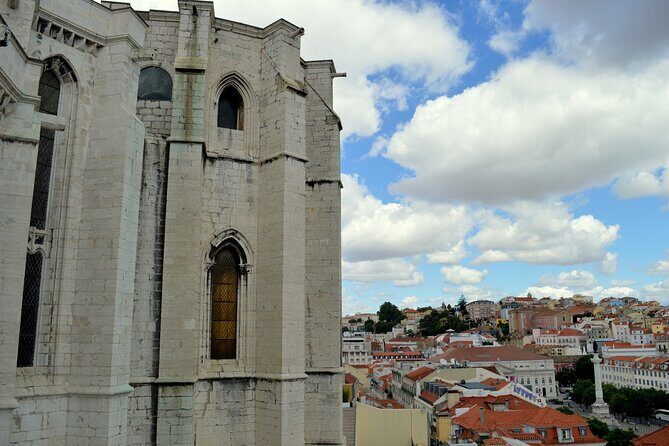
- Carmo Monastery ruins that connect Lisbon’s earthquake history to dictatorship-era memory
- Chiado + poet Fernando Pessoa for culture that fits the streets
- Bica Funicular and Miradouro de Santa Catarina for Tejo River views with Christ the Redeemer and the 25th of April Bridge in sight
- Time Out Market Lisboa finish with written restaurant tips to extend the day
Mapping Lisbon from Rossio Square to Time Out Market
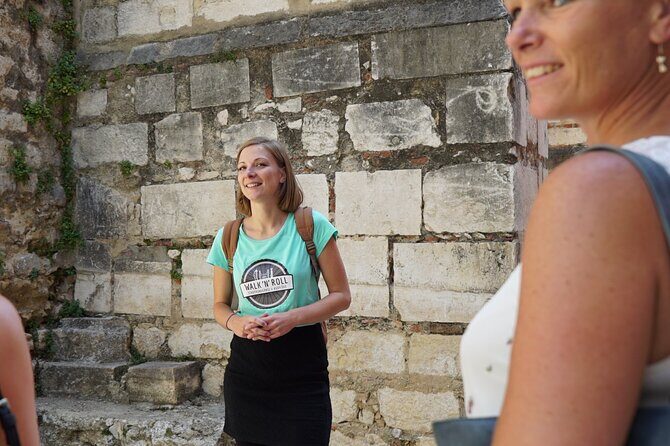
This tour is designed for people who want a smart first pass through Lisbon—fast, clear, and practical. You begin in Baixa, where Lisbon lays out wide squares and grid-like streets, then climb into the older neighborhoods of Chiado and the sloped viewpoints around Bica.
The best part is the “then what?” factor. By the end, you’re not dropped in some random location far from food. You finish in the big indoor hub of Time Out Market near the river, which makes it easy to continue on your own. The guide also hands out written recommendations, which is handy when you’re hungry and trying to choose between 10 great-sounding options.
Group size stays small (up to 12), and that helps with the flow. You’re not stuck in a loud herd where nobody can hear anything, and it’s easier to adjust on the fly if you’re more curious about viewpoints or street-level details.
You can also read our reviews of more city tours in Lisbon


Stop 1: Praca Dom Pedro IV (Rossio) and Baixa’s “center of gravity”
Your tour kicks off at Rossio Square, formally Praca Dom Pedro IV, right in Lisbon’s lower town. This is the kind of place where you can instantly understand the city’s layout. If you’ve ever felt lost in Lisbon’s hills, starting here gives you a reference point that makes later neighborhoods click.
Even if you only spend about 10 minutes here, you’ll get orientation that pays off later. Rossio is also close to public transport, so it’s a helpful starting node. The guide’s stories at the start matter because they set the theme: Lisbon isn’t just monuments—it’s also neighborhoods, daily life, and how history shows up in street corners and city decisions.
Practical tip: if you’re the type who likes to plan the rest of the day, use this first stop to decide what kind of photos you want. Wide square shots and street scenes are easiest early, before views draw bigger crowds.
Stop 2: Elevador de Santa Justa and the best angles toward Lisbon Castle
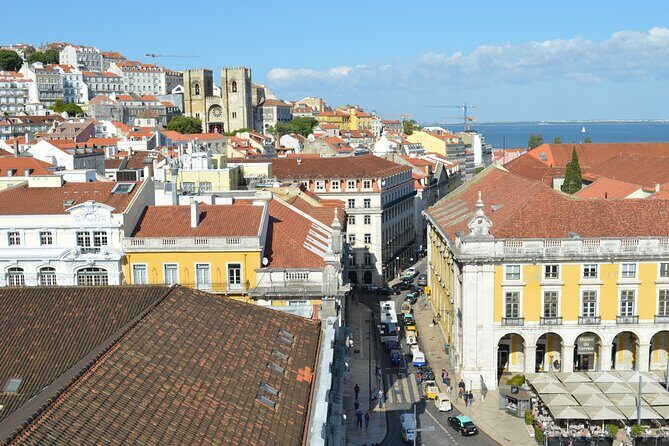
Next comes one of Lisbon’s “how is this even real?” moments: the Elevador de Santa Justa. You don’t just look up at it—you admire it from below, then you get time at the observation deck for a citywide view.
The pay-off here is the angle. The viewpoint gives you one of the best views toward Lisbon Castle, and that single visual helps you understand the relationship between the hills, the river, and the older parts of town. From street level, Lisbon can feel like it’s all slopes and stairs. From above, it starts to make sense.
This is also a great stop if you like architecture. Santa Justa is more than a ride; it’s a recognizable piece of Lisbon’s skyline and engineering pride. If you’re traveling with limited time, this kind of viewpoint stop is a smart investment because it teaches you where to aim your eyes for the rest of the day.
Stop 3: Convento do Carmo ruins and why Lisbon remembers
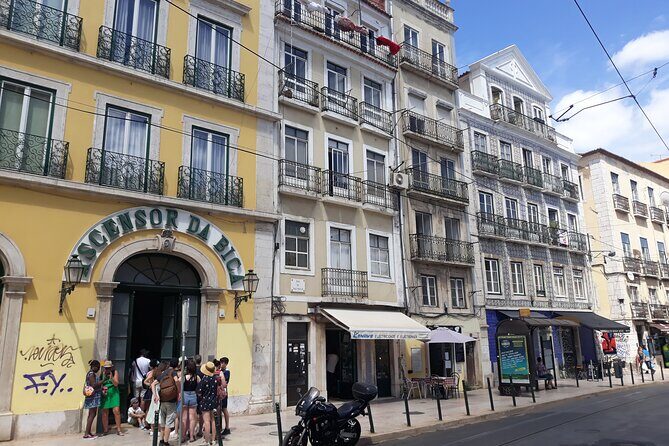
Then you reach the Convento do Carmo, specifically the monastery ruins. This spot is famous for two heavy themes: it commemorates the Lisbon earthquake and it connects to the era of Portuguese dictatorship.
What I like about this stop is the balance. The ruins are dramatic, but the guide’s framing gives the city’s layers a reason to exist. You’ll see how Lisbon’s architecture carries memory—how a place can be both beautiful in its age-worn look and serious in what it represents.
The time you get here is short (about 20 minutes), so you won’t have to worry about getting stuck reading every plaque. Instead, the guide points you toward what matters, and you move on with context for the rest of the walk.
Shoes tip: even if you’re not climbing aggressively, this part of Lisbon’s old core can still mean uneven ground. Walk like you’re in a historic district—watch your step, keep it relaxed, and you’ll be fine.
Stop 4: Chiado and Fernando Pessoa’s walking-town vibe
From Carmo, you shift into Chiado, Lisbon’s classic arts-and-poets neighborhood. The tour follows in the footsteps of Fernando Pessoa, which is a smart move because Pessoa isn’t just a name—you can feel his cultural presence in how Chiado is described and experienced.
You’ll also notice the streets themselves: charming facades and details like tiles, plus the sense that Chiado has always been a place where ideas move. You’re not only learning dates; you’re getting a feel for the mood of the area and why people connect Lisbon to writers, cafes, and intellectual life.
This portion is about atmosphere. If you’re someone who likes to understand a destination beyond the obvious photo spots, Chiado is where the tour becomes more than a checklist. And if you’re not a big poetry fan, the guide’s stories can still help you “read” what’s around you as you walk.
You can also read our reviews of more tours and experiences in Lisbon






Stop 5: Praca Luis de Camoes and the tram-lined picture of Lisbon
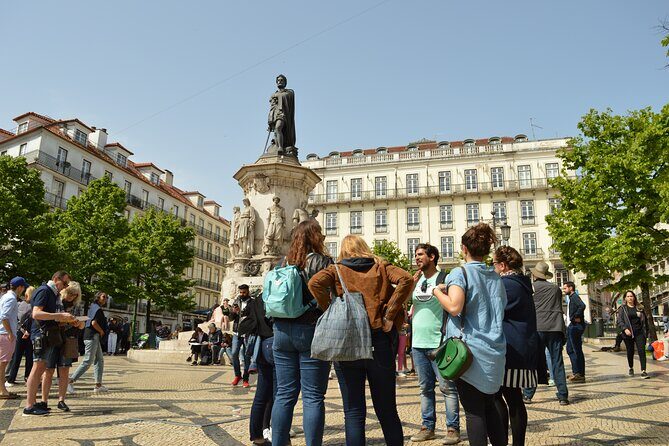
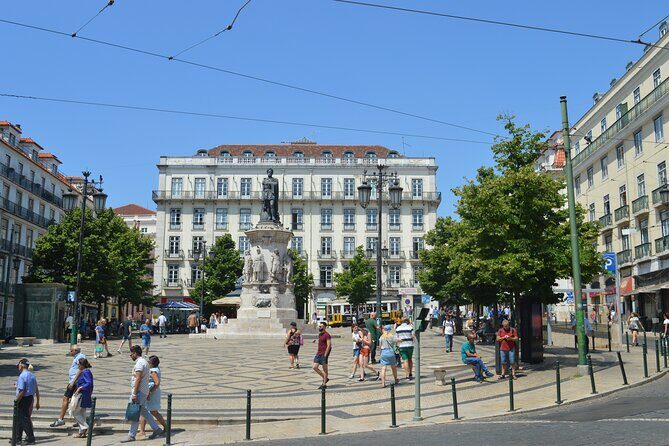
Next is Praca Luis de Camoes, a square surrounded by famous trams. It’s the kind of place where you can photograph Lisbon without even trying too hard—cables, tracks, classic street energy, and that “this is the real city, right now” feeling.
The guide gives tips here too, which matters because trams are a core Lisbon experience. Knowing where trams run and how to think about them can save time later. Even if you don’t ride everything, understanding how the network shapes movement helps you decide what’s worth your effort.
This stop is short (about 15 minutes), but it’s strategically placed. By the time you reach it, you’ve already had a viewpoint and a history stop, so the tour has a rhythm: perspective, memory, then everyday Lisbon.
Stop 6: Bica Funicular for one of Lisbon’s most photo-friendly viewpoints
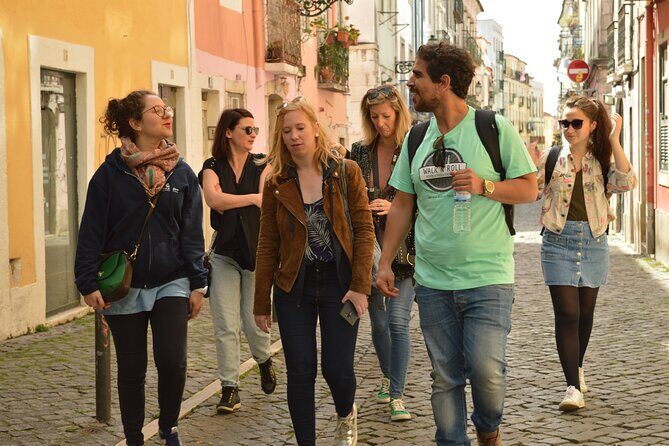
Bica Funicular is next, and it’s one of Lisbon’s most popular photo subjects. Even if you only get about 10 minutes here, the point is clear: this is a “get the view” stop with personality.
You’ll look down toward the Tejo River, and the overall angle is the kind you’ll remember later when you’re trying to explain Lisbon to friends. Lisbon’s hills can be disorienting, but funicular viewpoints are a cheat code. They show you the city’s slope in one frame, without needing to walk steeply for every photo.
If you’re sensitive to stairs and slopes, pace yourself. The route is doable, but Lisbon’s elevation is not subtle. Take breaks as needed, and treat the funicular segment as a chance to reset.
Stop 7: Miradouro de Santa Catarina and a postcard view with context
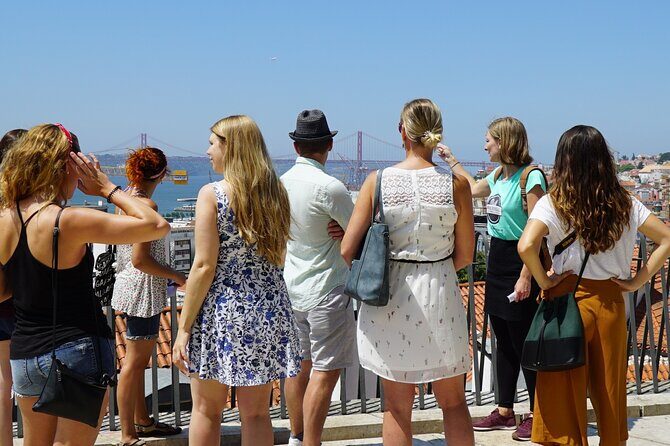
Now you get one of the tour’s biggest moments: Miradouro de Santa Catarina. The viewpoint is especially popular in the evening, but you can still enjoy it earlier or mid-day if you’re prepared for possible crowding.
What makes it valuable is the sweep. You get southern Lisbon and the Tejo River, and you can also see Christ the Redeemer and the 25th of April Bridge from here. Having those landmarks tied together in your view makes Lisbon feel like a connected picture, not separate sights.
This is also where your guide’s earlier stories pay off. After you’ve learned about the city’s identity, the earthquake memory, and the poetic Chiado mood, the viewpoint becomes more than a view. It’s the physical map of those stories—hills, river, and city expansion in one glance.
Photo tip: plan for changing light. If you’re aiming for bridge-and-river shots, watch the sky and hold your phone/ camera steady for a minute. The difference between a rushed shot and a careful one is huge at viewpoints.
Stop 8: Time Out Market Lisboa as a smart finish, not just a random ending
The tour ends at Time Out Market Lisboa in the Mercado da Ribeira area. This is the “largest and coolest market hall” style of stop—food-focused, lively, and easy to continue from.
The practical value is real. Instead of heading back into uncertainty, you’re done with the guided walk and ready to eat. Plus, you receive written recommendations from the city guides for restaurants and more. That matters when you’re hungry, tired, or just overwhelmed by options.
This ending works especially well if you took the tour early in your trip. You’ll come out with a mental map, then you can pick what to do next based on your own energy. If you’re only in Lisbon a few days, that kind of order is gold.
Price and value: is $32.10 for 2 hours a fair deal?
At $32.10 per person for a roughly two-hour highlights walk, the value comes from concentration. You’re paying for a guide who ties together multiple neighborhoods—Baixa, Chiado, Bica—plus several high-impact stops with major payoff views.
A big part of the value is the way it compresses orientation and entertainment into one outing. Instead of spending your limited time bouncing between places on your own, you get a route that makes sense, with stops that help you understand what to explore later.
Also, the tour uses a mobile ticket, and the admission tickets at the listed stops are shown as free within the tour structure. That combination—clear route, strong stops, and no added admission surprise—keeps the price easier to justify.
One more thing: the group stays small. That’s not just comfort. In a walking tour, small groups are often what make the difference between hearing the guide and missing the story.
Who this Lisbon highlights tour suits best
This is a strong match for:
- First-time Lisbon visitors who want quick orientation across Baixa, Chiado, and Bica
- People who want history with a human voice, not a lecture
- Anyone who likes viewpoints and wants context for what they’re seeing over the Tejo River
- Groups who want a smooth, small-group pace (max 12)
It’s less ideal if:
- You only want minimal walking and hate slopes
- You don’t speak German (the tour is German-speaking)
- You’re expecting long museum-style time at stops (this is a highlights tour, not a deep dive into one building)
If you care about getting your bearings fast, I’d schedule it near the start of your trip. The map in your head will make the rest of your Lisbon days feel easier.
Should you book this Lisbon highlights tour?
Yes, if your goal is to get oriented fast and then use Lisbon on your own terms. For the price, you get a smart sweep through major districts, memorable viewpoint moments, and a practical finish at Time Out Market with written food ideas.
Skip it only if German language and walking pace won’t work for you. Otherwise, this is the kind of short tour that improves the rest of your itinerary, because it teaches you where the city’s energy lives—squares, trams, tiles, viewpoints, and the river all in one flow.
FAQ
Is the tour in German?
Yes. The city tour is conducted in German.
How long is the Lisbon highlights tour?
The tour lasts about 2 hours.
What is the price per person?
The price is $32.10 per person.
Where does the tour start?
The tour starts at Rossio (Rossio 1100-202 Lisbon, Portugal).
Where does the tour end?
The tour ends at Time Out Market Lisboa at Mercado da Ribeira (Av. 24 de Julho, 1200-479 Lisboa, Portugal).
How many people are in the group?
The group size is limited to a maximum of 12 travelers.
What is included in the tour?
The tour includes the German-speaking city tour. Snacks are not included.
Do you get a ticket on your phone?
Yes. You receive a mobile ticket.
Is there an admission fee at the main stops?
The tour information lists admission tickets as free for the stops included in the route.
What happens if the weather is bad?
This experience requires good weather. If it’s canceled due to poor weather, you’ll be offered a different date or a full refund.