REVIEW · LISBON
Lisbon city tour on history, culture and current topics
Book on Viator →Operated by Walk 'N' Roll Stadtrundgänge & Ausflüge · Bookable on Viator
Lisbon feels easier when you walk it with someone who knows the angles. This 3.5-hour, small-group tour takes you from the low town up into the poets’ and old-quarter streets, while your German-speaking guide connects Portugal’s past with what people talk about now. I especially like the tight route (Baixa, Chiado, Bairro Alto, Alfama in one go) and the small group size that keeps questions flowing.
Two things I’d bet on if you’re deciding: you get big viewpoints without getting lost, and the guide’s practical tips actually help after the tour. I’ve seen guides named Pedro, Sara, and Melina on these tours, and the common thread is how friendly and responsive they are, with good humor and solid recommendations for what to do next.
One consideration: it’s a walking tour with a climb and some uneven streets, so it’s not for people with walking difficulties. If your mobility is limited, you may find the uphill/downhill pace challenging.
In This Review
- Quick highlights you’ll feel right away
- Rossio to the Tejo: How the Route Gets You Oriented Fast
- Praça Dom Pedro IV and Baixa: A Strong Start in Lisbon’s Lower Town
- Santa Justa Elevator Views: The Shortcut to Perspective
- Convento do Carmo Ruins: History You Can See From the Outside
- Chiado and Praca Luis de Camoes: The Poets’ Quarter in Real Life
- Bairro Alto Climb and Miradouro Sao Pedro de Alcantara: Day Quiet, Evening Life
- Rua Augusta to Alfama: From Main Street Energy to Old Quarter Confusion
- Miradouro Santa Luzia and the Praça do Comercio Finish at the River
- The Real Value: Guides Like Pedro, Sara, and Melina
- What You Actually Get (and What You Don’t)
- Price and Booking: Is $45.86 Worth It?
- Should You Book This Lisbon Walking Tour?
- FAQ
- FAQ
- What language is the Lisbon city tour offered in?
- How long is the tour?
- How many people are in the group?
- Where do we meet and where does it end?
- What is included in the price?
- Is the tasting a specific item or does it vary?
- Is there free cancellation?
- What if weather is bad?
Quick highlights you’ll feel right away
- Max 12 people keeps the tour personal and question-friendly
- Rossio to Praça do Comércio links Lisbon’s hills to its riverfront finale
- Santa Justa views twice (from below, then from the viewing platform)
- Chiado and Alfama by character, not just by postcard stops
- Miradouro breaks built in, including Sao Pedro de Alcântara and Santa Luzia
- One local tasting plus a guide recommendation sheet for your next meals
Rossio to the Tejo: How the Route Gets You Oriented Fast
This tour is designed like a guided shortcut through Lisbon’s most memorable “zones.” You start at Praça Dom Pedro IV in the Rossio area, then you move through the lower town, climb toward Chiado and Bairro Alto, and finally wind into Alfama, the oldest district. You end at Praça do Comércio right on the Tejo River, which is a great way to reset your bearings at ground level.
For first-time visitors, the value isn’t just seeing sights. It’s learning how the city layers work: flatter streets first, then steeper neighborhoods, then the viewpoints that show you how everything connects. By the time you reach the river, you’ll understand why Lisbon feels like it has several mini-worlds stacked on top of each other.
The pacing also matters. At roughly 3 hours 30 minutes, you get time for real stops—views, photo moments, short walks—without turning the whole day into a treadmill. And because the tour is in German, you’ll hear history and cultural context explained in a consistent way from start to finish.
You can also read our reviews of more city tours in Lisbon


Praça Dom Pedro IV and Baixa: A Strong Start in Lisbon’s Lower Town
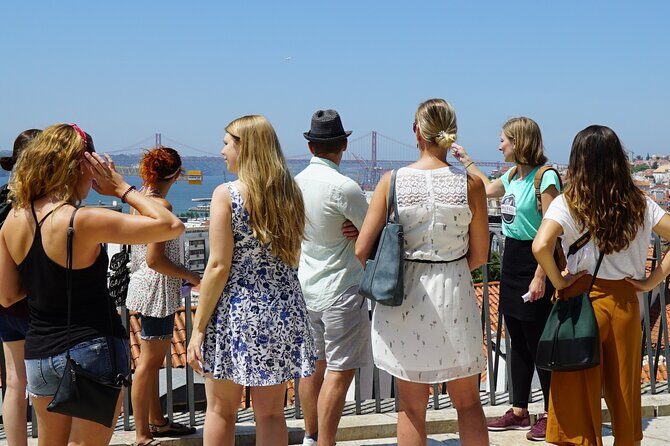
The meeting point is the north fountain at Rossio, at Praça Dom Pedro IV, between the King’s Statue and the National Theater. It’s central and easy to orient around, which helps you feel grounded before the climbs begin.
From there, you move into Baixa, Lisbon’s lower town. This section is where you get your first sense of the city’s layout at street level. It’s also a good warm-up zone: you’re not deep into hills yet, so your legs and breath have time to adjust before Chiado and Bairro Alto start working the incline.
I like Baixa on this kind of tour because it gives you context. When you later see Alfama’s narrow lanes and higher viewpoints, Baixa helps you understand what’s “above” and “below.” It turns the day into a map you can remember, not just a sequence of stops.
Santa Justa Elevator Views: The Shortcut to Perspective
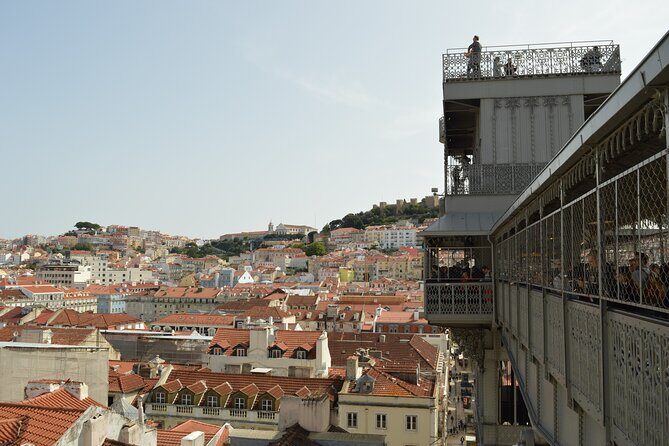
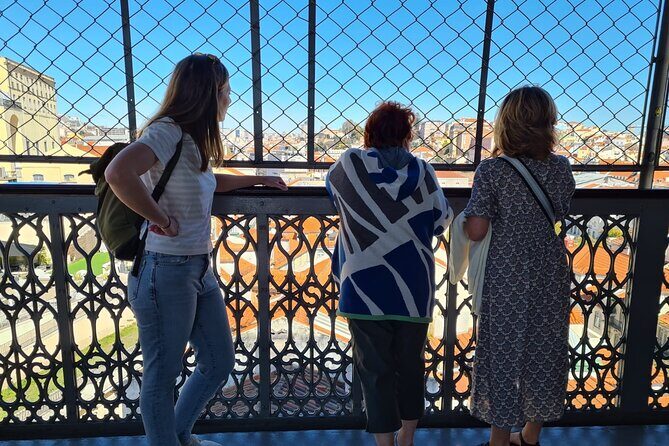
One of the smartest parts of this tour is how it uses Santa Justa Elevator for perspective, not just sightseeing. You admire the elevator from below first, then you see it again from the observation deck.
That double look is practical. From below, you get the scale against the surrounding streets. From the viewing platform, you get the bigger picture: Lisbon’s lower town and Lisbon Castle area framed by the city’s hills.
You don’t have to plan your own viewing route here. The guide does the timing and group movement for you, which saves the common first-timer problem: wandering up and down until you finally find the best angles. Even if you’re not riding the elevator, the viewpoint experience still does the job of “show me how Lisbon sits.”
Convento do Carmo Ruins: History You Can See From the Outside
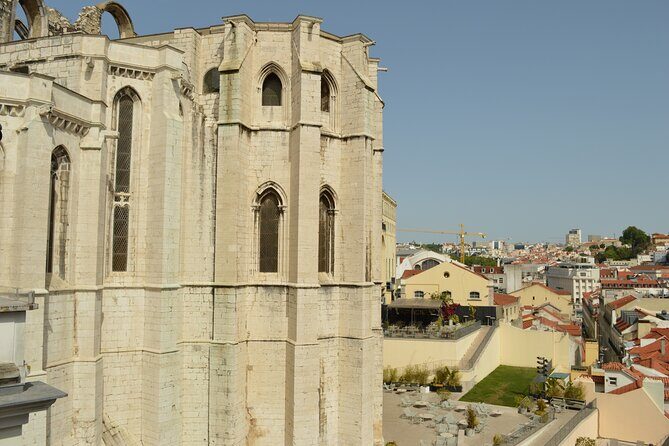
Next you head to the Carmo monastery ruins. You don’t go deep inside here; you admire the ruins from outside as part of the flow through Chiado.
Outside viewing has a benefit: you keep the tour moving and you spend your time where you can actually see the structure in relation to the streets around it. Ruins in a city like Lisbon can be a confusing stop on your own because you might not know what to look for. With a guide, you get the explanation that helps you read the space, rather than just photographing it.
This is also a nice transition stop. It bridges you from Baixa up into the Chiado area, where the city starts to feel more literary and more angled toward views and neighborhoods with their own rhythm.
Chiado and Praca Luis de Camoes: The Poets’ Quarter in Real Life
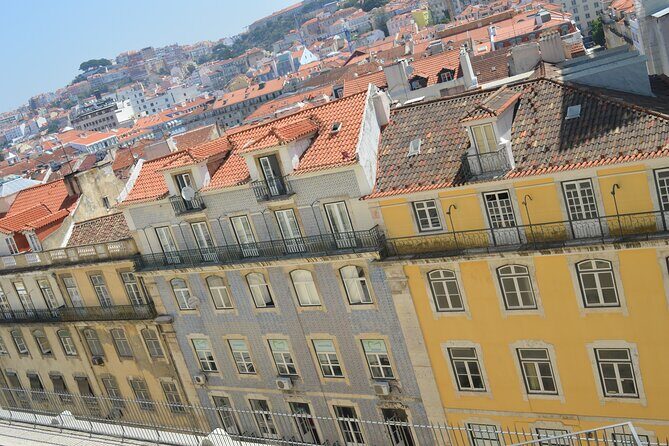
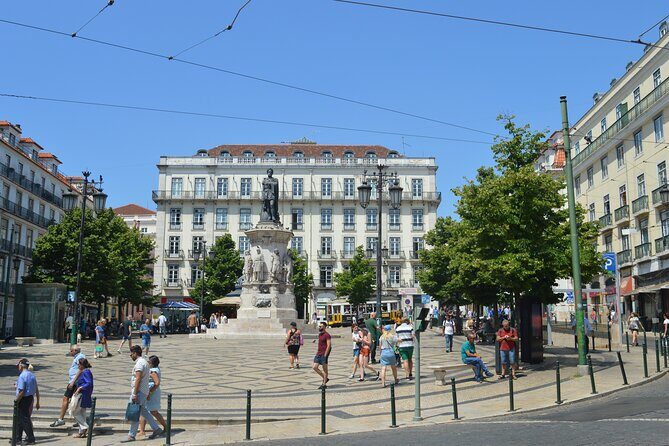
Chiado is described as the poets’ quarter, and the tour treats it like a place with identity—not just a name on a sign. You visit Chiado and then spend time around Praca Luis de Camões, the largest square in that poets’ area.
This portion works well if you like atmosphere. Squares and “known quarters” can feel generic when you rush, but here you get enough time to notice how the street life shifts with location. It’s also a good moment to ask questions about Portuguese culture and current topics, because the walking is steadier than later in Bairro Alto.
If you tend to over-plan your Lisbon day, Chiado is a good reality check. It reminds you that Lisbon isn’t only museums and viewpoints—it’s also neighborhood culture.
You can also read our reviews of more historical tours in Lisbon
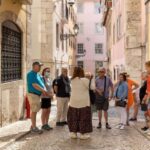





Bairro Alto Climb and Miradouro Sao Pedro de Alcantara: Day Quiet, Evening Life
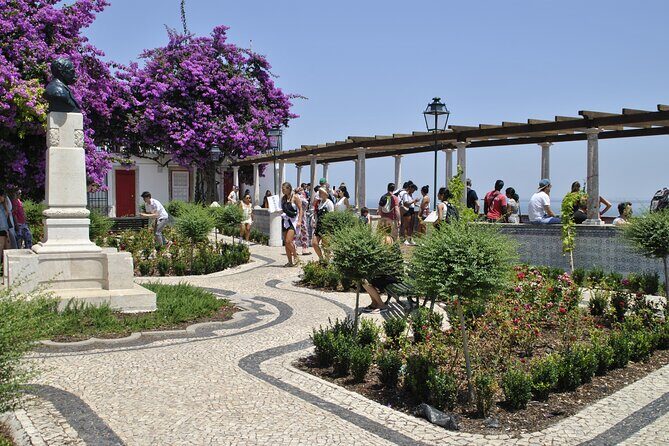
Bairro Alto is a highlight because the tour approaches it with timing in mind. During the day, it’s quiet, and later it comes alive as a bar district in the evening.
You stroll through Bairro Alto as a residential district, which means you’re seeing everyday city texture rather than only major monuments. Then you reach Miradouro Sao Pedro de Alcântara, where you linger for a break and soak in the view.
This is a smart use of time. After the climb, you don’t just keep walking until your legs are done. You get a viewpoint break built into the route, and that kind of pacing makes the rest of Alfama feel less brutal. It also gives you a chance to reset your camera settings, your water bottle, and your energy level.
Rua Augusta to Alfama: From Main Street Energy to Old Quarter Confusion
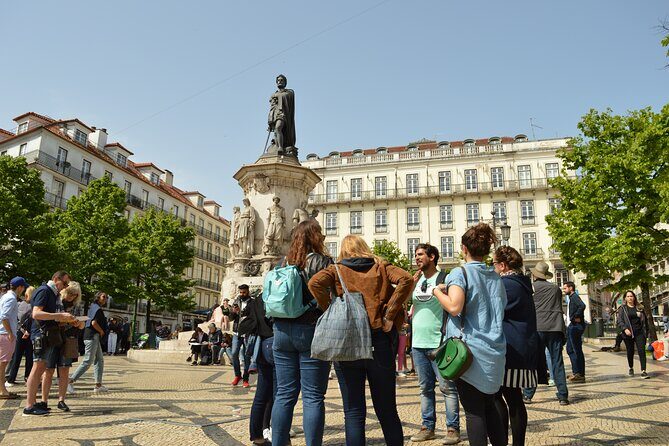
You pass Rua Augusta, Lisbon’s main shopping street, for a taste. Even if you’re not shopping, it’s useful as a contrast: this is where Lisbon feels more straightforward and commercial, before the old quarter turns steep and winding.
Then you head to Alfama, the oldest district. This is where Lisbon stops being a simple grid and starts being a maze of lanes. The tour gives you about 30 minutes here, which is enough to see the pattern: corners that hide viewpoints, streets that funnel you toward stairways, and neighborhoods that feel made for wandering.
Two things make Alfama especially worth it on a guided walk. First, your guide can help you understand what you’re seeing as the route turns and slopes. Second, you’re less likely to waste time trying to find the best sight angles by yourself.
Miradouro Santa Luzia and the Praça do Comercio Finish at the River
You end Alfama with Miradouro de Santa Luzia, described as the most beautiful viewpoint in Lisbon. Whether you agree with that wording or not, it’s clearly one of the key visual payoff stops on this tour.
From there, you move to Praça do Comércio (Terreiro do Paço) on the banks of the Tejo River. The grand square and its impressive triumphal arch make for a dramatic finish, and the river setting is a great place to relax your mind after the hills.
I love this ending because it changes your perspective one last time. You’ve spent the day moving upward and inward into narrow neighborhoods. Now you’re back to open space, water views, and an obvious “Lisbon’s here” feeling. It’s a strong way to close a first visit without ending exhausted.
The Real Value: Guides Like Pedro, Sara, and Melina
The standout across these tours is how personal the guidance feels. The guide names you’ll see most often include Pedro, Sara, and Melina, and the recurring theme is that the tour is both informative and entertaining without wasting time.
Small groups help a lot here. With a maximum of 12 participants, you’re more likely to get direct answers to your questions, and the guide can respond to what people actually want to know. In my view, that’s where paid tours beat free walking tours: the guide can steer the conversation, not just recite facts.
Also, the tour comes with a recommendation sheet with tips from your city guide. That matters because Lisbon is easy to over-schedule. Having a short, curated list you can use right after the walk helps you turn “I saw places” into “I ate well and planned smart.”
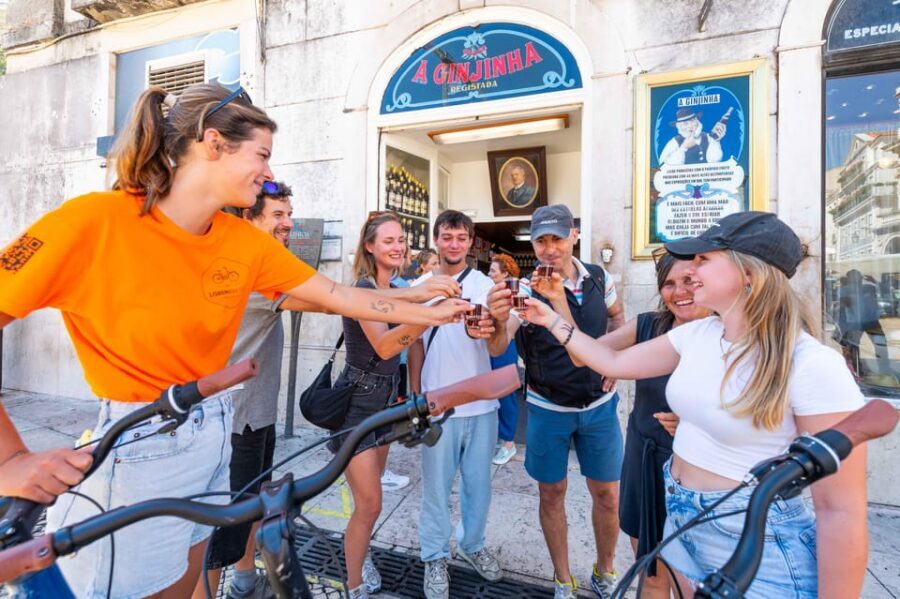
If you’re into food culture, the included tasting is part of the appeal. The tasting is one local pastry or a local liqueur, and it’s easy to end up with Portuguese favorites like pastéis de nata or ginjinha depending on what your guide offers on the day.
What You Actually Get (and What You Don’t)
This tour is built around a simple package:
- City tour on foot in German
- 1 tasting (local pastry or liqueur)
- Recommendation sheet with guide tips
You also get a mobile ticket, and the route is near public transportation. The “not included” part is transportation, which makes sense since the walk does the work of linking neighborhoods.
One more practical note: you should have moderate physical fitness. The route includes climbing and walking through areas that can be uneven. If you’re traveling with knee issues or you struggle with hills, you may find this tour too demanding.
Price and Booking: Is $45.86 Worth It?
At $45.86 per person, this isn’t a budget-free add-on, but it also isn’t priced like a private tour. The value comes from the combination: a compact route across several distinct districts, viewpoint time, a guided explanation in German, and a tasting plus an on-the-ground recommendations sheet.
Also, the tour is typically booked about 19 days in advance on average. That suggests demand is steady, and if your dates are fixed, booking sooner helps you avoid sold-out departures.
If you’re on a short trip, this is one of those experiences that can pay you back in planning. Instead of spending your next day trying to connect dots between Baixa, Chiado, Bairro Alto, and Alfama, you’ll already have the logic in your head.
Should You Book This Lisbon Walking Tour?
Book it if you want a clear first-pass orientation through Lisbon’s main hillside neighborhoods, with time at major viewpoint spots and a guide who explains history, culture, and current topics in German. It’s also a strong pick if you like small-group tours and you care about practical recommendations you can use that evening.
Skip it if you have limited walking ability or you can’t handle hills and uneven streets. Also, if you prefer doing everything fully on your own with no guided structure, you might feel boxed in by the set route—though you’ll still have viewing and walking flexibility.
FAQ
FAQ
What language is the Lisbon city tour offered in?
The tour is offered in German, with a German-speaking city guide.
How long is the tour?
It lasts about 3 hours 30 minutes.
How many people are in the group?
The tour has a maximum of 12 travelers.
Where do we meet and where does it end?
You meet at the north fountain of Rossio at Praça Dom Pedro IV, and the tour ends at Praça do Comércio on the banks of the Tejo River.
What is included in the price?
The price includes the on-foot city tour in German, one tasting (local pastry or liqueur), and a recommendation sheet with tips from your city guide.
Is the tasting a specific item or does it vary?
The tour includes one tasting, and it can be either a local pastry or a local liqueur.
Is there free cancellation?
Yes. You can cancel up to 24 hours in advance for a full refund.
What if weather is bad?
This tour requires good weather. If it’s canceled due to poor weather, you’ll be offered a different date or a full refund.