REVIEW · ALMADA
Lisbon: Tagus River Sunset Boat Tour with Welcome Drink
Book on GetYourGuide →Bookable on GetYourGuide
Lisbon looks different from the river. You’ll glide past Belém Tower and the 25 de Abril Bridge as the sky shifts from gold to pink, and you kick things off with a welcome drink onboard.
It’s built for a calm evening: a live guide in English, French, or Portuguese, plus a small group limited to 10. One catch: the crew may cancel the tour if weather conditions don’t allow good boating.
In This Review
- Quick reasons this Tagus sunset tour is a smart pick
- Setting out from Doca de Alcântara (Gate 2)
- The 2-hour Tagus sunset cruise: welcome drink + real breathing room
- Commerce Square: Lisbon’s grand riverfront energy
- Cruising past Christ the King: the city climbs while you float
- 25 de Abril Bridge: architecture in motion
- Belém Tower: the maritime icon, softened by sunset
- Monument to the Discoveries: seeing the Age of Exploration from the water
- MAAT and the modern Lisbon contrast
- Onboard comfort, crew attention, and the “small group” advantage
- What to wear and bring for a smooth evening
- Price and value: is $35 worth it?
- Should you book this Lisbon Tagus sunset boat tour?
- FAQ
- How long is the Lisbon Tagus River sunset boat tour?
- Where do I meet the group?
- What’s included in the ticket price?
- Is hotel pickup and drop-off included?
- What languages is the live guide available in?
- How big is the group?
- Is smoking or swimming allowed on the boat?
- What should I bring and wear for the evening?
Quick reasons this Tagus sunset tour is a smart pick
- Small group size (max 10): less noise, more space to enjoy the views.
- Onboard welcome drink: a simple start that makes the sunset feel like an event.
- Major landmarks from the water: Belém Tower, the Discoveries area, and the bridge all in one loop.
- You get a guide and still get downtime: explanations come, then you’re left to watch the light change.
- Weather-dependent: the route depends on conditions, so keep the evening flexible.
Setting out from Doca de Alcântara (Gate 2)
Most people arrive to Lisbon’s sights on land—stairs, streets, traffic, crowds. This one starts where the city turns nautical: Doca de Alcântara, at Gate 2.
You’ll want to arrive early, because the timing matters. Plan to get there about 30 minutes before departure, so you can check in without rushing and get seated comfortably before the safety briefing. If you’re coming from central areas, give yourself buffer time. Lisbon isn’t hard, but evenings can mean slow-moving streets and tighter schedules.
This dock area also helps you settle into the right mood fast. Once you’re on the boat, you stop thinking about where to park, what bus to take, and how to beat the next line. The river does the work.
You can also read our reviews of more boat tours in Almada

The 2-hour Tagus sunset cruise: welcome drink + real breathing room
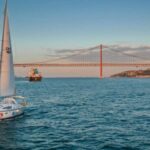
The experience is about two hours, paced for sunset. That time window is key. You’re not just looking at landmarks—you’re watching Lisbon change its colors as the sun drops behind the river and bridges.
Right at the start, you’ll get a safety briefing, then your guide handles the storytelling while you focus on being present. One detail I like is the tour’s rhythm: the explanations are there, but you’re not locked into a rigid lecture. Even better, the boat setting keeps it easy to relax.
And yes, the welcome drink matters. It’s not a fancy party. It’s more like a nice handhold at the beginning of the evening—something to sip while the first views open up. If your cruise has staff who are extra friendly, you may also be surprised by small onboard treats (pastel de nata is one example people talk about).
Practical note: this is a boat ride, not a warm indoor lounge. Bring a jacket. Lisbon evenings can turn breezy fast, especially once the sun is gone.
Commerce Square: Lisbon’s grand riverfront energy
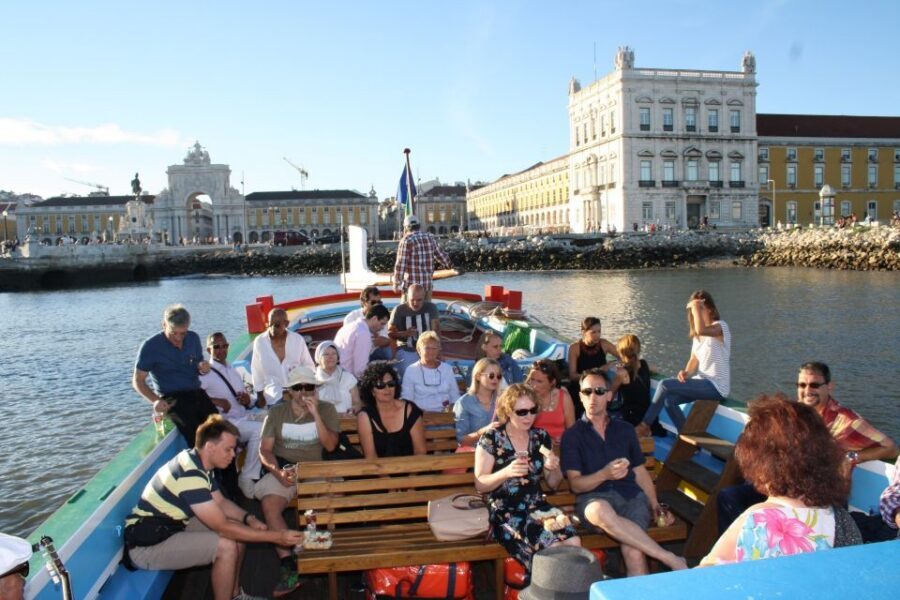
As you cruise, you’ll pass Commerce Square (Praça do Comércio). On foot, this area can feel like a quick stop—nice, open, impressive, then you’re off to the next street. From the water, it becomes something else: a wide riverfront stage.
Here’s what you’ll get from the boat perspective:
- Lisbon’s waterfront geometry looks sharper from the Tagus.
- You see how the city lays out along the river, not just around it.
- The light at sunset gives the stonework a softer look than it has midday.
The main drawback is also the main limitation of all water views: you can’t explore the square itself from the boat. If you want to linger in that area after the cruise, you’ll have to come back later by foot, tram, or taxi. But the trade-off is worth it because you’re saving time and getting a totally different angle.
If you’re taking photos, keep an eye on the sun’s position. Early in the cruise, some angles are cleaner; later, reflections can be pretty, but they can also wash out details. Move your phone or camera a few steps and you’ll often fix it.
Cruising past Christ the King: the city climbs while you float
Next up is Christ the King (Cristo Rei). This is one of those Lisbon landmarks that people talk about as a viewpoint, often reached by buses and hills. From the Tagus, it’s different: you don’t climb up to it—you watch it sit above the river corridor while you travel below.
This stop works for two reasons:
- It shows Lisbon’s layout, where hills rise quickly from the water.
- It adds a dramatic silhouette to the sunset palette.
You’ll likely notice the contrast more than anything—modern city movement in the distance, ancient-feeling waterfront lines below, and a statue perched above it all. It’s a reminder that Lisbon isn’t flat in the way you might expect.
If you’re sensitive to wind, this is a good moment to step slightly toward the calmer side of the boat (if there’s room). You don’t need to wrap up instantly, but once the breeze starts, it’s nice to manage it.
25 de Abril Bridge: architecture in motion
Then comes the star in many people’s photos: the 25 de Abril Bridge. You’ve probably seen it from land, but the bridge is made for this exact angle—long spans, strong lines, and a sense of scale you don’t fully feel until you’re under or near it.
From the water, you get:
- A cleaner look at the bridge’s structure than you usually get between buildings.
- A moving panorama, so you see it stretch and shift as the boat changes position.
- A layered background where the sky becomes part of the design.
This is also where the “wow” feeling tends to peak. Sunset light catches edges and cables, and the river adds texture through reflections. If you’re traveling with friends, this is a great moment for quick group photos, because everyone can point their camera without arguing about the best corner.
The main consideration here is timing. If you’re expecting the bridge shot to last forever, it won’t. It’s part of a loop, not a long sightseeing stop. You’ll enjoy it most if you treat it like a moving viewpoint—watch, snap a few, then relax.


Belém Tower: the maritime icon, softened by sunset
After the bridge energy, the cruise heads toward Belém Tower (Torre de Belém)—Lisbon’s most recognizable symbol of the sea. On land, Belém Tower is all about details: stone, angles, history. From the water, it’s about presence.
What makes this moment special:
- The tower’s silhouette stands out even when the light gets low.
- You see it as part of the waterfront setting, not isolated behind barriers.
- The sunset gives it a warmer tone than the flat daytime look.
This section of the cruise is where your camera really earns its place. Do a quick check at least once: wipe the lens, lock focus if your phone allows it, and try both wide and close framing. Sometimes the best photos are the less obvious ones—tower with bridge lines behind it, or tower with a darker sky for contrast.
If you’re sensitive to crowds, this is another reason the boat works. You can enjoy a landmark without battling for space at a viewpoint. The river gives you breathing room.
Monument to the Discoveries: seeing the Age of Exploration from the water
Right after Belém, you’ll pass the Monument to the Discoveries area. This monument is tied to Portugal’s seafaring story, and water is the best setting to “read” it.
From the Tagus, the monument’s meaning clicks faster. You’re surrounded by the same kind of setting that made those voyages possible—open water, long sight lines, and a city built around departure points. It’s not that the boat teaches history like a museum would. It’s that it gives the context your brain needs.
The potential downside: if you’re hoping to get close and look at every sculpted figure, you won’t. It’s a view-from-the-river experience. The value is scale and atmosphere, not a step-by-step museum tour.
If you like architecture and symbolism, this is a strong segment. If you prefer pure relaxation, you’ll still enjoy it because the sunset keeps everything visually gentle.
MAAT and the modern Lisbon contrast
Next, you’ll cruise by the Museum of Art, Architecture and Technology, Lisbon (MAAT). This is one of the coolest parts of the experience because it shows Lisbon isn’t stuck in one era.
From the water, MAAT offers a contrast:
- Historic seafaring landmarks nearby
- Modern design along the river
- A sunset palette that makes both styles feel connected
This is also where the cruise proves itself as more than a sightseeing loop. Lisbon is a mix. The river line is the thread that ties that mix together. Seeing MAAT after the Discoveries monument helps you understand how the city updates without abandoning the coast identity.
If you’re the type who likes one photo with a modern landmark and one with a historic one, this is your moment.
Onboard comfort, crew attention, and the “small group” advantage
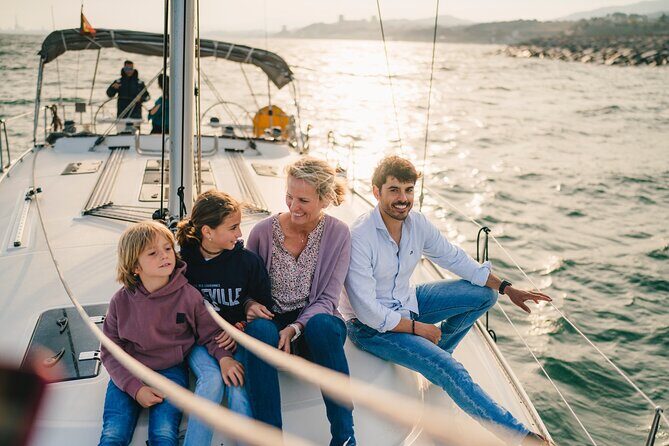
One of the most praised parts of this tour is how it feels in practice. The boat is typically clean, spacious, and comfortable, and the crew is friendly and attentive. That matters more than you’d think, because sunset tours can get stressful if service feels slow or chaotic.
Here’s what to expect from the way the tour is set up:
- A guide on hand to point things out and explain what you’re seeing.
- Time to relax without being constantly redirected.
- A group size capped at 10, which keeps things from turning into a stampede.
If your guide happens to be Mary, you may get that extra layer of local passion—clear explanations paired with time to just enjoy the light. Even without that specific guide name, the format is designed for engagement without pressure.
What you should do on your side: pick a spot and stay there for a bit. Constant moving can lead to missed views. You’ll get better photos and a calmer mindset if you settle in and let the scenery come to you.
What to wear and bring for a smooth evening
This is simple, but it affects your enjoyment.
Bring:
- A camera (you’ll want it once the sky changes)
- A jacket (even mild evenings can feel cool on the water)
- Comfortable clothes you can sit in for two hours
Also remember:
- No smoking
- No swimming
You don’t need to plan an outfit like you’re going to a gala. This is more about comfort, steady filming, and being ready for a breeze.
If you’re prone to motion sickness, you might find it helpful to choose a seat where you feel stable and keep your gaze level at the horizon. The tour isn’t described as rough, but any boat ride can still be a trigger for some people.
Price and value: is $35 worth it?
At $35 per person, you’re paying for three things at once:
- A guided sunset boat cruise
- A welcome drink
- Access to a water-level view of top Lisbon landmarks
On land, you’d likely spend time and effort bouncing between neighborhoods, paying for transport, and building your own “route.” Here, the river does the connecting. You get the Belém Tower + 25 de Abril Bridge + Discoveries area effect without doing logistics all evening.
Is it the cheapest way to see Lisbon? No. But it’s not trying to be. It’s trying to be an efficient, relaxing way to experience the city’s most famous waterfront points during peak light. For many people, that combination is the value sweet spot: less planning, better sight angles, and a calmer mood.
The main reason it might not be worth it for you is if you hate boat rides, or if you’re only interested in a single landmark and can’t spare the time for the full loop. Otherwise, this is a very reasonable “evening plan with payoff.”
Should you book this Lisbon Tagus sunset boat tour?
Book it if you want a low-stress evening with high visual payoff. It’s especially good for:
- Couples who want a calm shared experience
- Friends who want something scenic that doesn’t require constant walking
- Families looking for an activity that feels special without being complicated
- Anyone who wants river angles on Belém Tower and the 25 de Abril Bridge without fighting for viewpoints
Skip it (or keep expectations flexible) if you’re mainly chasing hands-on museum time, since this is a cruise and you won’t get close-up access to the monuments. Also plan around the fact that the crew can cancel if weather makes boating conditions poor.
If you do book, arrive early at Doca de Alcântara (Gate 2), bring a jacket, and keep your camera ready. This is the kind of Lisbon moment that’s better when you slow down and let the city glow.
FAQ
How long is the Lisbon Tagus River sunset boat tour?
The tour lasts about 2 hours.
Where do I meet the group?
You meet at Doca de Alcântara – Gate 2.
What’s included in the ticket price?
The ticket includes a welcome drink and the sunset boat tour.
Is hotel pickup and drop-off included?
No, hotel pickup and drop-off are not included.
What languages is the live guide available in?
The live tour guide is available in English, French, and Portuguese.
How big is the group?
The tour is a small group limited to 10 participants.
Is smoking or swimming allowed on the boat?
Smoking is not allowed, and swimming is not allowed.
What should I bring and wear for the evening?
Bring a camera, wear comfortable clothes, and bring a jacket since it can get chilly on the water. You should also arrive at the meeting point early.