Sintra in 90 minutes, no stress. This private tuk-tuk loop is a smart way to see the town’s highlights and the Serra viewpoints without losing hours to navigation, parking, or missed photo stops. I like that it’s private and guided in English, so you can ask questions as you go and get pointed at what’s worth your time.
Two things I really like: the tour gives you an early win with the historic center walk, and then it switches gears into classic Serra scenes where the views do the talking. I also appreciate how the stops are timed for quick appreciation plus photo moments, especially around the ruins of Castelo dos Mouros.
One consideration: the big sites come with extra entry fees. Pena Park/Palace and Castelo dos Mouros are not included, and since this tour is about 1 hour 30 minutes, you’ll want to plan your priorities so you’re not rushing through paid stops.
In This Review
- Key things to watch for on this tuk-tuk loop
- A private tuk-tuk primer to Sintra’s best bits
- Warming up in Sintra’s historic center: walk first, smile later
- Fonte Mourisca: a 5-minute stop with serious backstory
- Sintra Town Hall: Manueline architecture in the middle of it all
- Sabuga Fountain and the Fountain of Youth myth
- Casa Biester and the Ninth Door connection
- Parking your eyes at Vale dos Lagos (from Parque da Pena)
- Castelo dos Mouros: ruined walls, Moorish roots, big payoff
- Pena Palace and Parque da Pena: Romanticism plus serious views
- Price and entry fees: is this tuk-tuk worth it?
- How to get the most from 90 minutes
- Should you book this private tuk-tuk through Serra de Sintra?
- FAQ
- FAQ
- How long is the private Tuk Tuk Tour through Serra de Sintra?
- What is the price for this tour?
- Does the tour include pickup?
- Is the tour in English?
- Are tickets for Pena Palace/Parque and Castelo dos Mouros included?
- Is this a private tour?
- Final call
Key things to watch for on this tuk-tuk loop
- Moorish-inspired Fonte Mourisca (built in 1922) for a quick but memorable stop
- Manueline Sintra Town Hall positioned between Vila Velha and Vila Nova
- Sabuga Fountain water stop where you can refill a water bottle for free
- Casa Biester tie-in to the movie The Ninth Door with Johnny Depp
- Castelo dos Mouros ruins on routes tied to early Moorish presence
- Pena Palace and Parque da Pena as the Romanticism highlight, plus major viewpoints
A private tuk-tuk primer to Sintra’s best bits
This is a private tour for up to 2 people. That matters in Sintra, where roads twist and parking can eat time. With a tuk-tuk, you trade some legs for smoother positioning, and you get to choose how much you walk at each stop.
The pacing is also the real value. At about 1 hour 30 minutes, this tour is built for orientation: you see the main lookouts and landmark areas, then you can decide what to return to later. If you only have one short window in Sintra, this is a way to make it count.
You’ll likely get a guide who’s good at reading your pace and planning the route. Some guides you’ll see paired with this experience—like Vanda and Rodrigo—are known for making the drive feel purposeful, with clear explanations and photo-friendly stops. That’s not just nice. It saves you from wandering around guessing what angle is best.
Pickup is offered, and the tour is in English, so you’re not stuck with a translation gap while you’re trying to understand what you’re looking at.
You can also read our reviews of more private tours in Sintra
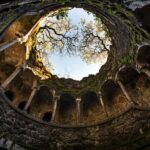
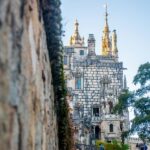
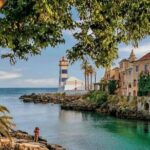
Warming up in Sintra’s historic center: walk first, smile later
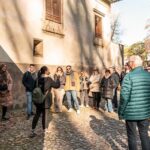
The tour starts in Sintra’s historic center. You’ll move through the old streets with curves and countercurves, passing craft shops, pastry shops, and typical local restaurants. This is a low-pressure opener. You get the feel of town before the Serra climb starts.
The walk isn’t long, and that’s on purpose. In a place like Sintra, your first job is to get your bearings. Once you see how the town is laid out and where the key heritage pockets sit, everything later feels easier.
Also, this early stretch is where you can connect to the vibe: Sintra is famous for palaces, but the streets are where it feels human. The guide will point you toward small details along the way—useful when you don’t have time to read every plaque.
Fonte Mourisca: a 5-minute stop with serious backstory
Stop 1 is Fonte Mourisca, a Moorish-inspired fountain. The timing is brief—about 5 minutes—but it’s the kind of stop that teaches you how Sintra’s heritage works: different periods layered on top of each other, all tied into the town’s daily life.
Here’s what’s worth noticing. The fountain was built in 1922, with a project credited to Master José da Fonseca. It was designed to enhance the village entrance and to dignify what the locals considered the most appreciated water in Sintra.
What I like about this stop is that it’s not just pretty. It gives you a handle on how water and design were used as identity markers. Even in a short tour, it helps you understand why Sintra looks the way it does.
Admission here is free, so you’re not paying to appreciate a quick piece of the puzzle.
Sintra Town Hall: Manueline architecture in the middle of it all
Next up is the Sintra Municipality stop, where you can see the Manueline-style Town Hall. Again, it’s a quick 5-minute look, but it’s well chosen.
The building is positioned between two neighborhoods: Vila Velha and Vila Nova de Estefânia. That’s a practical detail. It means you’re seeing architecture not in isolation, but in the geography of the town. It helps you picture how Sintra expanded and how power and planning showed up in stone.
Manueline style can be visually busy, so don’t try to memorize every feature. Instead, use the stop to get your eye calibrated. Once you’re tuned in, the rest of Sintra’s ornamentation reads easier.
Admission is free here too.
Sabuga Fountain and the Fountain of Youth myth
Stop 3 is Sabuga Fountain, often described as the Fountain of Youth. You’ll have another short 5-minute window, but this one adds a fun layer of local belief.
The guide talks about lore tied to health and healing. Sources named in the tour notes include:
- Osberno, a 12th-century crusader, who said the waters soothed coughs
- Aquilégio (1726), which attributes qualities to curing bilious diarrhoea
- And modern users who still attribute digestive benefits
Now, you don’t need to decide what’s medically true. The payoff is cultural. You’re seeing how legends stick to places, and how a town keeps telling itself stories through physical landmarks.
A practical tip you’ll actually use: bring a water bottle and you can refill it here for free. In Sintra, that’s more useful than you’d think—especially if you’re doing extra exploring beyond the tuk-tuk loop.
Admission is free.


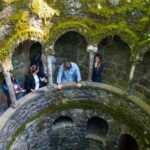

Casa Biester and the Ninth Door connection
As you head toward the Serra area, the tour includes Casa Biester. You’ll find it at the beginning of the Serra de Sintra, where the views start to open up.
This stop has a movie connection: Casa Biester was part of the film The Ninth Door, with Johnny Depp. Even if you don’t care about film trivia, it’s still a useful moment in the schedule. It breaks up the heritage pacing and gives you something different than fountains and town buildings.
Also, because it sits near the point where the Serra vibe kicks in, it’s often a good mental transition. You go from old streets to rolling viewpoints, and that shift makes the later stops feel earned.
Parking your eyes at Vale dos Lagos (from Parque da Pena)
Next, you’ll get the chance to see a viewpoint over Vale dos Lagos, from Parque da Pena.
This is a “look and breathe” moment. The tour doesn’t claim you’ll see everything from here, but it sets you up for what Pena does best: it turns scenery into a show. From this kind of viewpoint, you start to understand why Pena Palace became such a magnet for visitors.
In a short tour, these in-between viewpoints are not filler. They’re what help you connect the dots between the palaces and the mountains.
Castelo dos Mouros: ruined walls, Moorish roots, big payoff
One of the main paid highlights is Castelo dos Mouros. The ruins sit on two peaks of the Serra de Sintra, and the tour frames them as an early Moorish-era presence tied to occupation starting in the 8th century.
Admission isn’t included (budget €12 for Castelo dos Mouros), but the stop is worth planning around because the location does so much work. When you’re up there, the walls and tree cover make it feel like a natural fortress. You’re not just visiting a structure—you’re experiencing a viewpoint network.
Why this stop works on a tuk-tuk itinerary:
- You get a ride-position that makes reaching the ruins simpler
- You get a guided interpretation without having to figure out what to prioritize
- You get a photo-friendly angle right when you’re closest to the drama of the Serra
The one thing to keep in mind is that ruins tend to come with uneven ground and small walking stretches. The tour is only part walking, part viewing, but you’ll still want shoes that don’t punish you.
Pena Palace and Parque da Pena: Romanticism plus serious views
The final major attraction is Parque and National Palace of Pena. The tour uses the main entrance area as the meeting point for the descent, so you’re not left guessing where you need to be when the tuk-tuk is ready to move again.
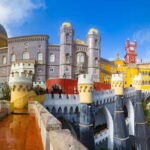
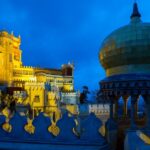
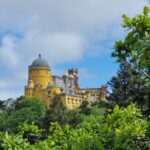
Pena Palace is one of Sintra’s signature sights for a reason. It represents one of the best expressions of 19th-century Romanticism, rising on a steep rock. It’s the second highest point in the Serra de Sintra, which is part of why the views feel so broad from the grounds and approaches.
Two other facts the guide may highlight:
- July 7, 2007, it was chosen as one of Portugal’s seven wonders
- It’s often described as the first Romantic palace in Europe, built about 30 years before Neuschwanstein
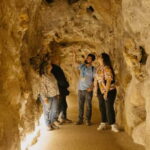
The Park portion matters too. Pena’s grounds include paths and garden constructions with bridges, caves, benches, pergolas, and fountains. You can also find greenhouses and nurseries connected with camellias, rhododendrons, and roses of unusual strains.
And yes, plant lovers have something to enjoy here. The Parque da Pena is known as having one of Europe’s richest sets of tree species, tied to origins that are hard to find in many other places today.
Costs are separate here. The tour notes that Park/Palace involves fees, with €14 listed for Park and National Palace of Pena and an additional €20 per person listed for National Park and Palace of Pena admission. You’ll also want to budget for anything not included on the day, like parking fees.
If you care about gardens, take your time looking outward before you rush inside. A lot of the magic is in the way the palace sits against the mountain and tree cover.
Price and entry fees: is this tuk-tuk worth it?
The price is $216.86 per group (up to 2) for about 1 hour 30 minutes. That base cost is for private transportation, not for the palace admissions.
So what are you really paying for? Time and convenience, plus a route that hits several top areas. In Sintra, that’s the hard part: getting around. A shared bus can work, but it usually gives you less flexibility on viewpoints and walking choices. Here, you’re paying to shrink the time cost and grow the visit quality.
Now add the likely extras:
- Castelo dos Mouros: €12
- Pena Park/Palace: €14 plus €20 per person admission for National Park and Palace of Pena
- Parking fees may apply
Even with those add-ons, the structure is still often good value if you:
- have limited time
- want an efficient introduction to Sintra
- prefer a route someone else plans
- like the idea of doing quick viewing stops first, then choosing what to return to
If you’re the type who already has a strict plan and doesn’t want any guidance, a private tour may feel like paying for motion. But if you’re trying to get oriented fast, the money tends to make sense.
How to get the most from 90 minutes
This tour is short. So your best move is to show up ready to spend your energy on what matters most to you.
A few practical tips that fit the actual route:
- Bring a water bottle. You can refill it at Sabuga Fountain for free.
- Pack layers. Serra areas can feel cooler than the town center.
- Keep camera and phone handy. Several stops are designed for quick photo opportunities.
- Decide in advance how much you want to walk at Castelo dos Mouros and within the Pena area, because those are the stops where time can vanish fast.
Also, if you’re planning a meal, ask your guide for a recommendation. One of the standout notes from guides paired with this tour includes Rodrigo suggesting an excellent restaurant with a view. That’s the kind of local practical help that extends your day.
Should you book this private tuk-tuk through Serra de Sintra?
Book it if you want a fast, well-organized way to see Sintra’s signature highlights—historic center details, fountain lore, and the Serra viewpoints—without the stress of figuring out timing and logistics. It’s especially smart for couples or small groups who only have a short window and want a clear sense of what to revisit later.
Skip or reconsider if you’re trying to avoid paid entries and you already know you’ll spend most of your time only at one big site. With this tour, the guided approach is the value, and the paid stops are part of the deal.
FAQ
FAQ
How long is the private Tuk Tuk Tour through Serra de Sintra?
It lasts about 1 hour 30 minutes.
What is the price for this tour?
The price is $216.86 per group, up to 2 people.
Does the tour include pickup?
Pickup is offered.
Is the tour in English?
Yes, it’s offered in English.
Are tickets for Pena Palace/Parque and Castelo dos Mouros included?
No. Park and National Palace of Pena, National Park and Palace of Pena admission, and Castelo dos Mouros have additional fees not included.
Is this a private tour?
Yes. It’s private, and only your group participates.
Final call
If your goal is to see the highlights and learn what matters in a tight schedule, this private tuk-tuk route is one of the easiest ways to do it. You’ll finish with both great views and a clearer map of where you might want to go next.