Lisbon can feel like a blur. This private day keeps it clear. You get an 8-hour route across the main neighborhoods, but the real win is the flexibility: you can shape the pace and focus with your guide so the day feels like your Lisbon, not a checklist. I especially like that you can choose a start time and use the guide to handle the language barrier when you need directions or context.
Two things I’d put at the top: the comfort (pickup, a very comfortable vehicle, bottled water, and Wi‑Fi) and the guidance (a licensed guide who can explain what you’re seeing as you move). One thing to consider is that monument and pastry costs can add up, since not every site entrance is included.
Because the route covers a lot of ground, the day works best when you’re ready for an active sightseeing rhythm. If you want a slow, sit-down-only day, you may want to adjust your time at each stop during the tour.
In This Review
- Key things I’d bookmark before you go
- Why this private Lisbon plan works so well for a first visit
- The “value” question: what your money buys here
- The day at a glance: Parque das Nações to Belém
- Stop 1: Parque das Nações and the story of Expo ’98
- Stop 2: Alfama, Lisbon’s oldest streets and fado roots
- Stop 3: Lisbon Cathedral area and Saint António’s birthplace site
- Stop 4: Baixa, Rossio, and Restauradores after the 1755 earthquake
- Stop 5: Parque Eduardo VII and the England–Portugal link
- Stop 6: Belém’s waterfront and the era of Portuguese exploration
- Stop 7: Mosteiro dos Jerónimos and the Pastéis de Belém moment
- Who this private tour fits best
- How the guide quality shows up in your day
- Things to plan for so the day feels easy
- Should you book the Passeio Privado de Lisboa?
- FAQ
- How long is the private Lisbon tour?
- What does the tour price include?
- Is the tour really private?
- Do I need to pay for entrance tickets?
- Does the tour offer pickup from my hotel?
- Can I choose a start time?
- What if it rains?
- Is the cancellation flexible?
Key things I’d bookmark before you go
- Private and fully flexible from start to finish: you steer the schedule with your guide.
- Hotel pickup plus an extremely comfortable vehicle: less hassle, more sightseeing time.
- You get Wi‑Fi and bottled water in the car: small comfort that helps on a long day.
- Stops include Alfama, Baixa/Rossio, Parque Eduardo VII, and Belém: classic Lisbon in one loop.
- Some entrances and Belém pastries cost extra: plan for a few add-ons.
- Family-friendly touches: child chairs and rain hats are provided.
Why this private Lisbon plan works so well for a first visit
Lisbon is the kind of city where you can spend a whole day and still feel like you missed the point. This private format fixes that problem by doing two jobs at once: it gets you to the key areas, and it gives you enough control to slow down or speed up based on what you actually care about.
The “private” part matters. With only your group in the vehicle, you aren’t squeezed into someone else’s pace. The guide can also help you ask questions—without the awkward stares when you’re trying to figure out the right street or the right words.
And because you can pick your start time, you can avoid the worst parts of your own schedule chaos. Late morning? Fine. Earlier start so you get the views before the light changes? Also fine. You’re not stuck with a fixed departure that forces your day around the tour.
The “value” question: what your money buys here
At $254.50 per person for about 8 hours, this is not the cheapest way to see Lisbon. But it isn’t overpriced in the way some “private” tours are. You’re paying for several very practical things that add up fast:
- Pickup and drop-off at your hotel (or another location you choose)
- A licensed guide who can explain what you’re seeing
- A comfortable, air-included ride with Wi‑Fi and bottled water
- A private setup with only your group participating
- A plan you can customize, rather than a rigid script
Where the cost can grow is admissions and meals. Monument entrances are not included across the board, and Pastéis de Belém tasting is specifically not included. If you’re the kind of traveler who hates surprise add-on fees, that’s the main thing to watch. But if you like flexibility and comfortable logistics, this format gives you more than just transportation.
The day at a glance: Parque das Nações to Belém
This is a one-day loop that makes sense: start with a modern, easy-to-reach district, then move into historic neighborhoods, then finish with the grand Belém monuments and the famous pastry stop.
The timing on the stops is built for learning without burning your legs. Most segments are about an hour, with one longer stretch in central Lisbon. A typical day like this is ideal when you want a first pass at the city’s “why,” not just photos.
Stop 1: Parque das Nações and the story of Expo ’98
You start in Parque das Nações, Lisbon’s former Expo 98 zone. The area is huge—about 330 hectares—and what I like about this stop is that it shows how Lisbon modernized after the world event ended.
You’ll hear how the urban landscape changed. Before the Expo, the land held industrial uses like refineries, warehouses, and other working sites. After Expo ’98, the district went through intense rehabilitation and became a more refined, business-linked part of the city, with strong connections to the train and metro. That matters because it’s not just history on a map; it explains why getting around can feel easier in this area.
This stop is also a good “warm-up” segment. Admission is listed as free here, and the focus is on orientation and context: where you are in Lisbon’s broader story, and why this part of town looks the way it does.
Stop 2: Alfama, Lisbon’s oldest streets and fado roots
From modern Lisbon, you head into Alfama, the city’s oldest neighborhood. This is the part where Lisbon stops feeling like a city you’re driving through and starts feeling like a place with a pulse.
Alfama is described as an ancient Medina with tight lanes and defensive-looking paths shaped by history. After the Christian Reconquest, the story gets more complicated, with Arabic culture moving to nearby hills and helping form the neighborhood of Mouraria. It’s the kind of context that makes the maze of streets feel purposeful, not random.
And then there’s fado—Portugal’s signature music. You’ll connect fado’s tone to the idea of saudade, a word that’s hard to translate but easy to feel once you’ve been walked through the setting where it took root. Even if you don’t plan a fado night, understanding the roots makes the neighborhood visit hit harder.
This stop runs about an hour, and admission is listed as free, so you can use the time to wander with purpose rather than worrying about tickets.
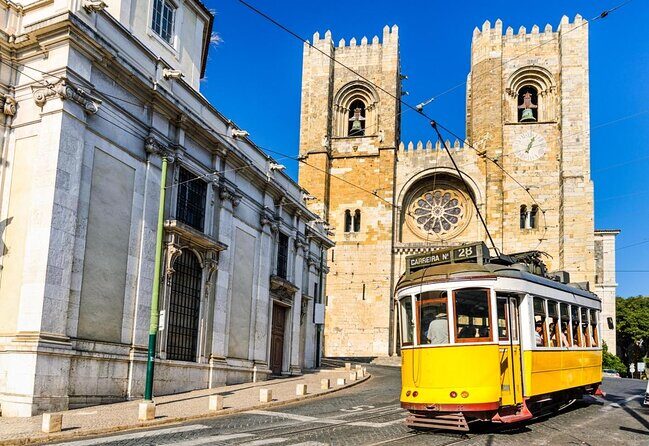
Stop 3: Lisbon Cathedral area and Saint António’s birthplace site
Next up is the Lisbon Cathedral area, centered on the church of Santo António. This is a great stop if you like religious history that links directly to a real person’s life.
The focus here is that Santo António’s church is built on the exact site associated with his birth. The timeline matters too: construction is described as dating to the 12th century under D. Afonso Henriques, right after Lisbon was conquered from the Moors.
The important practical note: admission is not included for this stop. That doesn’t make it a bad stop—cathedral areas are usually worth it—but it does mean you should expect a ticket cost if you choose to go in.
Stop 4: Baixa, Rossio, and Restauradores after the 1755 earthquake
This is your longer central Lisbon block, about two hours in Baixa, Rossio & Restauradores. If you want Lisbon’s “big idea,” this is where it lives.
You’ll walk through the aftermath of the 1755 earthquake and how it changed Portuguese thinking and the city’s architecture. The tour frames the rebuilding approach as a deliberate shift: wider streets, more squares, and architecture designed for the real possibility of seismic shocks. You’ll also hear about the role of Marquês de Pombal, who drove reconstruction and helped shape the economic and social changes that followed.
Why I like this stop for first-timers: it helps you read Lisbon’s layout. When you understand why streets and open spaces are where they are, you stop feeling lost and start feeling like you’re decoding the city.
Admissions are listed as free here, so the time you spend is mainly about streets, buildings, and explanation—not ticket lines.
Stop 5: Parque Eduardo VII and the England–Portugal link
After the central core, you rise to Parque Eduardo VII. This is a view stop, but it isn’t just for selfies. It’s a “connect the dots” moment.
From the top, you get panoramic city sightlines, and the tour ties the view to broader relationships between Portugal and England—using treaties and alliances as part of the story. That connection is also linked to how the formation of the Portuguese colony in Brazil played into a changing world landscape after independence.
This stop is free and lasts about an hour. It’s especially useful if you want to understand Lisbon’s nickname as a city of seven hills. After you’ve stood above it, the “up and down” feel of Lisbon becomes less of a workout surprise and more of a planned city feature.
Stop 6: Belém’s waterfront and the era of Portuguese exploration
Next you head west to Belém, where Lisbon leans into monuments and maritime history. This stop is described as packed with historical sites, museums, and attractive gardens along the Tejo (Tagus) estuary.
The tour emphasizes the idea that this area was once tied to docks and shipbuilding—the kind of place where explorers prepared for long routes toward India, Africa, and Brazil in the 15th century. It’s a practical framing: you’re not just looking at buildings, you’re learning why ships left from here and how wealth from colonies flowed back to Portugal.
This stop is about an hour and listed as free for admission. In my view, that makes it a great “breather” before the bigger-ticket monument moment near the end of the day.
Stop 7: Mosteiro dos Jerónimos and the Pastéis de Belém moment
You finish with the Mosteiro dos Jerónimos, a major 16th-century site tied to the age of exploration. This is the part of the day that feels most ceremonial, and it’s one of Lisbon’s true “don’t miss” landmarks.
The tour also points you toward the associated area, including the famous tower of Belém (with your guide explaining how the pieces connect). This is where the city’s maritime story becomes stone and design.
But here’s the budget reality: admission is not included for this segment. The plan also includes a visit and tasting at Pastéis de Belém, and that is also listed as not included. In other words, plan for pastry costs as a finishing treat, not a surprise.
Even if you’re not a sweet-tooth person, this stop is worth it because the bakery is tied directly to the cultural identity of Lisbon. The pastry stop is short, but the symbolism is big: it’s a simple end to a day about ships, wealth, and the way Portugal remembers its past.
Who this private tour fits best
This experience is a strong match if you:
- Are visiting Lisbon for the first time and want the big neighborhoods without planning
- Prefer a private, flexible day where you can adjust the pace
- Want a guide to help with language and directions
- Like comfort on long days (pickup, Wi‑Fi, bottled water, a comfortable vehicle)
- Travel with kids (child chairs are provided)
If you’re traveling on a tight budget or you don’t want to pay any extra entrance fees, you’ll need to budget for tickets and the Pastéis de Belém stop.
How the guide quality shows up in your day
The written feedback you’d expect to find here is practical: people highlight punctuality, good communication, and that the guides handle timing smoothly. Names that come up include André and Carlos Souza, both described as attentive, punctual, and deeply familiar with the places they explain.
That’s more than nice-to-have. When your schedule is one full day and you’re moving through multiple neighborhoods, a good guide prevents the day from turning into random walking. You get context where it counts—like why Alfama is shaped the way it is, or why Baixa was rebuilt with earthquake risk in mind.
Things to plan for so the day feels easy
A few practical thoughts so you’re not caught off guard:
- Expect some add-on costs for entrances and Pastéis de Belém, since not all sites are covered.
- Wear comfortable shoes. Lisbon includes hills and uneven streets, and your day includes multiple neighborhoods.
- Use the private setup to ask questions. If something looks interesting, your guide can adjust your time where it makes sense.
- If you want a calmer pace, ask early to spend more time at one stop and less at another. The tour is flexible for a reason.
Also, don’t ignore the small comfort features: rain hats and Wi‑Fi are included, which is handy because Lisbon weather can change fast.
Should you book the Passeio Privado de Lisboa?
I’d book this tour if you want a first-time Lisbon day that balances structure with choice. The combination of pickup, comfort, a licensed guide, and flexible pacing is what makes it feel like a real upgrade over trying to do everything on your own.
Skip or rethink it if you’re strongly budget-limited on entrances and meals, or if you prefer a very slow, low-walking sightseeing style. In that case, you might be happier with fewer stops and longer time in one area.
If you’re torn, choose it if you value logistics plus local explanation. It’s the kind of day that helps you understand Lisbon quickly, so the rest of your trip feels easier and more intentional.
FAQ
How long is the private Lisbon tour?
It runs for about 8 hours.
What does the tour price include?
It includes hotel pickup (or another meeting spot you choose), a licensed guide, a private and fully flexible format, Wi‑Fi, and bottled water.
Is the tour really private?
Yes. It’s a private tour/activity, and only your group participates.
Do I need to pay for entrance tickets?
Some entrances are included while others are not. Lisbon Cathedral and Mosteiro dos Jerónimos (and the Pastéis de Belém tasting) are listed as not included, while other stops are listed as free.
Does the tour offer pickup from my hotel?
Yes. The tour starts and ends at your hotel or another location you decide.
Can I choose a start time?
Yes, you can choose a start time that fits your schedule.
What if it rains?
Rain hats are provided.
Is the cancellation flexible?
You can cancel for a full refund up to 24 hours before the experience start time.