Fatima is the kind of place that changes your pace. This full-day route strings together four big Portuguese stops, moving from the Marian devotion of Fátima to the UNESCO-style architecture of Batalha Monastery, then down to coastal Nazaré and the storybook lanes of Óbidos. You get history along the way too, with films as you travel, so the day feels connected instead of like a checklist.
I really like two things here: first, the small group size (maximum eight) makes the day feel manageable, especially once you’re walking through busy sights. Second, the setup inside the vehicle helps you stay comfortable and ready, with onboard Wi‑Fi plus USB sockets for charging, and air-conditioning for the ride.
The one possible drawback is simple: this is a long day with fixed time windows at each stop. Fatima gets 4 hours, but the other towns are shorter, so you’ll want to keep your expectations realistic and plan for a bit of walking and quick photo stops.
In This Review
- Key highlights
- A 9-Hour Private Day From Lisbon: Small Group Comfort
- Fátima’s Basilica and the 1917 Story: Why This Stop Gets Real Time
- Batalha Monastery’s Manueline Details: UNESCO for the Detail-Spotters
- Nazaré Coastal Cliffs and Big-Wave Lore: Views With Perspective
- Óbidos Medieval Lanes and the Ginjinha Cup Tradition
- What You Get For Your Money: Value, Comfort, and Time Windows
- Who This Tour Fits Best (and Who Might Prefer Something Else)
- Final Call: Should You Book This Full-Day Route?
- FAQ
- Is pickup offered for the Private Tour Fátima – Batalha – Nazaré – Óbidos?
- How long is the tour?
- What’s included in the price?
- Is lunch included?
- Are admissions included at each stop?
- Is the tour only for my group?
- Can I cancel for a full refund?
Key highlights
- Max group size of eight for a more personal feel than big-bus tours
- Onboard Wi‑Fi + USB charging sockets so you can stay connected during the ride
- 4 hours in Fátima at the shrine, including time near key basilica areas
- UNESCO-listed Manueline/Gothic details at the Batalha Monastery
- Scenic Nazaré coastal views paired with Portugal surfing lore
- Óbidos with the ginjinha tradition and time for wandering medieval lanes
A 9-Hour Private Day From Lisbon: Small Group Comfort
This is a full-day outing that starts early, around 8:30 am, and runs for about 9 hours total. The best part of that schedule is that it gets you out of Lisbon while the day is fresh, then you cover the essentials of central Portugal in one shot.
The tour is set up as private for your group, with a maximum of eight people. That matters more than you’d think. When you’re visiting holy sites, a monastery, and two towns, the bottlenecks are real—entry lines, crowds at viewpoints, and time to move between spots. With a small group, you spend less time waiting and more time actually seeing.
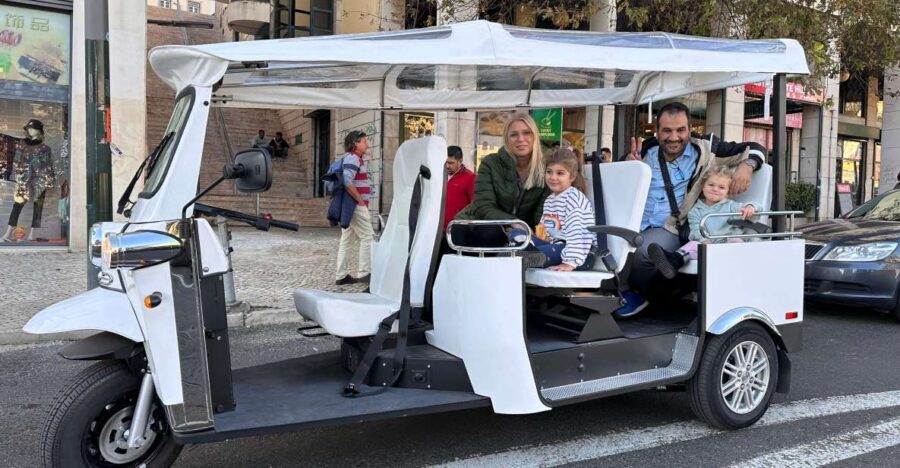
Inside the vehicle, you’re not stuck in airplane-mode. There’s Wi‑Fi on board, USB charging sockets, air-conditioning, and water. Also, there are films as you travel, which helps you link what you’re seeing today to Portuguese history and the significance of each stop. If you’re the type who likes context (and not just photos), this adds real value.
One more practical note: you’re getting a mobile ticket, and the tour runs in English (and may be guided by a multi-lingual guide). For international visitors, that reduces the usual day-of-the-tour stress.
Fátima’s Basilica and the 1917 Story: Why This Stop Gets Real Time
Fátima is your first major stop, at the Basilica de Nossa Senhora do Rosário de Fátima and the Shrine of Fátima area in Cova da Iria. This isn’t just a church visit; it’s a world-known Catholic pilgrimage center tied to the apparitions in 1917. The key people are the three young shepherds: Lúcia dos Santos, Francisco Marto, and Jacinta Marto.
What I like most about starting here is that the day has a clear emotional anchor. Once you’re there, you understand why the shrine receives around six million visitors a year and why major popes have visited over time, including Pope John Paul II, Benedict XVI, and Pope Francisco. Even if you’re not traveling for religious reasons, the scale and devotion are hard to miss.
You get about 4 hours here, and that’s the right amount of time. With a shrine like this, it’s not only about what’s inside a single building. You also need room to step back, take in the grounds, and understand the timeline. Construction of the sanctuary began in 1919, following the events of 1917, and the area includes the Chapel of the Apparitions as a key starting point for the site’s development.
One timing tip: try to use your first hour for orientation. You’ll see a lot quickly if you rush, but the place makes more sense when you slow down. Use the extra time to get your bearings, then focus on the parts that connect most to your interests—architecture, story, or simply the atmosphere.
Admission is free for this stop, which is another plus for value. Just remember that a religious site can mean crowds and lines, so comfortable shoes and patience help.
Batalha Monastery’s Manueline Details: UNESCO for the Detail-Spotters
Next up is the Monastery of Santa Maria da Vitória, also known as the Monastery of Batalha. The origin story is vivid: it was built in 1386 by King João I as a thank-you for the victory against Castilian rivals in the Battle of Aljubarrota.
This is where the tour shifts from devotion to design. The monastery is associated with the Dominican Order of St. Dominic and took shape over a long stretch, with construction spanning about two centuries until around 1563, during the reign of several Portuguese kings. That long build time is part of why the monument feels layered and expressive.
The big architectural takeaway is Manueline-style craftsmanship, alongside Gothic influences. It’s UNESCO-listed, and it rewards people who like to look closely. If you pause for a minute, you can spot how the ornament and structure work together, not just how the building looks from far away.
Your time here is about 1 hour, and admission is not included. That means you’ll want to plan around potential entry procedures and ticket handling so you don’t waste your one hour.
Is one hour enough? For many people, yes—if you come with a simple plan. Pick one or two things you want to focus on (facade details, interior features, or the overall layout) and don’t try to photograph everything. A monastery doesn’t give its best in a sprint.
Nazaré Coastal Cliffs and Big-Wave Lore: Views With Perspective
After Batalha, you head toward Nazaré, westward to the coast. Nazaré is one of those places where the geography does the work: cliffs, ocean views, and a coastline that feels dramatic even when you’re just standing and looking.
This is also a modern tourism magnet because of surfing. Nazaré became famous worldwide after Garrett McNamara surfed the biggest wave in the world in 2011, roughly 24 meters (79 feet). Even if you’re not into surfing, that story adds context to what you’ll see—this is a coastline where the ocean can be serious.
You’ll have about 1 hour here, with admission listed as free. For me, the ideal way to use this hour is to choose one viewpoint and take your time there. You don’t need to cover every street; you need to soak up the cliff-and-coast perspective and then decide whether you want a short walk down or a quick look around town.
One consideration: coastal weather can change fast. The tour doesn’t mention special gear, so bring layers if you run warm indoors but feel cool at sea level.
Óbidos Medieval Lanes and the Ginjinha Cup Tradition
Finally, you reach Óbidos, the medieval village that people love for its tight streets and storybook feel. Here, the tour’s highlight is the classic local ritual: drinking ginjinha (cherry liqueur) in a chocolate cup. It’s one of those traditions that turns a visit into a memory you can actually taste.
Óbidos also has deep historical layers. It was taken to the Moors in 1148, received a charter in 1195 under D. Sancho I, and later became part of the dowry system for many Portuguese queens, including D. Urraca of Castile, Queen Santa Isabel, and others. That background helps explain why the village carries such a distinct, royal-ish identity.
The tour gives you about 2 hours here, which feels right. That extra time compared with Nazaré is useful because Óbidos is a place where you can wander, stop in a shop, or simply walk the walls and lanes without feeling rushed.
Admission is listed as free, which also improves value. Still, food and drinks aren’t included, so if you want more than one snack or want to buy something, set aside some spending money.
Quick practical advice: if you go for the ginjinha, pace it. The chocolate cup can be messy, and the village streets can be slick with foot traffic.
What You Get For Your Money: Value, Comfort, and Time Windows
At $168.58 per person for a full day, you’re paying for convenience, comfort, and an organized flow between four different stops. The value comes from the combination of small-group size, private-group format, and the ability to hit Fátima, Batalha, Nazaré, and Óbidos in one day without figuring out transport between them.
Here’s what you’re clearly getting:
- Pickup offered
- Air-conditioned vehicle
- Onboard Wi‑Fi
- USB charging sockets
- Bottle of water
And what you’re not getting:
- Food and drinks
- Lunch
Because lunch isn’t included, I suggest planning around snack timing. With fixed stop durations, hunger can turn into stress quickly. Carry a small snack with you if you think you’ll need it, and be ready to handle lunch on your own during the gaps.
Dress code is smart casual, and children must be with an adult. Service animals are allowed, and most travelers can participate. If you have mobility limits, the itinerary includes several walking segments in villages and at a large shrine, so it’s worth thinking about your stamina before committing.
Also, the tour may be operated by a multi-lingual guide. English is offered, and films in the vehicle add continuity, so you won’t feel totally cut loose during transfers.
Who This Tour Fits Best (and Who Might Prefer Something Else)
I’d point this tour toward travelers who want a structured day but don’t want a crowded bus experience. The maximum eight group size is perfect for:
- families who want smooth logistics and a guide who can manage pace
- history-minded visitors who like the story behind each place
- first-timers who want a high-value route across central Portugal without planning every leg
One thing I loved in the way the day is run: the guide experience can be a real part of the trip, especially for kids. I was particularly impressed by Lima, who, in at least one group experience, kept children entertained and stayed flexible with the family’s needs. That kind of personal touch is often what separates a good day from a truly easy one.
If you’re the type who likes long stays and slow travel, you might find the stop durations tighter than you’d like. Still, the day is built around smart coverage: 4 hours where it matters most (Fátima) and shorter visits where you’re there for atmosphere and highlights (Nazaré and Óbidos).
Final Call: Should You Book This Full-Day Route?
Yes, I’d book it if you want a smooth, well-paced route that hits the big names: Fátima, Batalha Monastery, Nazaré, and Óbidos—all in one day. The onboard Wi‑Fi, charging sockets, and small group size make the transfers feel less painful, and the time in Fátima is generous enough to feel like more than a quick photo stop.
Skip it (or look for a slower alternative) if you hate tight schedules or you want lots of free time in each village. This tour is built for momentum, not wandering all day.
If you want a first taste of Portugal’s central highlights with comfort and context, this is a solid pick. Just plan for a long day, eat before you get too hungry, and take it one stop at a time.
FAQ
Is pickup offered for the Private Tour Fátima – Batalha – Nazaré – Óbidos?
Yes. Pickup is offered, and the tour meets at 8:30 am.
How long is the tour?
The duration is listed as approximately 9 hours.
What’s included in the price?
Included items are bottle of water, USB charging sockets, onboard Wi‑Fi, and an air-conditioned vehicle.
Is lunch included?
No. Food and drinks are not included, and lunch is not included.
Are admissions included at each stop?
Fátima admission is listed as free. Batalha Monastery admission is not included. Nazaré and Óbidos are listed with free admission.
Is the tour only for my group?
Yes. It’s a private tour/activity, so only your group will participate, with a maximum group size of eight.
Can I cancel for a full refund?
Yes. You can cancel up to 24 hours in advance for a full refund.