Lisbon looks different when someone points things out. This Lisbon walking tour links Chiado and Baixa with stories tied to the 1755 disaster, plus plenty of stop-and-look moments in central squares and shop streets. You’ll meet at Estação Ferroviária do Sul e Sueste and finish near Praça Luís de Camões, with a professional photographer along for vacation-worthy shots.
I especially love the way the guide spots the small visual clues—like where old uses show up in storefront details and building trim—and then turns that into a clear mini-history you can actually remember. I also like that you’re not left to guess for photos; the photographer is there to help you get the angle right in places like Praca do Comércio and the Santa Justa lift area.
One possible drawback: it’s a 3 to 4 hour walking loop in the downtown core, so if you’re easily tired or you have tight timing for later plans, you’ll want to plan your day around the end point at Praça Luís de Camões.
In This Review
- Key highlights at a glance
- Why Chiado and Baixa make this Lisbon walking tour feel worth it
- Starting at Estação Ferroviária do Sul e Sueste: your convenient anchor
- Praca do Comércio (Terreiro do Paço): the Royal Square and the 1755 rebuild
- Santa Justa area (Elevador de Santa Justa): lift views plus 19th-century Lisbon vibes
- Praca Dom Pedro IV: Lisbon’s most popular square and the ground you can’t ignore
- Praca da Figueira: Original shops and the Hospital for Dolls
- Igreja de São Domingos: a majestic facade with a surprising interior story
- Luvaria Ulisses and the Carmo Wall: tiny shop inside big stone history
- Armazens do Chiado: the department-store memory lane
- Bertrand bookstore area and Brasileira café culture
- Fernando Pessoa sculpture: Lisbon’s writer energy in a single stop
- Praça Luís de Camões: romantic Lisbon and a lively finish
- What the guides and photographer add (beyond facts)
- How to get the most out of your 3 to 4 hour route
- Is this tour good value for $29.64 per person?
- Who should book Lisbon Trendy Downtown
- Should you book Lisbon Trendy Downtown?
- FAQ
- How long is the Lisbon Trendy Downtown walking tour?
- Where do we meet, and where does the tour end?
- What’s included in the tour price?
- How much does it cost?
- Is this tour suitable for children?
- Can I cancel and get a full refund?
Key highlights at a glance
- Chiado + Baixa on foot: a focused downtown route without wasting time zigzagging.
- 1755 rebuilt Lisbon theme: you’ll see how the city’s key squares were rebuilt and reshaped.
- Santa Justa, Praca Dom Pedro IV, and Praca do Comércio: major landmarks, explained in plain language.
- Tile, storefront, and architectural details: the guide points out evidence you’d normally miss.
- Professional photographer with you: helpful framing so your pictures look like you planned them.
- Private tour for your group: only your party participates, so questions stay easy.
Why Chiado and Baixa make this Lisbon walking tour feel worth it
If you want Lisbon without the rushed bus-stop vibe, this is the kind of walking tour that helps you slow down just enough. The route takes you through two of the most “Lisbon-feeling” neighborhoods—Chiado for shops and writerly corners, and Baixa for the grand rebuilding-after-1755 story in wide squares.
The value is in how it’s paced and supported. You get a local guide plus a professional guide, and a professional photographer is part of the group, so you’re not only learning—you’re also leaving with better photos.
And yes, it’s designed for history lovers, but it doesn’t drown you in dates. The emphasis is on what you can see right now: facades, squares, and the way shops and buildings carry layered identities.
Starting at Estação Ferroviária do Sul e Sueste: your convenient anchor
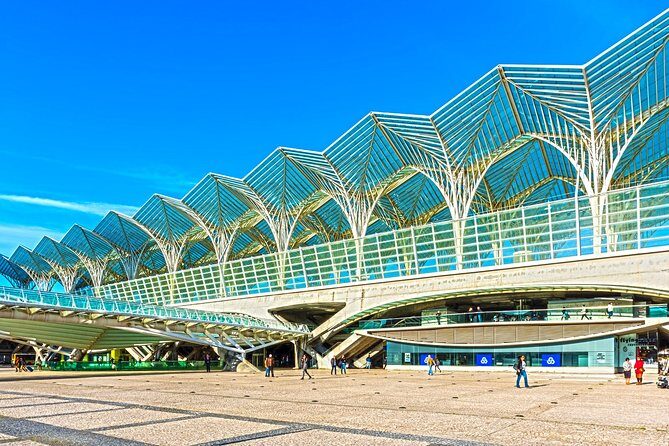
You meet at Estação Ferroviária do Sul e Sueste, at Av. Infante Dom Henrique 1B (1100-016 Lisboa). This is a practical start because it puts you in Lisbon’s central flow from the beginning, instead of dragging you across town for the first 10 minutes.
The route then carries you through the downtown core and ends at Praça Luís de Camões (1200-243 Lisboa), near the Baixa/Chiado underground station entrance. That end point matters: it’s a great place to keep walking, snack, or line up the next leg of your day without backtracking.
Also, the tour uses a mobile ticket, which is simple if you’re juggling maps, photos, and your phone battery.
Praca do Comércio (Terreiro do Paço): the Royal Square and the 1755 rebuild
Your first stop is Praca do Comércio (Terreiro do Paço), for about 20 minutes. This is one of Lisbon’s most dramatic starting points: the majestic buildings, fine sculptures, and the scenic pier setting give you instant scale.
What makes it more than a pretty square is the theme of repair after the 1755 flood/tsunami. Lisbon’s downtown identity is tied to that rebuilding, and here you can see how the city’s “before and after” feel show up in the layout and grandeur.
What to watch for: look at the way the square frames the waterfront and how the architecture is built to feel formal and balanced. If you like photography, this is a strong early location because you’ll have plenty of space to capture the pier and the surrounding facades.
Santa Justa area (Elevador de Santa Justa): lift views plus 19th-century Lisbon vibes
Next comes the Elevador de Santa Justa stop, about 15 minutes. Even if you’re mainly viewing it from street level, the Santa Justa lift area has that instantly recognizable “Lisbon postcard” look—an elegant structure tied to 19th-century versions of the city.
The tour also points you toward nearby flavor points connected to that period: Pastelaria A Camponesa and Animatógrafo are named as part of this zone, which is useful because it helps you connect the lift landmark to the living street around it.
Photo note: the lift area is great for vertical shots and dramatic angles, but you’ll get more out of it if you’re told where to stand. That’s where the photographer support becomes a real advantage—your pictures will look less like accidental snapshots.
Praca Dom Pedro IV: Lisbon’s most popular square and the ground you can’t ignore
From there, you head to Praça Dom Pedro IV for about 15 minutes. This is described as the most popular square in town, and it earns that reputation with a strong frame of 18th-century buildings.
The details here are the fun part: you’ll also spot the National Theater, a wave-pattern pavement, and a couple of historic coffee shops. That wave pavement is the kind of thing people walk over without noticing—until someone tells you it’s part of the design.
A drawback to consider: because it’s popular, it can feel busy. If you’re hoping for a calm photo with zero people, you may have to wait a minute or accept that you’re photographing Lisbon as a working city, not a museum set.
Praca da Figueira: Original shops and the Hospital for Dolls
The route then goes to Praca da Figueira (about 15 minutes). This stop is geared toward shopping streets and quirky identity, including Hospital for Dolls.
That matters because downtown Lisbon isn’t just monuments. It’s everyday life layered into old spaces, and Praca da Figueira gives you that texture—shops with character, not just tourist signage.
What you’ll enjoy most here is the guide’s “evidence spotting” approach. You’ll get ideas on what to look for on shopfronts and how storefront choices can hint at past uses. It’s the kind of small-thinking that makes your walking tour feel smarter than a standard sightseeing loop.
Igreja de São Domingos: a majestic facade with a surprising interior story
Next up is Igreja de São Domingos for about 15 minutes. Outside, you’ll recognize the “wow” factor: a majestic facade that signals this is more than a quick stop.
Inside is where the surprise comes in. The tour highlights overwhelming ruins inside and mentions a masonic churchyard. In other words: you’re not just looking at pretty walls—you’re seeing the layers of the city’s past.
Practical bonus: the tour notes the best cherry liqueur just around the corner. I can’t promise you’ll love that specific bottle, but it’s a nice nudge that the area has a “try it now” food-and-drink option close by, which helps you turn a history stop into a full experience.
Luvaria Ulisses and the Carmo Wall: tiny shop inside big stone history
Then you move to Luvaria Ulisses (about 15 minutes). This is one of those Lisbon moments where scale flips in a fun way: you’ll find incredibly tiny shops that are described as directly dug in the massive Carmo Wall.
Around this wall area, the tour also points out “more style-forward” shopping context, including Grandes Armazéns, described here as Parisian-style, and rebuilt after a fire in 1988.
This stop is perfect for people who like the “how did this happen” angle. Even if you don’t go in everywhere, you’ll understand how Lisbon mixes old stone infrastructure with newer retail identities.
Tip for your own pacing: shop streets can tempt you into detours. If you know you get distracted easily, treat this as a “look first, buy later” stop, and you’ll stay on schedule for the rest of the walk.
Armazens do Chiado: the department-store memory lane
Next is Armazens do Chiado for about 15 minutes. The tour frames it as a memory of the department-store area, pointing to named spots like Antigos Armazéns Grandella, Chiado, Paris em Lisboa, and Ramiro Leão.
This is a great stop for understanding how Lisbon’s commercial life evolved in the central core. Even if you’re not shopping, you’ll learn the visual language—signage, storefront scale, and the way these brands occupy space.
If you love architecture details, this stop also benefits from the guide’s skill. Based on what the guide is praised for, you’ll likely get help reading the clues on buildings and storefronts rather than just walking past them.
Bertrand bookstore area and Brasileira café culture
After Chiado’s shopping identity, you head to the Bertrand area (about 20 minutes). Bertrand is highlighted as the oldest bookstore in the world (as described in the tour context), and the walk also includes Brasileira, noted as a muster point for artists and writers for the last hundred years.
This pairing is smart. It connects Lisbon’s “idea culture” (writers and artists) with a literal building associated with books. Even if you don’t read Portuguese, you’ll feel the city’s intellectual rhythm in the way the tour points you to these places.
Photo tip: bookstore entrances and café fronts tend to look best with human-scale framing. With the photographer present, you’re more likely to get that “I’m in Lisbon” look instead of a blurry sign shot.
Fernando Pessoa sculpture: Lisbon’s writer energy in a single stop
Next is the Escultura de Fernando Pessoa for about 15 minutes. This is a smaller stop, but it plays a key role in tying together the Lisbon writer-and-coffeehouse theme the tour is building.
If you like literature history, this one lands. It also works even if you’re not a Pessoa deep-follower, because it gives you a visual anchor in a city full of words.
One thing I like about stops like this: they prevent the tour from becoming only architecture and shopping. You get a quick pause to connect place to person.
Praça Luís de Camões: romantic Lisbon and a lively finish
The final stop is Praça Luís de Camoes for about 10 minutes. The tour frames it as a square that epitomizes Romantic Lisbon, and it’s also identified as one of the most lively places in town.
This is a strong finish because it gives you momentum at the end of your walking effort. You’re not dropping into a dead-end street; you’re finishing near an area where it makes sense to continue your day on your own.
If you’re trying to plan dinner or a post-tour stroll, this is a good place to start looking around immediately since you’ll be ending your guided time right here.
What the guides and photographer add (beyond facts)
The standout praise for this tour centers on the guide’s ability to point out meaningful details. One recent highlight was how the guide explained nuances in architecture, tiles on the ground and buildings, and storefront evidence—basically showing you how design choices can reveal past uses.
That approach makes your walk feel like you’re learning Lisbon’s visual language. Instead of memorizing dates, you start noticing patterns: the way Lisbon rebuilds, the way the city preserves, and the way everyday shops fit into major historical structures.
The photographer also changes the experience. In downtown areas, it’s easy to get “standing there” photos. With a professional along, you can get help with angles and timing, especially at classic backdrops like the squares and the Santa Justa lift zone.
If you’re the kind of person who usually ends up with only a few good vacation photos, this included photography support is a real plus.
How to get the most out of your 3 to 4 hour route
Here’s how I’d set yourself up so you don’t miss the good parts:
- Wear comfortable shoes. You’re walking through central Lisbon for a few hours.
- Bring a fully charged phone or camera. You’ll want it for the square-to-square photo rhythm.
- Keep your pace steady. The tour is timed, and each stop has a short window to look closely.
- Use the guide’s cues for what to notice. The biggest value is not the landmark name; it’s what you’re taught to look for once you’re there.
If you like shopping, this route won’t stop you, but it will keep you moving. If you’d rather browse slowly, treat this tour as the “orientation walk” and do your longer shopping later after you finish.
Is this tour good value for $29.64 per person?
At $29.64 per person, this is priced like an accessible downtown experience. What makes it feel like value is the package: you get local and professional guiding plus a professional photographer, and the stops are marked as admission ticket free in the plan.
Now, it’s still a walking tour. If you’re expecting private car transfers or long museum-style time, this won’t match that. But if your goal is to see major downtown places and understand what you’re looking at, the structure is built for that.
Also, the tour is described as a private tour/activity where only your group participates. That’s a quality-of-life upgrade: fewer crowds with your guide and easier questions.
Who should book Lisbon Trendy Downtown
You’ll probably love it if:
- you like walking tours with explanations you can use on your own later
- you care about architecture and the “why does this look like this” part of Lisbon
- you want help getting photos in key downtown landmarks
- you’re staying in central areas and want a smart route through Chiado and Baixa
You might choose something else if:
- you have very limited mobility or you need long rests (the tour is walking for 3 to 4 hours)
- you prefer a quiet, no-crowds experience at every single square
- you don’t care about guided interpretation and would rather just roam
Should you book Lisbon Trendy Downtown?
I’d book it if you want your Lisbon day to feel organized but not robotic. This route covers famous squares like Praca do Comércio, landmarks like Santa Justa, and identity-rich stops like São Domingos, Luvaria Ulisses, and the Bertrand bookstore area—then ties it all together with details you’ll actually remember.
If you’re on the fence, think about one question: do you want help noticing Lisbon, or do you just want photos and names? If you want help noticing, the guide’s tile-and-architecture focus plus the photographer support make this a strong use of your time.
FAQ
How long is the Lisbon Trendy Downtown walking tour?
It runs about 3 to 4 hours.
Where do we meet, and where does the tour end?
You meet at Estação Ferroviária do Sul e Sueste, at Av. Infante Dom Henrique 1B. The tour ends at Praça Luís de Camões, near the entrance of the Baixa/Chiado underground station.
What’s included in the tour price?
The experience includes a local guide, a professional guide, and a professional photographer guide. It also uses a mobile ticket.
How much does it cost?
The price is $29.64 per person.
Is this tour suitable for children?
Children must be accompanied by an adult. Child rates apply only when sharing with 2 paying adults.
Can I cancel and get a full refund?
Yes. You can cancel for free up to 24 hours in advance for a full refund. If you cancel less than 24 hours before the start time, the amount you paid will not be refunded.