Lisbon feels best when you understand the street plan first. This private walking tour strings together the city’s big eras in a way that actually helps you move around on your own. I like that it mixes major sights with the kind of practical guidance you use later: where to eat, what to skip, and how to pace Lisbon’s hills.
Two things I’d book for right away. First, you get a private, personalized feel, not a factory-group shuffle. Second, the route hits key neighborhoods like Alfama and Baixa, so you leave with a map in your head, not just photos. One thing to consider: it’s still a walking tour with lots of steps and uphill bits, so comfy shoes matter.
In This Review
- Key highlights at a glance
- Starting at Praça do Comércio: Lisbon’s big welcome sign
- Augusta Street Arch and Casa dos Bicos: the city’s layers in miniature
- Sé Cathedral and the move into Alfama’s old streets
- Portas do Sol viewpoint: where your photos finally make sense
- National Pantheon, St. Vincent church, and the castle from the outside
- Baixa and Rua Augusta: Lisbon’s downtown muscle
- Dom Pedro IV square and Rossio: two public squares that act like anchors
- Santa Justa and the engineering-vs-stairs reality check
- The Memorial Jewish Victims: remembering is part of the walk
- Casa do Alentejo and Igreja de S Domingos: grand interiors without rushing
- The “Champs Elysees of Lisbon,” Chiado, and the Carmo square vibe
- Praça Luís de Camões: where the tour ends and your day continues
- What makes the guides stand out (and why it affects your whole day)
- Timing, walking level, and what “3 hours” really feels like
- Price and value: $84.69 for a private orientation you can build on
- Who should book this tour
- Should you book Best of Lisbon Private Walking Tour?
- FAQ
- How long is the Best of Lisbon Private Walking Tour?
- Where does the tour start and end?
- Is this tour private?
- What language is the tour offered in?
- Are there admission tickets included for stops?
- How strenuous is the walking?
- What weather conditions can affect the tour?
- Can I cancel for a full refund?
- Is the meeting point near public transportation?
Key highlights at a glance
- Private guide just for your group (tour time and pace can match your interests)
- Landmarks that anchor the city from Praça do Comércio to Rossio and Chiado
- Alfama + viewpoints for that classic Lisbon feel, narrow streets and all
- Ticket-free stops listed throughout, including Sé Cathedral and several photo breaks
- Guides who tailor and recommend, with examples like Tiago, Beatriz, Samuel, and Telma
Starting at Praça do Comércio: Lisbon’s big welcome sign
Your walk kicks off at Praca do Comercio, Lisbon’s grand waterfront square. It’s not just pretty; it’s historically important, and the tour explains why that square mattered so much to the city. Even if you arrive with zero background, you’ll leave understanding what you’re looking at instead of just photographing it.
This is also a smart start because it sets your bearings. From here, Lisbon’s layout makes more sense as the tour moves into older districts and then back toward the downtown core.
Augusta Street Arch and Casa dos Bicos: the city’s layers in miniature
Next comes the Arco do Triunfo on Rua Augusta, one of Lisbon’s most photographed arch landmarks. The tour breaks down what the arch means, so you know the story behind the postcard view.
Then you pop by Casa dos Bicos, an early-16th-century building dating to 1523. It’s the kind of stop that’s short on purpose: you see a distinctive facade, get the context, and keep moving.
If you like Lisbon because it’s compact, full of contrasts, and slightly chaotic in a good way, these quick hits help you “read” the city.
Sé Cathedral and the move into Alfama’s old streets
At Lisbon Cathedral (Sé Cathedral), you get inside and learn about its architecture and why it’s considered the oldest church in Lisbon, with construction dating to the 12th century. This stop gives you a real sense of what early Lisbon looked like, and it’s also a good pause when the walking rhythm gets steep.
After that, the tour slides into Alfama, Lisbon’s oldest neighborhood, traced back to the 8th century. Alfama isn’t laid out for convenience. It’s a maze of narrow streets that forces you to slow down and look around. That’s the point. You’re not just sightseeing; you’re learning how old Lisbon still works day-to-day.
Portas do Sol viewpoint: where your photos finally make sense
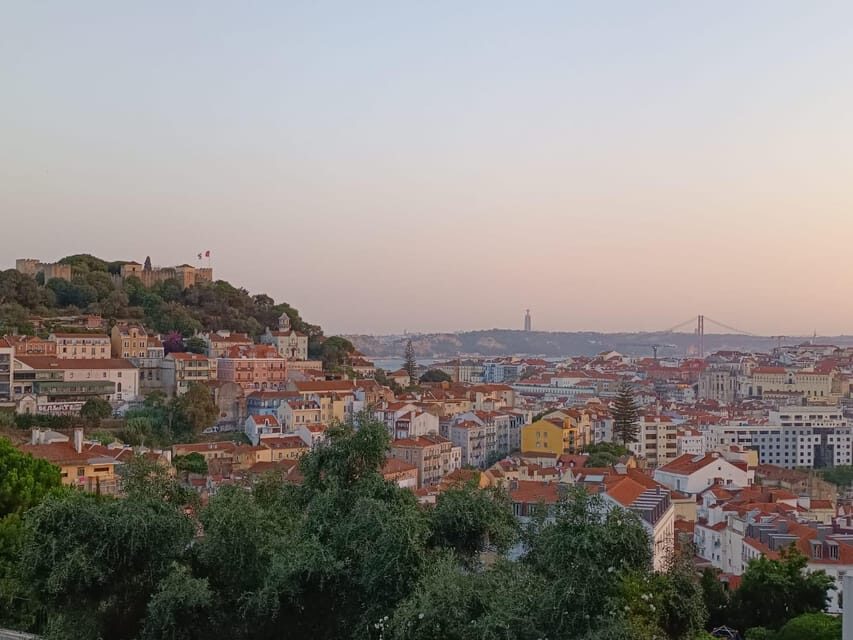
One of the best rewards on this route is Miradouro Das Portas Do Sol, described as the most famous viewpoint in Lisbon. You’ll get time for pictures here, and you’ll understand what you’re seeing from that height.
This is also where the “why this tour is useful” becomes clear. A viewpoint without context is just a view. With a quick explanation from your guide, you can tell how the city rises, where the older streets sit, and how the downtown areas connect.
National Pantheon, St. Vincent church, and the castle from the outside
From there, you’ll see the National Pantheon of Portugal from afar, including the idea that important personalities are buried there. You’ll also spot the impressive church of St. Vincent from a distance and learn why it matters to Lisbon.
Then you reach the St. George Castle area, which has protected Lisbon for centuries. Even if you don’t go into the fortress grounds on this specific walk, the tour’s framing helps. You’ll understand the strategic reason for its location, and that changes the way you see the skyline.
Baixa and Rua Augusta: Lisbon’s downtown muscle
After the steep, atmospheric feel of Alfama, Baixa de Lisboa is a welcome contrast. It’s the downtown area, and the tour explains how it grew into the shopping and central hub it became starting in the 18th century.
Then you head toward Rua Augusta, which the route describes as Lisbon’s most important street, also built in the 18th century. You’ll feel the shift in width and flow here. Baixa and Rua Augusta make the city feel more navigable after the older lanes.
Dom Pedro IV square and Rossio: two public squares that act like anchors
You’ll pass Praca Dom Pedro IV, described as Lisbon’s oldest square, with imposing buildings dating to the 18th century. Squares like this matter in Lisbon because they act like orientation points. Once you connect the dots between Baixa, Rossio, and the hillier parts, you stop feeling lost.
Later, you’ll see Estacao do Rossio, listed as the most beautiful train station in Lisbon. It’s a quick stop, but it’s the kind of landmark you remember, especially if you’re planning day trips by train.
Santa Justa and the engineering-vs-stairs reality check
At Elevador de Santa Justa, you learn why this engineering marvel was built in the area. It’s a very Lisbon moment: technology and infrastructure created solutions for steep geography that would otherwise be miserable.
This stop also helps you plan your own next moves. If you’re planning to hop between higher and lower areas, you now know where the city’s “vertical fixes” are.
The Memorial Jewish Victims: remembering is part of the walk
The tour includes the Memorial Jewish Victims, a stop that remembers one of the saddest episodes in Lisbon’s history. It’s brief, but it gives the day weight. Lisbon is beautiful, yes, but it isn’t only postcards. This kind of stop keeps the tour grounded.
Casa do Alentejo and Igreja de S Domingos: grand interiors without rushing
Then you reach Casa do Alentejo, described as a majestic palace with Moorish influence in the heart of Lisbon. The tour treats it like more than a facade: you get a quick sense of how style signals history and identity in Portugal.
After that is Igreja de S Domingos, described as one of the most beautiful churches in Europe. Again, it’s a stop that balances “see it” with “understand what you’re seeing,” so you’re not just walking past impressive walls.
The “Champs Elysees of Lisbon,” Chiado, and the Carmo square vibe
You’ll also pass the part locals call the Champs Elysees of Lisbon, which gives you a more elegant boulevard feel before the tour pushes into the artsy center.
Next comes Chiado, described as the heart of the city where poets, writers, artists, and politicians meet since the 18th century. Even on a short walking segment, Chiado feels different—more reflective, more urban-café Lisbon.
Then there’s Museu Arqueologico do Carmo, which the description calls an unfinished church and an important symbol, located in a charming square with the same name. “Unfinished” sounds odd until you see it. It’s a good contrast to the rest of the day’s more polished facades.
Praça Luís de Camões: where the tour ends and your day continues
The walk finishes in Praça Luís de Camões (the tour’s end point). It’s a strong landing spot because you’re back in a central zone where it’s easy to grab food, continue walking, or take public transit.
This ending matters for value. You’re not left far from options after 3 hours. You’re placed where Lisbon is easiest to navigate next.
What makes the guides stand out (and why it affects your whole day)
This tour’s biggest strength is how much the guide shapes your experience. The reviews you provided repeatedly point to guides who are both fun and useful—people like Tiago, Beatriz, Samuel, Jose, Kleiber, Natalia, and Telma.
Here’s what that tends to feel like in practice:
- You ask questions and get straight answers, not rehearsed speeches.
- You get restaurant and exploring suggestions you can actually use after the tour.
- The guide can adjust to your interests, like spending more time in Alfama or setting a comfortable walking pace.
One note from feedback: if a guide’s stop explanations run long, you might feel like the day gets slightly off balance. Since this is a private tour, you can correct that quickly. If you want faster sight checks or more time on the viewpoints and less talk on the street corners, ask early. A good guide will match the group.
Timing, walking level, and what “3 hours” really feels like
The tour is listed at about 3 hours and is a true walking experience. In one review, the group clocked about 3 miles with a lot of hills. So even though the route is only a few hours, don’t plan it like a casual stroll.
Bring:
- Comfortable walking shoes (Lisbon’s slopes are real)
- Water, especially on warm days
- A bit of patience when you’re moving from square to square up and down
The good news: the stops are frequent enough that you’re not stuck for ages without a chance to look, rest, or rehydrate.
Price and value: $84.69 for a private orientation you can build on
At $84.69 per person for an approximate 3-hour private tour, the value depends on how you like to travel.
This makes sense if:
- You want an efficient first-day orientation through Lisbon’s main districts.
- You prefer private pacing over group “follow the leader.”
- You’ll use the guide’s food and exploration recommendations immediately.
It may feel less worth it if:
- You don’t mind reading on your own and you’re happy with a generic landmark checklist.
- You want lots of paid museum time, because this walk leans toward exterior sights, viewpoints, and street-level context.
A key value detail: many stops are listed as admission ticket free, including several major landmarks. That helps keep the day from turning into a stack of separate entry fees.
Who should book this tour
Book it if you’re:
- In Lisbon for a short visit and want a clear “map in your head” fast
- Interested in how the city’s old and newer sections connect
- Traveling with teens or family members who do well with lively, story-based guiding
- The type of traveler who wants insider tips on where to eat and what to explore next
You might skip it (or choose a different style) if:
- You dislike hill-heavy walking
- You need frequent bathroom breaks or long indoor museum time (this walk focuses on street sights and architecture)
- You strongly prefer very short stop explanations; ask your guide to keep things moving
Should you book Best of Lisbon Private Walking Tour?
I think this is a strong pick for a first Lisbon day or an early orientation window. You’ll hit recognizable landmarks, get real context at the stops that matter, and end in a central square where you can keep exploring without stress.
If you book, do one simple thing: tell the guide what you care about most before you start—history, viewpoints, food tips, or just moving efficiently. With the tour being private, that request can shape the day fast.
FAQ
How long is the Best of Lisbon Private Walking Tour?
It’s listed at about 3 hours.
Where does the tour start and end?
It starts at Praca do Comercio (1100-148 Lisbon) and ends at Praça Luís de Camões (1200-243 Lisboa).
Is this tour private?
Yes. It’s a private tour/activity, so only your group participates.
What language is the tour offered in?
The tour is offered in English.
Are there admission tickets included for stops?
Many stops are listed as admission ticket free, and you’ll also be taken inside Lisbon Cathedral as part of the walk. For anything not explicitly mentioned, you’d want to confirm on the day.
How strenuous is the walking?
It’s a walking tour with hills. One review noted about 3 miles walked with lots of hills, so plan for uphill segments.
What weather conditions can affect the tour?
The experience requires good weather. If it’s canceled due to poor weather, you’ll be offered a different date or a full refund.
Can I cancel for a full refund?
Yes. You can cancel up to 24 hours in advance for a full refund.
Is the meeting point near public transportation?
Yes, it’s listed as near public transportation.