Five stops, one well-run loop. This private tour is a practical way to get out of Lisbon and see the highlights of central Portugal without trying to connect buses or trains. I especially liked the air-conditioned mini van and the chance to focus on two UNESCO monastery stops up close, with a real guide explaining what you’re seeing. The main catch is simply that it’s a full day: you’ll be on the move for about 10 hours, and entrance fees for Batalha and Alcobaça are extra.
What makes this tour feel worth it is how personal it can be. You have a driver/guide with you full time, and the itinerary can be adjusted to your pace. I also like that you get a included tasting of ginjinha and fresh water, so you’re not scrambling for basics all day long.
One more heads-up: some sights run on a tight clock. Fátima, for example, is moving and beautiful, but it can feel more like a major pilgrimage complex with plenty of visitors than a quiet historic neighborhood. If you need solitude, you might want to bring extra patience.
In This Review
- Quick hits you’ll care about
- Why this Lisbon-to-central-Portugal loop makes sense
- Price and logistics: what you’re really paying for
- Your 8:00 am start: timing, pacing, and why it matters
- Fatima Sanctuary: more than a quick stop
- Batalha Monastery: Portuguese Gothic with a medieval battle behind it
- Alcobaça Monastery: Cistercian simplicity with a love-story twist
- Nazaré: Atlantic views, cliffs, and the surfer reputation
- Óbidos: medieval walls, cobblestones, and the included ginjinha
- Lunch and breaks: how to plan during a tight route
- Guides and the private advantage: why it can feel better than group tours
- What to pack and wear for this day
- Who should book this tour
- Should you book the Batalha, Alcobaça, Óbidos, Fátima & Nazaré Private Tour?
- FAQ
- What are the main places this private tour visits?
- How long is the tour?
- Is pickup included, and where does it start from?
- Are entrance fees included?
- Is food included on this tour?
- Is this a private tour?
- Is there a limit on luggage?
Quick hits you’ll care about
- UNESCO monastery pair: Batalha and Alcobaça in one day, both with strong architectural stories
- Full-day private pacing: your guide keeps the timing flowing and helps you manage the long route
- Fátima, Nazaré, Óbidos all included: pilgrimage site, Atlantic beach views, and a walled medieval town
- Ginjinha tasting: an easy included cultural stop, not just a photo-op
- Two sites cost extra: plan for paid entrances at Batalha and Alcobaça
Why this Lisbon-to-central-Portugal loop makes sense
If you only base yourself in Lisbon, it’s easy to miss how much variety exists just a short stretch beyond the city. This tour does a good job of covering that variety in a single day: religious Portugal in Fátima, medieval Portuguese Gothic in Batalha and Alcobaça, Atlantic surf-and-views in Nazaré, and storybook streets in Óbidos.
The biggest value here is not one single monument. It’s the flow. You get monasteries with UNESCO weight and real context, then you shift to coastline views and a compact medieval town. That mix is hard to recreate on your own in one day unless you’re comfortable with planning and driving.
Price and logistics: what you’re really paying for
At $330.42 per person, this isn’t the cheapest way to do a day trip. But private tours tend to cost more because you’re buying three things: transport, time, and expertise.
Here’s what you’re getting for the price:
- A private air-conditioned mini van for the full day
- A driver/guide with you the entire time
- Fresh water during the trip
- Pickup and drop-off from Lisbon or Sintra central hotels, plus Lisbon cruise terminal/airport and some nearby resort areas
- Ginjinha tasting in Óbidos
Now, the part you should plan for: entrance fees. Admission isn’t included for the monastery stops at Batalha and Alcobaça. The tour lists entrance fees at €30 per person, so you’ll want to budget for that on top of the base price.
If you like spending money where it saves time and reduces stress, this one makes sense. If you prefer a self-guided day trip where you control every minute, you might feel the price is high for the time spent in each place.
Your 8:00 am start: timing, pacing, and why it matters
This tour starts at 8:00 am and runs about 10 hours. That early start is key. It gives you daylight for the Atlantic coast and better odds for a calmer experience in the morning at the larger, more structured sites.
The pacing is “cover a lot, but don’t rush you out the door.” Each main stop gets a defined visit window:
- Fátima: about 1 hour
- Batalha Monastery: about 1 hour
- Alcobaça Monastery: about 1 hour
- Nazaré: about 45 minutes
- Óbidos: about 1 hour
That structure is why the tour works well. You get enough time to actually look around and absorb the place, not just sprint through it. Still, it’s a long day, so comfy shoes are not optional.
Fatima Sanctuary: more than a quick stop
Fátima is famous worldwide, and this stop takes you right into the heart of why. You’ll visit the Sanctuary area, which centers on the Basilica of Our Lady of the Rosary and the Chapel of Apparitions, marking the 1917 apparitions to three shepherd children.
This is the kind of place where you can tell the guide’s role matters. The guide doesn’t just point at buildings; they explain the story that makes the architecture feel personal rather than just impressive. You’ll also likely hear details about the site’s religious meaning and how pilgrims use it.
One thing to consider: Fátima can feel busy and visitor-focused, especially if you’re expecting a quiet “historic square” vibe. The complex is designed for large numbers. So if you’re sensitive to crowds, plan to keep your expectations grounded and focus on the Basilica and the chapel itself, which is where the experience becomes real.
Practical note: the tour lists the Fátima admission ticket as free, and the visit window is about 1 hour.
Batalha Monastery: Portuguese Gothic with a medieval battle behind it
From Fátima, the day turns toward architecture and medieval storytelling at Batalha Monastery. This is a UNESCO World Heritage Site, and it’s famous for late Gothic design and the feeling that every stone detail has a job.
What I like about this stop is that it’s easy to understand once someone frames it for you. The monastery was commissioned by King João I in 1386 to commemorate the Portuguese victory at the Battle of Aljubarrota in 1385. That connection helps the building make sense: this isn’t random ornate stonework. It’s a statement of power, gratitude, and national memory.
In terms of what you’ll see, the tour description points to Portuguese Gothic elements like:
- intricate stone carvings
- ribbed vaults
- elaborate ornamentation
And it also highlights a more flamboyant Gothic presence in the Founder’s Chapel.
The visit is about 1 hour, and admission is not included here. Plan on paying the listed entrance fees and giving yourself time to look up as well as around—this is a “ceiling matters” kind of place.
Alcobaça Monastery: Cistercian simplicity with a love-story twist
Next is Alcobaça Monastery, also a UNESCO World Heritage Site. Officially known as the Monastery of Santa Maria de Alcobaça, it was founded in 1153 by Afonso Henriques and entrusted to the Cistercians.
Here’s why I think this stop is one of the strongest on the route: the Cistercian influence tends to translate into a style you can feel. The description emphasizes simplicity, harmony, and monumental scale. You get a sense of spiritual contemplation rather than showy decoration for decoration’s sake. The church and cloisters are presented as austere yet elegant, built for communal religious life.
And yes, there’s also a famous human story linked to the site. Some people connect it to the Romeo and Juliet theme—so even if you’re not there for literature, it can help you connect emotionally to what you’re seeing in the stone.
This stop is about 1 hour and admission is not included (again, budget for the €30 per person entrance fees).
Nazaré: Atlantic views, cliffs, and the surfer reputation
Then the day shifts from monasteries to the coast with Nazaré, about 120 kilometers north of Lisbon. This town is known for its beach and towering waves that attract surfers from around the world.
Even if you’re not chasing surf culture, the value here is the viewpoints and the town’s cliffside setting. Nazaré sits between cliffs with wide sandy beach stretching along the shore. You’ll get a feel for the scale of the Atlantic and the way the town relates to the sea—views that don’t depend on museum hours.
The stop is 45 minutes and the admission ticket is free. That time can be short if you want to wander down to the water level, so focus on the best viewpoints first. If the weather is clear, you’ll have a much better experience. If it’s cloudy or rainy, at least you’ll still understand the geography quickly.
Óbidos: medieval walls, cobblestones, and the included ginjinha
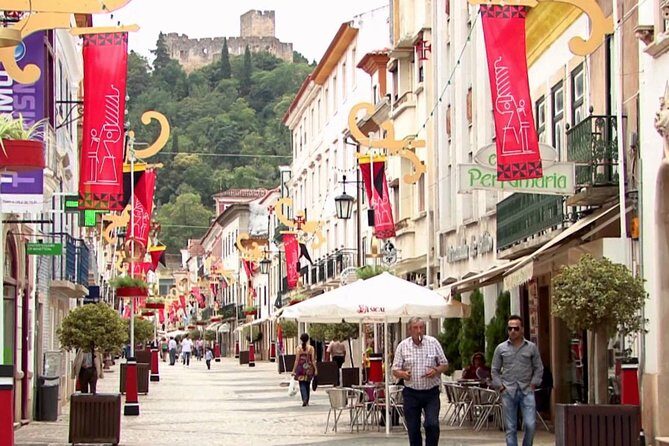
Finish in Óbidos, a medieval town surrounded by ancient walls. This is one of those places that makes a strong first impression fast: narrow cobblestone streets, whitewashed houses with colorful flower displays, and a castle presence that gives the whole town its frame.
The best use of your hour is simple:
- walk a few streets to get oriented
- then shift your focus to the castle walls and viewpoints
- pop into small artisan shops without turning it into a shopping marathon
The tour includes a ginjinha tasting, a cherry liqueur that’s become part of the town’s identity. Since it’s included, it feels like you’re doing something local without spending extra time searching for where to try it.
One consideration from real-world experience: if rain hits, the cobblestones can slow you down and daylight can disappear quickly. In other words, bring a light layer even in shoulder seasons, and be ready for a “best effort” wander.
Lunch and breaks: how to plan during a tight route
Food isn’t included in the tour price unless specified. That means lunch depends on what your guide schedules during the day.
On a route like this, lunch commonly lands around early afternoon, and your guide may point you toward a good restaurant option when you’re between major stops. What matters is how you handle timing: you’ll have a full day, so pick something that’s filling but not slow, and keep it simple.
Also remember this: the tour includes fresh water. Bring it with you where you can, especially if the weather turns warm. For snacks, it’s smart to have a backup in your bag. The tour is structured around visiting sites, not around long sit-down meals.
Guides and the private advantage: why it can feel better than group tours
Private tours tend to shine when the guide’s communication is strong, and this one has a clear pattern of positive guide energy in the people who run it. Names that show up often include Daniel and Vasco, both described as friendly, well-informed, and very good at explaining what’s happening at each place.
The practical advantage is this: you can ask questions that connect the sites. You can also get help adjusting your walking pace if you want photos, a longer look at a chapel, or a quicker route when you’re tired.
Also, because it’s private, your group stays together in one vehicle. That reduces the usual chaos of waiting for multiple groups to regroup after bathroom breaks or photo stops.
What to pack and wear for this day
The tour suggests smart casual and recommends comfortable clothing and shoes. I’d treat that as a must, not just advice.
Bring:
- comfortable walking shoes (cobblestones and uneven paths are common in old towns)
- a small weather layer (coast + chance of rain)
- a camera with enough battery (you’ll want it for monastery details and cliff views)
Baggage is limited to 4 medium-sized suitcases on the mini van. If you’re traveling with more than that, plan to travel lighter or adjust expectations.
And do follow the onboard rules: no smoking and no eating inside the vehicle.
Who should book this tour
This tour is a great fit if you:
- want a one-day overview of central Portugal’s big hitters outside Lisbon
- prefer private transport and a full-time guide over DIY transit
- like UNESCO sites but also want a coast town and a medieval finish
It’s also a good match for couples and small families who want one organized day rather than multiple half-days.
If you’re the type who wants to wander slowly with no timetable, you might find the schedule packed. In that case, consider splitting into two days instead of trying to do everything in one long push.
Should you book the Batalha, Alcobaça, Óbidos, Fátima & Nazaré Private Tour?
I think it’s a smart buy if you want value in the form of time saved and context provided. You’re paying for private transport, pickup/drop-off convenience, and a guide who helps the history and architecture click. The included ginjinha is a small bonus, but it also signals the tour isn’t only about sightseeing from a distance.
Book it if:
- you want Fátima plus the UNESCO monastery pair plus coast-and-medieval charm in one day
- you’re okay with a long schedule and paying entrance fees for two stops
- you’d rather relax in an air-conditioned vehicle than plan routes all day
Skip it if you:
- hate tight timing
- need unstructured free time in each location
- have trouble with long days and lots of walking
One last point: this tour gets booked far ahead on average (86 days), which usually means it’s popular for a reason. If your dates are set, don’t wait until the last week.
FAQ
What are the main places this private tour visits?
You’ll visit Fátima, Batalha Monastery, Alcobaça Monastery, Nazaré, and Óbidos.
How long is the tour?
The duration is about 10 hours.
Is pickup included, and where does it start from?
Pickup and drop-off are included from Lisbon or Sintra central hotels, Lisbon cruise terminal/airport, and also Lisbon/Cascais/Estoril central hotels. You need to inform the provider of your pickup location.
Are entrance fees included?
No. Entrance fees are not included for Batalha and Alcobaça. The tour lists entrance fees as €30 per person. Admission for Fátima, Nazaré, and Óbidos is listed as free.
Is food included on this tour?
No. Food and drinks are not included unless specified.
Is this a private tour?
Yes. It’s a private tour/activity, and only your group participates.
Is there a limit on luggage?
Yes. Baggage transport is limited to 4 medium-sized suitcases.